
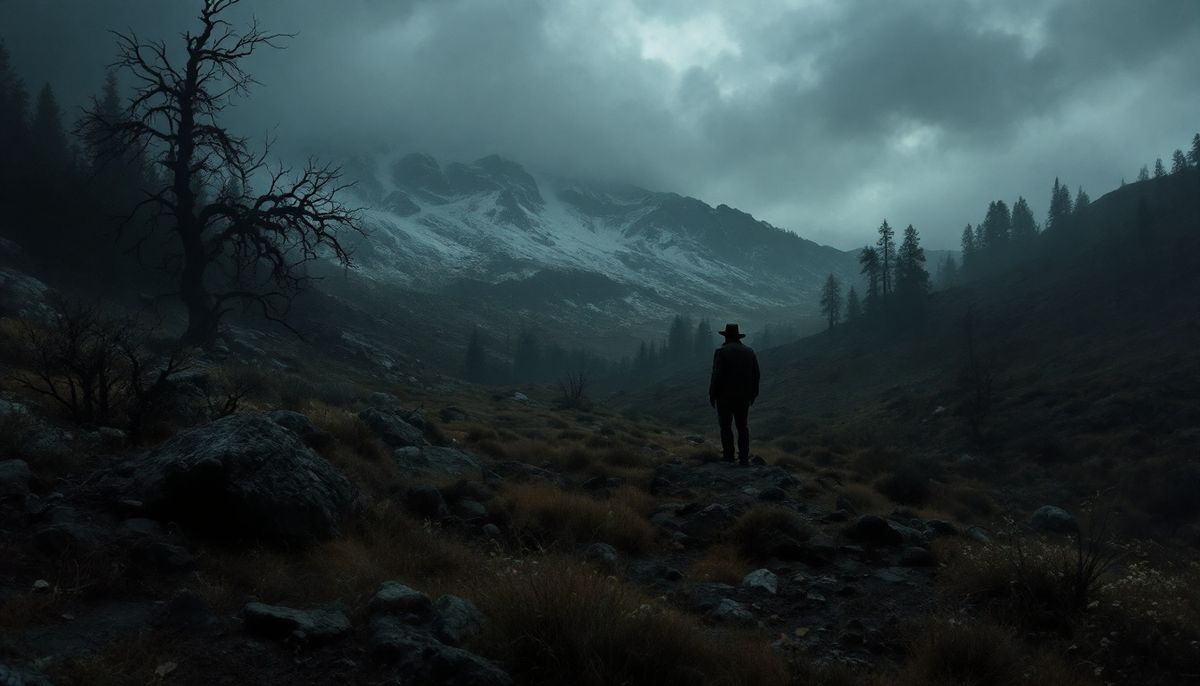
Let me tell you about the most hunted patch of ground in America — and before you roll your eyes at the words “lost gold mine,” understand this: the man at the center of the story was real. His grave is in Phoenix. His name is in territorial records. And the gold he left behind wasn’t a rumor — it was forty-eight pounds of ore, sitting in a box under his deathbed, so rich that people who saw it never stopped talking about it.
The man was Jacob Waltz, a German immigrant — “Deutschman,” which frontier Arizona mangled into “Dutchman” — who spent decades prospecting the territory east of Phoenix. He was a loner, secretive, the kind of old-timer who paid for supplies with high-grade ore and answered no questions about where it came from. In October of 1891, dying of pneumonia in the home of a woman named Julia Thomas who had taken him in, Waltz reportedly did the one thing he’d refused to do his entire life: he talked. Somewhere in the Superstition Mountains, he said — that jagged, violent wall of volcanic rock looming east of the city — was a mine of almost absurd richness. He gave directions. By some accounts he sketched a crude map. Then, on October 25, he died, and the ore under his bed became the only physical evidence that any of it was true.
Julia Thomas believed him. She sold what she had, partnered with two brothers named Petrasch, and marched into the Superstitions in the summer of 1892 — three brutal weeks of heat and canyon country that left them broke and empty-handed. Financially ruined, Julia did something that would echo for a century: she started selling copies of the map. And with that, the legend slipped its leash. The Superstitions filled up with searchers, each generation armed with new maps, new clues, new theories — and the mountain range, it must be said, did not treat them kindly.
Which brings us to the part of the story that turned a treasure tale into something darker. In the summer of 1931, a Washington, D.C. veterinarian named Adolph Ruth — elderly, walking with a cane, carrying what he believed was an old map to the mine — hiked into the Superstitions alone. He never came out. Six months later, an expedition found his skull near a formation called the Red Hills, and the anthropologist who examined it, the Smithsonian’s Dr. Ales Hrdlicka, concluded the two holes in it looked like the entry and exit wounds of a bullet. The rest of Ruth’s remains turned up some distance away — along with his checkbook, in which he had scrawled directions and a final, electric boast: “Veni, vidi, vici.” I came, I saw, I conquered. The map was never found. Now, I’ll be straight with you: both county sheriff’s offices ruled Ruth died of thirst and exposure, Hrdlicka himself hedged on the bullet holes, and a forensic pathologist who re-examined the photos decades later said the damage didn’t match a gunshot at all. But try telling that to the newspapers of 1932. The story went national, and the Lost Dutchman became the most famous lost mine on earth.
People have been dying out there ever since. The tally of searchers who’ve perished in the Superstitions over the decades is genuinely disputed — you’ll see claims of well over a hundred, which is legend’s territory — but the deaths themselves keep happening in documented, modern fashion. As recently as 2010, three men from Utah went into those mountains hunting the Dutchman’s gold in July heat. Their remains were found the following year. The mountain does not care what century it is.
So is there anything actually out there? Here’s the honest ledger. Against: geologists will tell you the Superstitions are volcanic rock, not classic gold country, and a fair number of historians suspect Waltz’s ore came from somewhere else entirely — highgraded, perhaps, from a known mine like the Vulture near Wickenburg, with the “secret mine” story as cover. Some think it wasn’t a mine at all but a hidden cache. For: the ore was real, it was rich, and assays and surviving pieces of it — some famously kept by the family of Dick Holmes, who claimed Waltz made a separate deathbed confession to him — have kept experts arguing for a century about whether it matches any known Arizona source. A dying man with no reason to lie, forty-eight pounds of evidence, and directions that led… nowhere anyone has ever been able to follow.
And that’s where the trail still ends, a hundred and thirty-five years later. Thousands of searchers, generations of maps, helicopters, metal detectors, satellite imagery — and the Superstition Mountains have given back exactly nothing except bones. Maybe the mine was never there. Maybe it was buried in a rockslide or an earthquake. Or maybe it’s exactly where Jacob Waltz said it was, and every search party for a century has walked within a few hundred feet of it, the way you can only do in country that steep and that cruel. The old Dutchman took the answer with him on an October night in 1891 — and the mountain, so far, is keeping it.
Unsolved Mystery
