
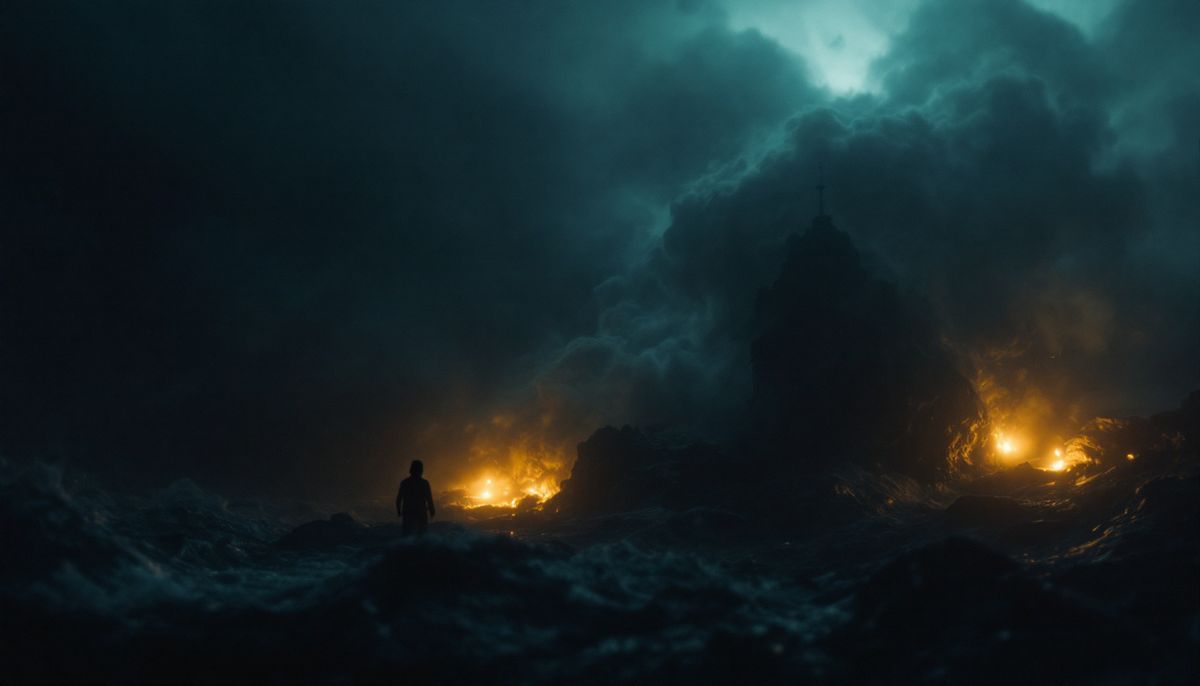
Let me set the scene, because the setting is half the story. It’s the summer of 1997, and the National Oceanic and Atmospheric Administration is running a network of underwater microphones — hydrophones — scattered across the Pacific. This equipment is a peace dividend: the listening technology descends from Cold War systems the Navy built to track Soviet submarines, and now the scientists have it, using it to eavesdrop on earthquakes, volcanoes, and whales. These instruments hear everything. Ship engines. Seafloor tremors. The long, mournful calls of blue whales from hundreds of miles away. The people who monitor them know the ocean’s soundtrack the way you know the noises of your own house at night.
And then, that summer, the house made a noise nobody recognized.
It was an ultra-low-frequency rumble that rose in pitch over about a minute — and when researchers checked the network, they found it hadn’t tripped one sensor. It had registered on hydrophones more than 3,000 miles apart. Stop and sit with that. For a single sound to be picked up across that kind of distance, the source has to be enormously powerful — far louder than a blue whale, and the blue whale is the loudest animal that has ever lived. Whatever made this sound out-shouted the largest creature in the history of the planet. Triangulating the signal, NOAA traced it to a remote patch of the South Pacific, west of the southern tip of South America — about as far from human eyes as a point on Earth can be. They gave it a name that sounds like a joke and reads like a dare: the Bloop.
Here’s what lit the fuse: the sound’s profile looked, to some analysts, almost organic. Christopher Fox, the NOAA scientist overseeing the program, allowed publicly that its signature resembled a biological sound — while noting that no known animal could produce anything close to that volume. That one careful sentence was all the internet needed. If it sounded alive, and nothing known to science was big enough to make it… then something unknown to science was down there. And the deep South Pacific is a good place to hide — we’ve mapped Mars in better detail than our own seafloor. Then someone checked a map and found the detail that made the Bloop immortal: the sound’s estimated origin sat eerily close to the coordinates H.P. Lovecraft had invented, decades earlier, for R’lyeh — the sunken city where his monstrous god Cthulhu lies dreaming. A real, unexplained roar from the fictional address of a sleeping sea god. You couldn’t script it better, and for years, nobody had to.
Now for the part where I’m straight with you, because this one — unlike most stories I tell around this fire — has an answer. As NOAA’s acoustic monitoring expanded toward Antarctica through the 2000s, researchers recorded thousands of icequakes: the deep cracking and splitting of glaciers and ice shelves as massive bergs shear away. And the spectrograms of those icequakes matched the Bloop. Same character, same profile. NOAA’s conclusion is that the Bloop was ice — a very large frozen thing breaking, hundreds of miles closer than the original estimates assumed, its “voice” carried across an entire ocean by deep sound channels that pipe low frequencies almost losslessly around the globe. It wasn’t a monster. It was the sound of Antarctica coming apart at the seams, which, depending on your disposition, may not be less unsettling.
But before you file this one under “solved” and wander off, consider two things. First: it took roughly fifteen years to get that answer. From 1997 into the 2010s, the honest scientific position on the loudest unexplained sound ever recorded in the ocean was a shrug. That gap — a decade and a half when the best-equipped listeners on Earth could not tell you what they’d heard — was real, and everything that grew in it was a fair harvest. Second: the Bloop had company. NOAA’s hydrophones have caught a whole family of named mystery sounds — Julia, Train, Slow Down, most of them now also attributed to ice — and one called Upsweep, first detected in 1991, a chorus of rising tones that has continued for years, waxing and waning with the seasons. Upsweep is generally chalked up to undersea volcanic activity, but its source has never been pinned down with the confidence the Bloop eventually earned. It’s still out there, still sounding.
So here’s where I leave you. The Bloop is the rare campfire story with a punchline — science listened long enough, and ice confessed. But the reason the story endures isn’t the answer. It’s the fifteen-year question, and the picture it forced everyone to confront: that we have wrapped this planet in instruments sensitive enough to hear a glacier crack from an ocean away, and we still hear things in the deep water that take us years to name. Some of them, like Upsweep, we’re still working on. The hydrophones are listening right now. Whatever the ocean says next, we’ll hear it — and if history is any guide, we won’t immediately know what it is.
Unsolved Mystery
