
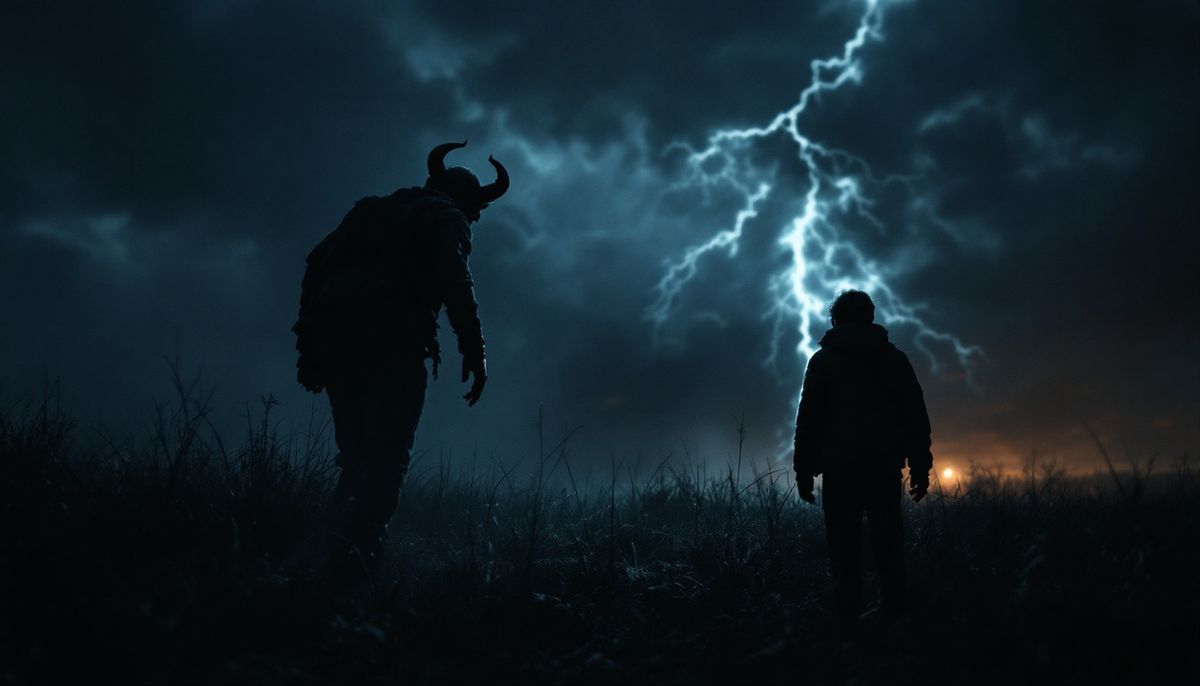
Let me set the scene for you, because the setting matters. It’s the night of August 21, 1955, on a farmhouse property near the tiny community of Kelly, Kentucky, just up the road from Hopkinsville. No electricity out at the Sutton place. No running water. Two families — the Suttons and the Taylors, eleven people in all, including children — gathered on a hot summer night. And around 8 p.m., Billy Ray Taylor walks out to the well for a drink of water and comes back inside saying he’s just watched a silvery object with a rainbow-colored exhaust streak across the sky and drop into a gully behind the farm. The family laughs him off. A shooting star. Sit down, Billy Ray. About an hour later, the dog starts barking like it’s lost its mind — and then it bolts under the house and doesn’t come out for the rest of the night. That detail has always stuck with me. The dog knew first.
What the family said happened next is the part you’ve heard echoes of your whole life, even if you’ve never heard the name Kelly. Billy Ray and Elmer “Lucky” Sutton stepped outside to see what had spooked the dog — and saw a glowing figure coming toward them from the tree line. Small, maybe three and a half feet tall. Oversized head. Huge, luminous yellow eyes set wide apart. Long arms ending in clawed hands, and skin — if you could call it that — that looked like polished silver metal. The two men did what Kentucky farm men in 1955 did about most problems: they grabbed a shotgun and a .22 rifle and opened fire. They said the shots sounded like they were hitting a metal bucket. And the creature didn’t die. It flipped backward, scurried off into the dark — and then things got worse. For the next several hours, by the family’s account, the creatures — at least two, maybe more — laid siege to the farmhouse. Faces appearing at windows. A clawed hand reaching down from the roof. One was blasted clean off a barrel by the front door and simply floated to the ground and skittered away.
Around 11 p.m., the families broke. All eleven of them piled into two cars and drove flat-out to the Hopkinsville police station. And here’s where this story separates itself from a thousand campfire tales: the police chief, Russell Greenwell, later said these people were genuinely terrified — that something had scared them, and scared them badly. He’d seen fear before. This wasn’t performance. Within the hour, more than a dozen officers — city police, state troopers, military police from nearby Fort Campbell, a sheriff’s deputy — descended on the Sutton farm.
Now, what did they find? This is the part I need you to hold onto, because it’s the honest heart of the whole mystery. They found no creatures. No scorched gully, no crashed craft. But they found real evidence that something had happened: bullet holes through the window screens and walls, spent shells, a house shot to pieces from the inside out, and eleven people in a state of fear that hardened lawmen found convincing. One officer reported seeing a strange glow in the woods. Another said a patch of luminous something was found on a fence where a creature had been shot. The investigators left after 2 a.m. having documented a genuine panic — with no cause they could name. And by the family’s account, once the police left, the creatures came back, peering in windows until just before dawn.
So what were they? The best skeptical explanation — and I’ll give it to you straight, because it’s a good one — came years later: Great Horned Owls. Follow the logic. It’s a strong theory. Great Horned Owls stand about two feet tall, have enormous yellow eyes, long talons, fly silently, float rather than fall when startled, and will aggressively defend a nest at night. Silver? Moonlight on gray-brown feathers, filtered through adrenaline and maybe a beer or two — though the police, notably, found no evidence of drinking. A pair of territorial owls, a dark farm, one jumpy report of a “spaceship,” and eleven increasingly terrified people feeding each other’s fear for hours. Mass panic with feathers. It accounts for a lot. It’s the explanation I’d bet on, if you made me bet.
But here’s why I can’t close the file, and neither can anyone else. The Suttons never made a dime off this. They never wrote the book, never sold the movie, never worked the county-fair circuit. When curiosity-seekers swarmed the farm — at one point they tried charging admission just to make the crowds go away — the family got so sick of the ridicule that they stopped talking about it almost entirely. And they never recanted. Not in 1955, not decades later. Lucky Sutton reportedly held to the story, unchanged, until the day he died. Liars embellish. Hoaxers cash in. The Suttons did neither. They just wanted it to go away — and it never did. The U.S. Air Force’s Project Blue Book took notice of the case; skeptics and believers have been fighting over it ever since.
One more thing before I let you go. When the newspapers wrote it up, the wire services needed a shorthand for the small, metallic, big-eyed things the family described — and somewhere in the retelling, the phrase “little green men” got attached to the story and stuck to it in the national press. The family never said green. But the label survived, and it crawled so deep into the culture that today it’s the default cartoon shorthand for aliens everywhere on Earth. Every “little green men” joke you’ve ever heard traces back, in part, to one shot-up farmhouse outside Hopkinsville, Kentucky. Owls or not — the goblins won that much.
Unsolved Mystery
