
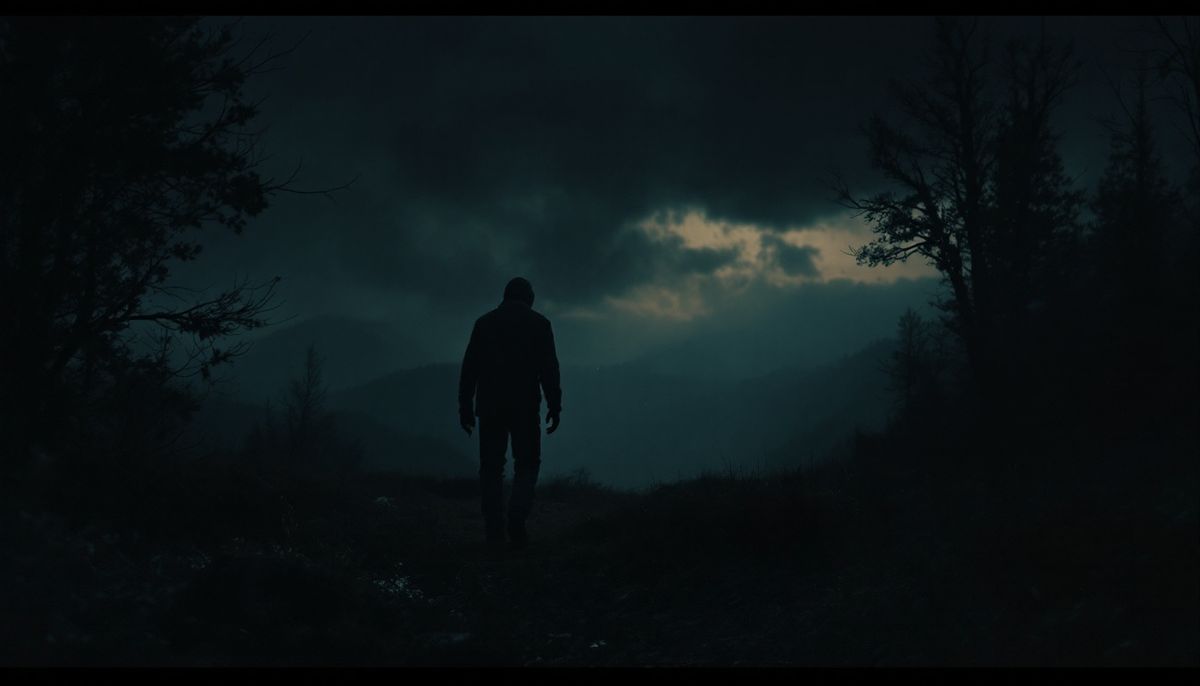
Let me set the scene for you, because the setting matters: Flatwoods, West Virginia, September 12, 1952. A town of a few hundred people folded into the Braxton County hills. And a country already on edge — that summer, unidentified objects had been tracked on radar over Washington, D.C. itself, and flying saucers were front-page news. Keep that in mind. It cuts both ways.
Just before nightfall, a group of boys was playing football at the local school when they saw something bright streak across the sky and appear to come down on a nearby hilltop — a pulsing red glow settling onto the Fisher farm. Boys being boys, they ran to see it. They collected Kathleen May, a local beautician and mother of two of them, a 17-year-old National Guardsman named Eugene Lemon, and a dog, and the whole party climbed the dark hill toward the light.
Here’s what they said happened next, and the accounts are remarkably consistent. Near the top, they hit a strange, foul mist — a metallic, sulfurous stink that burned their eyes and throats. The dog bolted first, tail down, back toward town. Then Lemon’s flashlight swept up into the branches beside them and found two glowing points of light. What the group described standing beneath those lights was something out of no field guide: a figure roughly ten feet tall, with a red face and a dark, spade-shaped cowl behind its head — like the ace of spades, Mrs. May said — a dark green body that seemed pleated or metallic, and small claw-like hands. It hissed. It glided — didn’t walk, glided — toward them. And that was the end of the expedition. Grown woman, armed Guardsman, half a dozen boys: everyone ran down that hill in a flat sprint.
Now, here’s the part that separates Flatwoods from a hundred campfire stories, and it’s the part I can’t wave away: the witnesses got sick. That night and into the next day, several of the party suffered vomiting, throat irritation, and swollen nasal passages — documented at the time, with a local doctor comparing the symptoms to exposure to an irritant gas. A reporter from the Braxton Democrat was on the hill within hours and confirmed the lingering odor himself. Whatever happened up there, something physical happened. Terror alone doesn’t usually inflame your throat.
So what did they see? The skeptical case is honestly pretty good, and I’m going to give it to you straight. The streak in the sky matches a meteor seen across three states that evening — that part’s essentially settled. The pulsing red light on the hill was plausibly a beacon on a nearby aircraft tower. And the creature? Investigators later argued the group, primed by the “crash” and strung tight in the dark, hit the glowing eyes and hunched silhouette of a barn owl perched on a branch — the spade-shaped head matching an owl’s facial disc, the “claws” its talons, the glide its silent wing-drop, the hiss exactly what a cornered barn owl does. Even the nausea gets an explanation: raw panic, hyperventilation, maybe irritating grass fumes on the hill. Line it all up and it clicks together almost perfectly.
Almost. Because the witnesses themselves never bought it. Kathleen May told her story to national television that same month and never recanted it — not in 1952, not fifty years later. A ten-foot figure is a lot of barn owl. Seven people described the same impossible thing within hours of seeing it, before anyone could compare notes with the press. And that sulfurous mist — smelled by a newspaperman who wasn’t even there for the monster — has never been pinned to any owl on earth.
Flatwoods, for its part, made a different kind of peace with the mystery. Today the town calls itself the Home of the Green Monster. There’s a museum in nearby Sutton full of 1952 clippings, a string of ten-foot Flatwoods Monster chairs scattered across Braxton County for tourists to sit in, and festivals celebrating the thing that once sent its citizens fleeing down a hillside. Which might be the strangest twist of all: the monster stayed.
And that’s where the record leaves us. A meteor, a beacon, and an owl — or a visitor no one has seen since. The physical evidence is a smell that faded by morning and a set of sore throats that healed within days. Every witness is on the record; most went to their graves insisting they told it true. Seventy years on, you can climb that hill in Flatwoods yourself. All you’ll find at the top is the dark, and the question.
Unsolved Mystery
