
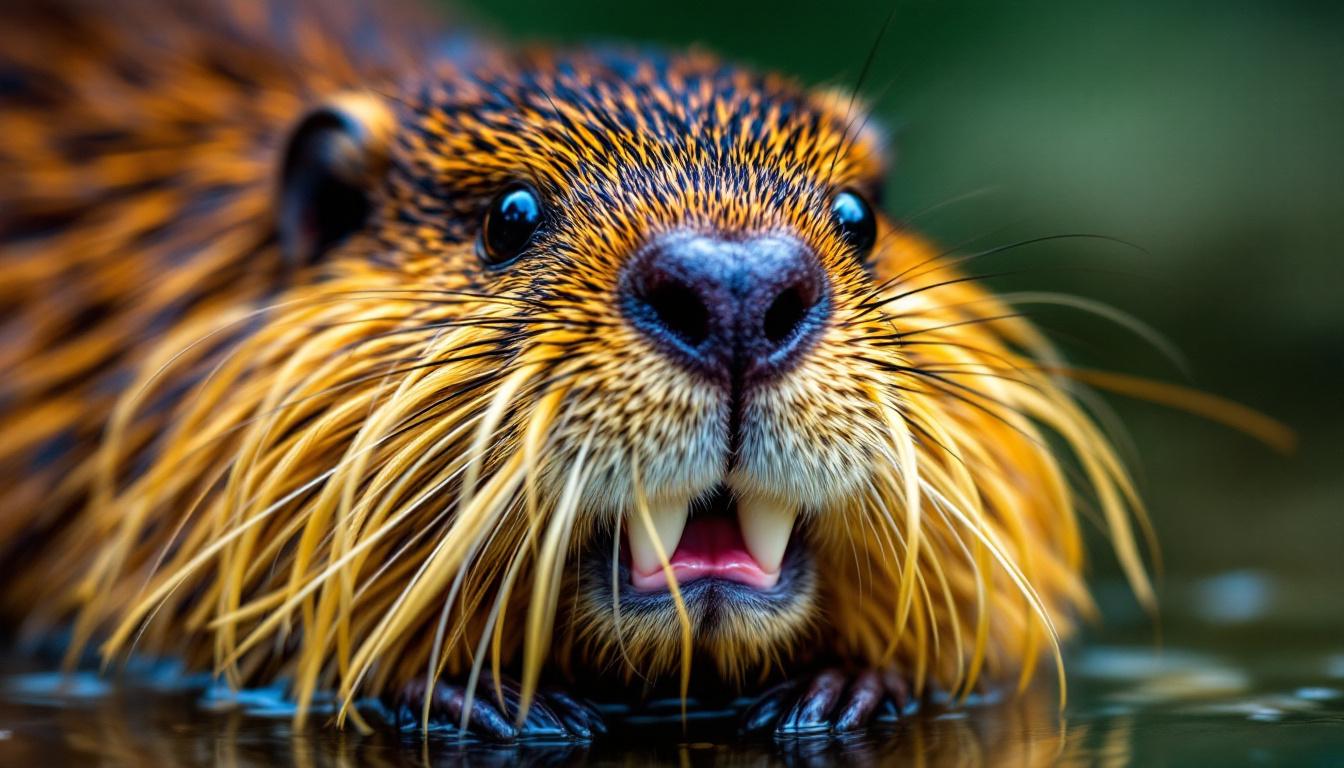
You’re going to walk away from this article with a brand new respect for beavers. I’m sorry in advance. I went in expecting “they build dams” and came out with “the U.S. government once parachuted 76 of them into the wilderness on purpose.”
Did you know beavers have iron-reinforced teeth that sharpen themselves and never stop growing?
That’s why beaver teeth are orange — the front face of each incisor is reinforced with iron, which makes the enamel acid-resistant and harder than a typical rodent’s. The back of the tooth is softer dentin, so it wears down faster than the iron-armored front, which is why the teeth automatically maintain a chisel-sharp edge every time the beaver chews. And those teeth never stop growing — a beaver’s incisors can grow up to four feet a year. Four feet. If a beaver stopped chewing wood, its own teeth would eventually become the problem.
Did you know beavers have a built-in pair of underwater goggles, plus lips that close *behind* their teeth?
Beavers have a transparent third eyelid called a nictitating membrane that slides across each eye when they dive, so they can see clearly underwater with their eyes effectively shut. As if that weren’t enough, their lips seal closed behind their front teeth, which means they can chew on a branch six feet below the surface without taking on a single drop of water. They are basically rodents wearing a submarine.
Did you know a beaver can hold its breath for 15 minutes and refill 75% of its lungs in a single exhale?
When a beaver dives, its heart rate drops to about 60 beats per minute — roughly half normal — and its body redirects oxygen to the brain. Their muscles also store huge amounts of myoglobin, which acts like an oxygen savings account they can draw down from. When they come back up, they replace about 75% of the air in their lungs with one breath. Humans replace about 15%. We are, comparatively, terrible at breathing.
Did you know there’s a beaver dam in Canada so big it’s visible from space?
In 2007, a researcher spotted it on satellite imagery while scrolling Google Earth. It sits in Wood Buffalo National Park in northern Alberta, stretches roughly 2,790 feet end to end — that’s longer than eight football fields — and may have been under construction by generations of beavers since the 1970s. NASA satellite photos from before 1980 don’t show it, which means somewhere out there is a family tree of beavers that have been adding to the same construction project for nearly half a century. The Hoover Dam took five years and 21,000 humans. These guys are just casually outbuilding us.
Did you know the U.S. government once parachuted 76 beavers into the Idaho wilderness, and 75 of them survived?
In 1948, the Idaho Department of Fish and Game had a beaver problem — too many beavers in the populated valleys, not enough in the remote backcountry where they were actually useful. Driving them in by mule was expensive and stressful for the animals, so a state biologist named Elmo Heter had what can only be described as a 1948 idea: stick them in custom wooden crates, fly them over the Chamberlain Basin in a Beechcraft, and parachute them in. He tested the rig on an older male beaver they named Geronimo, who reportedly took several practice drops with the patience of a saint. On the real mission, 76 beavers were dropped. 75 walked away and started building. The whole thing was filmed, lost for 65 years, rediscovered in a Fish and Game archive in 2015, and is now on YouTube. Your tax dollars have done worse things.
Send this to the friend who underestimates beavers. They have iron in their teeth, submarine eyelids, can outbuild the Army Corps of Engineers, and one of them was named Geronimo and had a federal parachuting career. Show some respect.
