
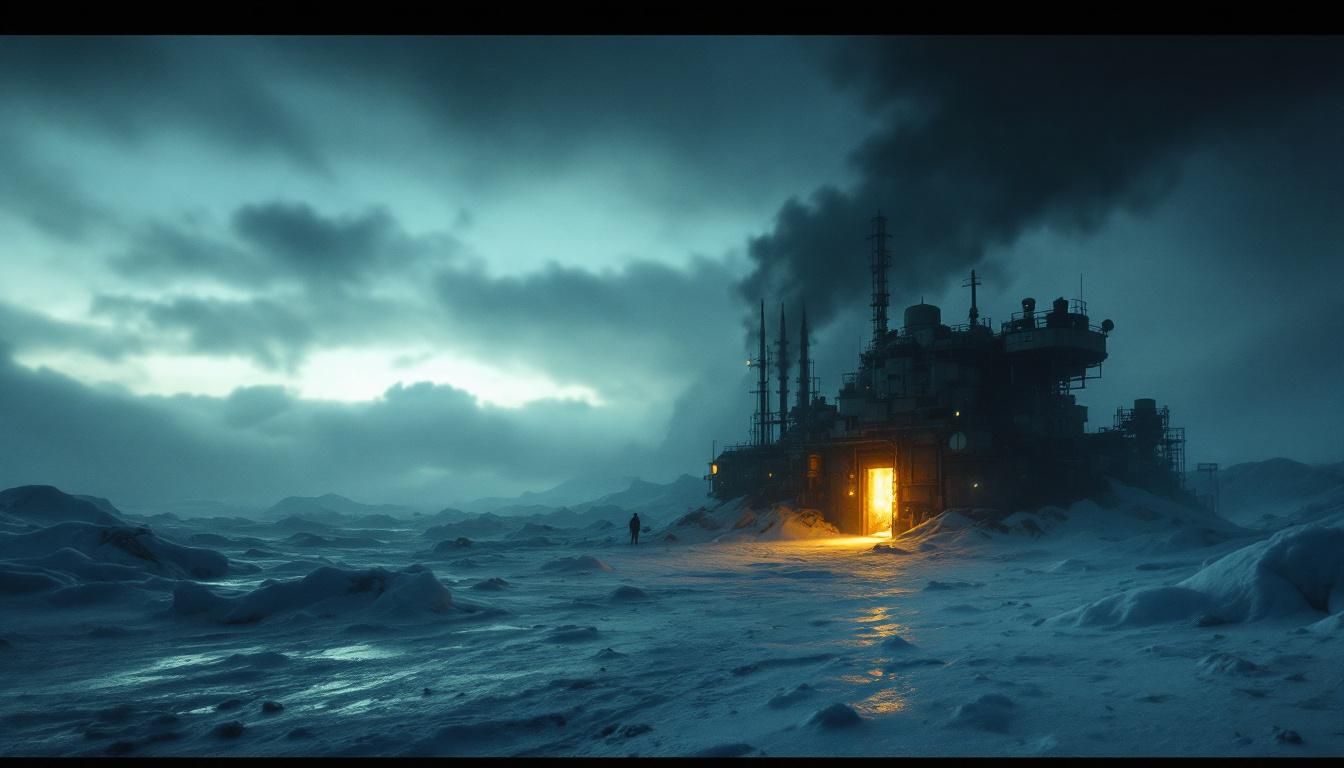
In the summer of 1960, a column of tractors began dragging something across the Greenland ice cap. It had come off a ship at Thule Air Base, broken down into pieces, and now those pieces were being hauled 138 miles inland over a frozen plateau where the wind never really stops. The cargo weighed hundreds of tons. When the tractors finally reached the spot the Army had picked out — a flat stretch of nothing, two miles up on top of the ice sheet — the engineers began reassembling it.
It was a nuclear reactor. They were installing a nuclear reactor inside a glacier.
Now sit down, because this one is going to take a minute.
The place was called Camp Century, and the official story — the one the Army told reporters, the one the Army told the Danish government, the one the Army put in a cheerful documentary film narrated like a travelogue — was that it was an Arctic research station. A laboratory. A proving ground for cold-weather construction. And on paper, all of that was true. Camp Century was real. You could walk through it. By 1960 it had grown into a buried town of 21 tunnels carved straight down into the ice, running about 9,800 feet end to end, roofed over with corrugated steel and snow. Roughly 200 men lived down there. They had dormitories. A kitchen and a mess hall. A small hospital. A chapel. A laundry. A recreation hall. They even had a barber shop. The Army called it “the city under the ice,” and they meant it as a brochure line, not a warning.
The reactor — designated PM-2A, the world’s first portable nuclear plant, built by the Alco company for the U.S. Army — sat in its own trench and powered the whole thing. The military liked to point out that it ran on 44 pounds of uranium and saved them from hauling more than a million gallons of diesel up onto the ice. Walter Cronkite himself flew up to tour the place for CBS in 1961. Boy Scouts visited. It was, by any reasonable measure, one of the most public secret bases in the history of the United States.
That was the cover. Here is the part that stayed buried for thirty-five years.
The real reason Camp Century existed had a different name. It was called Project Iceworm, and it was a U.S. Army plan to turn the entire Greenland ice sheet into the largest nuclear missile launch platform on Earth. The idea was almost elegant in its strangeness. The ice cap is enormous. It is also, from the air, completely featureless. If you dug a vast grid of tunnels beneath it, you could lay railroad track inside those tunnels, and you could run missile cars back and forth along the track on a schedule nobody outside the program would ever know. The Soviets would have no way of telling which tunnel held a missile at any given moment. The plan called for a network of tunnels roughly 2,500 miles long, holding as many as 600 nuclear missiles — a weapon the planners had already nicknamed the “Iceman” — shuttling between something on the order of 2,100 firing positions. A first strike against it would be like trying to hit a shell game the size of a small country.
The whole concept rested on one assumption. It rested on the idea that the ice would hold still.
It did not hold still. The ice, it turned out, was the entire problem.
Glaciologists working at Camp Century — doing the legitimate science, drilling the ice cores that would later make the place genuinely famous — started taking measurements of the tunnels themselves. And the numbers were not good. The trenches dug in 1959 were deforming. The walls were squeezing inward. The ceilings were sagging. Within four years, several of the tunnels had compressed so far that they had already reached the limit of what they were designed to take. The reactor trench was closing in faster than the rest, partly because the warmth of the reactor itself was softening the ice around it. The glacier was alive, in the slow way glaciers are alive, and it was patiently crushing the city the Army had built inside it. The geologists ran the math and concluded that the ice would deform the planned missile tunnels and launch positions in roughly two years. You cannot run a railroad through a tunnel that is folding shut around the tracks.
The PM-2A reactor was shut down and pulled out in 1964. Camp Century was kept going on diesel generators for a while longer, then abandoned in 1966. Project Iceworm was quietly canceled. And here is a detail worth sitting with: the Danish government, which actually owned Greenland, was never told that any of this was about missiles. Denmark had a standing policy against nuclear weapons on its territory. The Army’s planners had been counting on simply not raising the subject. The necessary permission was never asked for, and so it was never given.
The whole thing might have stayed a footnote forever, except that in January of 1995 a Danish parliamentary inquiry started digging into the history of nuclear weapons in and around Greenland. Investigators with the Danish Institute of International Affairs requested American records, and in 1996 they got back a declassified set of documents that spelled out Project Iceworm in plain language — the tunnels, the missiles, the launch grid, the cover story. The Danish public found out their country had nearly become a hidden nuclear arsenal from a government report. The American public found out the same way. The “city under the ice,” it turned out, had been the friendly face on something the Army had genuinely intended to build.
And the strangest part of this story is the part that is still happening. Camp Century is not gone. It is buried. When the base was abandoned, the Army left a great deal behind, on the reasonable-sounding assumption that the ice would keep it sealed away forever — the same ice that, just a few years earlier, had refused to hold still long enough to launch a missile. Down in that glacier today sits an estimated 47,000 gallons of low-level radioactive coolant water from the reactor, somewhere around 200,000 liters of diesel fuel, a quantity of PCB-laden waste, and millions of liters of untreated sewage. In 2016 a team of climate scientists published a study warning that as Greenland warms, meltwater could eventually work its way down and start releasing all of it — possibly within this century. In 2024, a NASA aircraft flying radar surveys over the ice sheet picked up the buried outline of the camp by accident, the tunnels showing up on the scan like the bones of something that was never meant to be seen again.
The Army built a secret city in a glacier to hide 600 nuclear missiles from the Soviet Union, and the glacier won. The documents that prove it are public now. You can read them. And the city itself is still down there, in the dark, slowly being squeezed by the one thing in the whole plan that nobody could outsmart.
I’m just telling you what’s in the file.
Conspiracy Confirmed
