
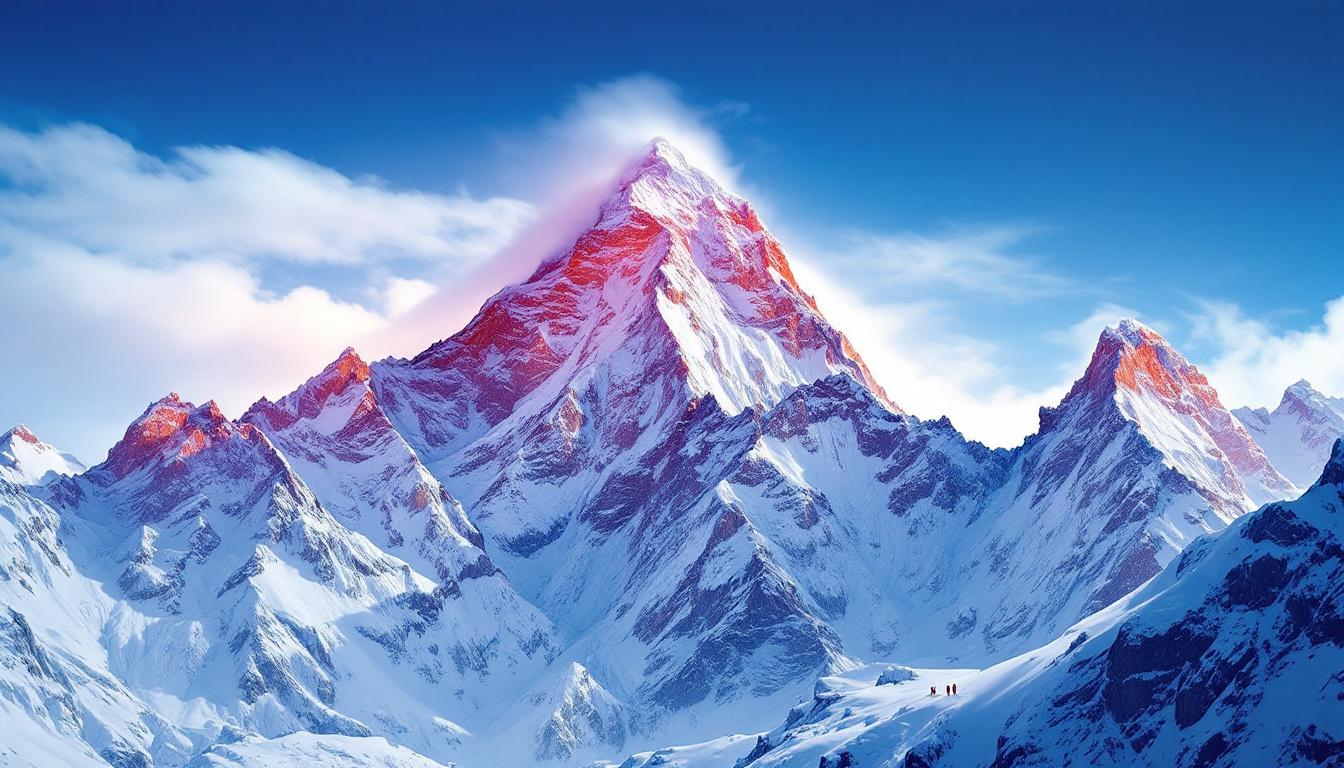
I thought I knew Mount Everest. Tallest mountain on Earth, very cold, people climb it, end of file. Then I spent an evening reading about it and realized I had most of it wrong. It’s not actually the tallest mountain. The rock at the summit used to be at the bottom of an ocean. And the man it’s named after begged everyone not to name it after him.
1. The rock at the very top of Everest was once at the bottom of the sea.
The summit of Everest is made of limestone and marble loaded with the fossilized shells of sea creatures that lived in a warm, shallow ocean roughly 470 million years ago. That ancient sea, the Tethys, got squeezed out of existence when the Indian plate crashed into Asia, and the seafloor got shoved 29,000 feet into the sky. So the highest point on the planet is, geologically speaking, an old beach. Climbers reaching the top are standing on seashells.
2. Everest is not the tallest mountain on Earth.
It’s the highest — its peak reaches farther above sea level than any other — but “tallest” measured base to peak goes to Mauna Kea in Hawaii. Mauna Kea stands about 33,500 feet from its underwater base to its summit; Everest is roughly 29,032. The catch is that most of Mauna Kea is hidden underwater, so only about 13,800 feet of it pokes above the ocean. Everest wins on a technicality. Mauna Kea is just modest about it.
3. Everest’s summit isn’t even the highest point on Earth from the center of the planet.
That title goes to Mount Chimborazo in Ecuador. The Earth isn’t a perfect sphere — it bulges at the equator — so a peak sitting right on that bulge gets a head start. Chimborazo is only about 20,500 feet above sea level, but because it’s near the equator, its summit sticks out about 7,000 feet farther from the Earth’s core than Everest’s does. If you want to stand at the point closest to outer space, you skip Nepal entirely.
4. The man Everest is named after didn’t want it named after him.
The mountain honors Sir George Everest, a British surveyor general of India — who, when the idea came up, objected. He argued the name couldn’t be written in Hindi and couldn’t easily be pronounced by the people who actually lived near the mountain, and he thought local peaks should keep their local names. The Royal Geographical Society named it after him anyway in 1865. One more twist: his surname was pronounced “EVE-rest,” like Christmas Eve. We’ve all been saying it wrong for 160 years.
5. Everest already had names — two of them — long before the British showed up.
In Tibetan it’s Chomolungma, “Goddess Mother of the World.” In Nepali it’s Sagarmatha, “Goddess of the Sky” or “Forehead of the Sky.” Both names are centuries older than the survey that produced “Everest,” and both are still in official use today. The mountain wasn’t discovered by Western surveyors so much as measured by them. The people living in its shadow had been on a first-name basis with it for a very long time.
6. There’s a tiny spider that lives higher up Everest than almost any other animal on the planet.
It’s the Himalayan jumping spider, and its scientific name, Euophrys omnisuperstes, literally means “standing above all.” It has been found at around 22,000 feet — well above where any plant grows. Its food supply is whatever the wind carries up the slope: tiny flies and springtails that get blown to an altitude where, frankly, nothing should be living at all. A spider has a higher permanent address than most of the climbers it shares the mountain with.
7. Everest grows a little taller every year — and an earthquake can shrink it in seconds.
The same plate collision that built the Himalayas is still happening, so Everest creeps upward by a few millimeters annually. But it’s not a steady climb. The 2015 Nepal earthquake dropped the summit by about an inch in moments and shoved the entire mountain a couple of centimeters to the southwest. Everest is less a fixed landmark and more a very, very slow-motion negotiation between two tectonic plates.
8. The official height changed in 2020 — and it took two rival nations to agree on it.
For decades, Nepal and China couldn’t even agree on how tall Everest was, partly because China measured the rock and Nepal measured the snow cap on top of it. In 2020, after sending separate survey teams to the summit, the two countries jointly announced a single agreed-upon figure: 8,848.86 meters, about 29,032 feet. It made the mountain officially a bit taller than the number most of us learned in school. Two governments that rarely agree on anything shook hands over a mountaintop.
9. The wind at the summit can hit hurricane force — and rip a permanent “plume” of snow off the peak.
For most of the year, the jet stream parks itself right over Everest’s summit, blasting it with winds that can top 175 mph. That’s what creates the iconic sideways banner of snow streaming off the peak in photos — that “plume” is the jet stream made visible. Climbing is only possible during brief windows, mainly in May, when the approaching monsoon shoves the jet stream north and the wind drops. Miss the window and the mountain is, quite literally, unsurvivable at the top.
10. A 13-year-old has stood on the summit — and so has an 80-year-old.
In 2010, American Jordan Romero reached the top at 13 years and 10 months, climbing from the Tibetan side because Nepal won’t issue permits to anyone that young. At the other end, Japanese climber Yuichiro Miura summited in 2013 at age 80. So the span of people who’ve stood on the highest point on Earth runs from a teenager who wasn’t old enough to drive to a man who qualified for the senior discount everywhere else on the planet.
Which one made you go “wait, what?” Send this to the friend who thinks they know geography.
