
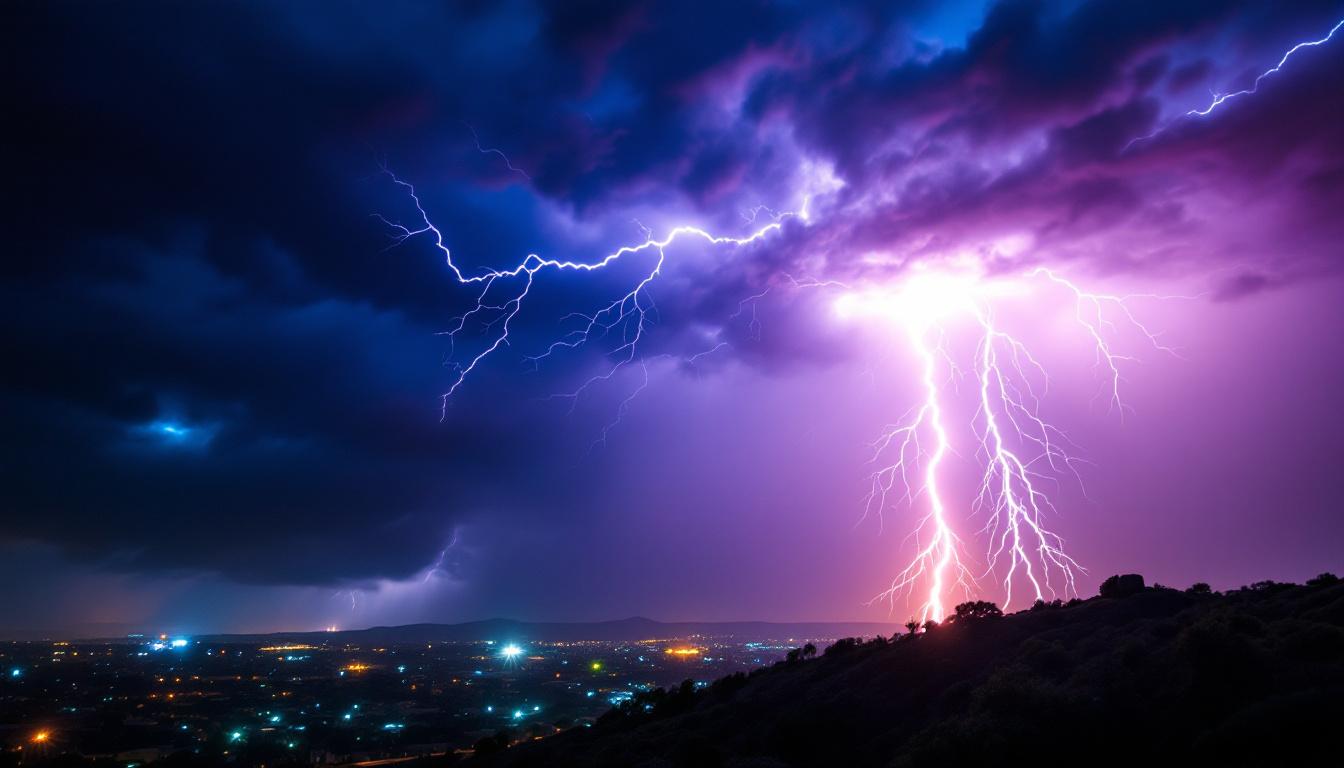
I have watched lightning my whole life and never once questioned what I was seeing. Then I read a few sentences about how it actually works, and it turns out almost everything I assumed was wrong — including which direction the bolt goes. Here are five facts that completely rewired how I see a thunderstorm.
Did you know a bolt of lightning is about five times hotter than the surface of the Sun?
The air inside a lightning channel gets heated to roughly 50,000 degrees Fahrenheit. The surface of the Sun, by comparison, is a relatively chilly 10,000 degrees. The reason it doesn’t fry the whole neighborhood is that the flash lasts only a few thousandths of a second, so all that heat is gone almost before it arrives. A burst of fire hotter than the Sun, passing through your backyard, and over before your eye can finish blinking.
Did you know the lightning bolt you see actually travels UP from the ground, not down from the cloud?
This is the one that broke my brain. A storm sends a dim, invisible “stepped leader” creeping down from the cloud, while the ground sends up a streamer to meet it. The instant they connect, a blindingly bright “return stroke” comes roaring back up the channel — and that return stroke is more than 99% of what your eye registers as the bolt. So the flash you call lightning is genuinely moving from the ground toward the sky. Your whole life, you’ve been watching it backwards.
Did you know thunder is the sound of air physically exploding?
When lightning superheats that channel of air to 50,000 degrees in an instant, the air has no time to expand gradually — it detonates outward and slams into the surrounding air, creating a shockwave. That shockwave is thunder. It’s the same basic event as a sonic boom, just triggered by heat instead of a jet. The long rolling rumble isn’t an echo, either — it’s you hearing different parts of one very long, jagged bolt, each at a slightly different distance, arriving one after another.
Did you know “lightning never strikes the same place twice” is completely false?
Lightning loves a repeat performance. Tall, pointy, isolated objects get hit over and over — the Empire State Building takes around 25 strikes a year, every year. The old saying isn’t just slightly off; it’s the opposite of true. And here’s another myth while we’re at it: metal doesn’t attract lightning. What lightning actually cares about is height, a pointed shape, and isolation — the keys in your pocket make no difference at all.
Did you know lightning can melt sand into glass — and one bolt once stretched 477 miles across three states?
When lightning slams into sandy ground, the heat can fuse the sand into a hollow glass tube called a fulgurite — basically a frozen fossil of the bolt’s exact path underground. And lightning doesn’t think small. In April 2020, a single “megaflash” stretched 477 miles across Texas, Louisiana, and Mississippi — one continuous flash longer than the drive from Boston to Washington, D.C. A storm in one state, sharing the same bolt with a storm two states over.
Send this to the friend who still says “lightning never strikes twice.” It strikes the Empire State Building 25 times a year, it’s hotter than the Sun, it travels upward, and it can melt the ground into glass. We have all been watching the sky wrong.
