
May 16th
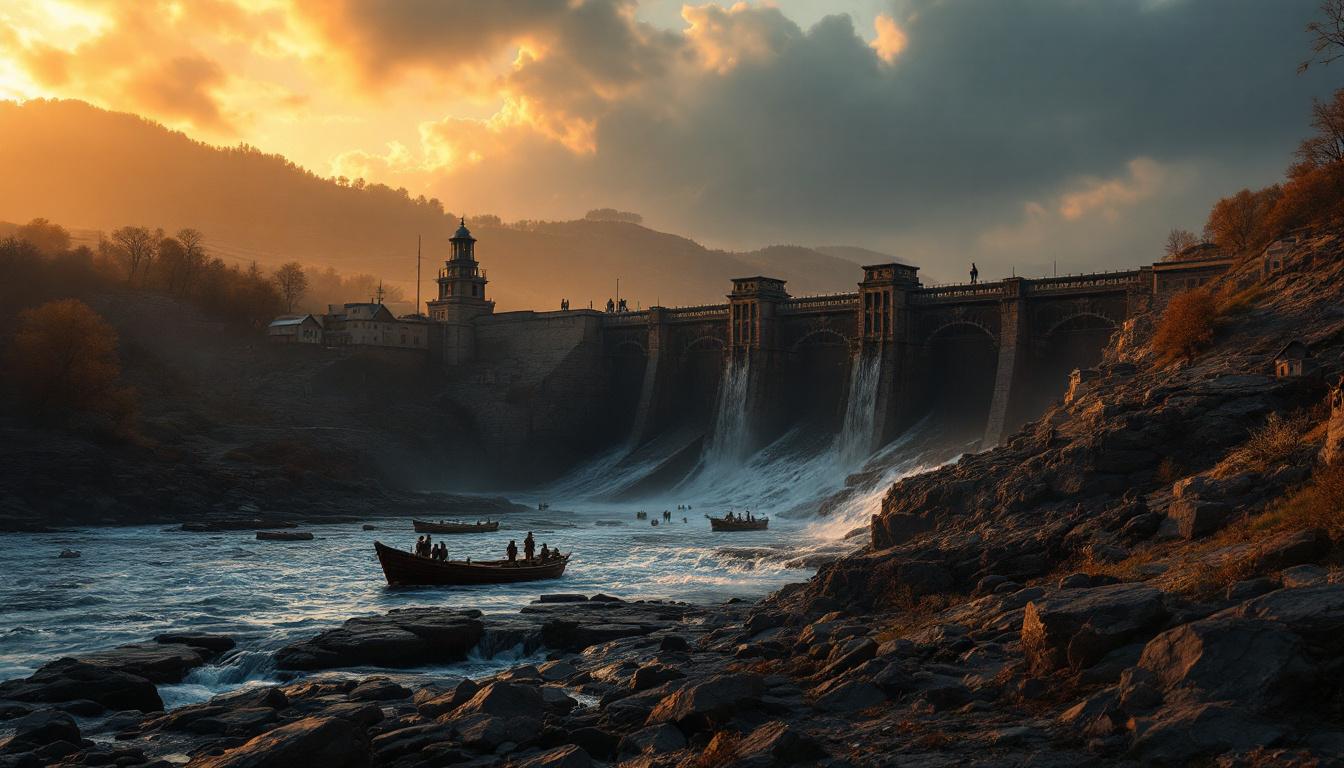
At 7 o’clock in the morning on May 16, 1874, a dam keeper named George Cheney stood at the Williamsburg Reservoir in western Massachusetts and watched a 40-foot slab of earth slide right off the face of the dam. He didn’t wait around to see what happened next. He jumped on his horse and rode downhill toward the factory villages, shouting that the dam was going. The problem was that a man on a horse can only ride so fast, and 600 million gallons of water travel a lot faster.
The dam never should have been there in the first place — not like that. Ten years earlier, eleven local mill owners had formed a company to build it, and to save money, they designed and built it themselves. The surveyor objected. The workers objected. They cut corners anyway: a poorly grouted stone wall sitting on top of earthen embankments, holding back a 100-acre reservoir. On May 16, after days of rain, the saturated bank behind that stone wall finally gave up, and the wall went with it. What followed was a wall of water that tore an 8-mile path of destruction through Williamsburg, Skinnerville, Haydenville, and Leeds.
It took roughly one hour. One hundred thirty-nine people died, four villages were gutted, and it became one of the worst dam disasters of the 19th century — the first of its kind in Massachusetts. Here’s the part that still gets me: even though the mill owners and their amateur engineering were plainly responsible, not one person was ever held to account for it. The only thing that did come out of it was a wave of new dam safety laws — the country deciding, far too late, that maybe a dam shouldn’t be a do-it-yourself project.
Also On This Day…
1770 — A 14-year-old marries her way into the most famous downfall in history On May 16, 1770, a 14-year-old Austrian archduchess named Marie Antoinette married the 15-year-old heir to the French throne in the Royal Chapel at Versailles. The whole point was political — France wanted to lock in an alliance with Austria, its longtime enemy — and two teenagers got handed the job. She would become Queen of France, become a lightning rod for a furious nation, and lose her head to the guillotine 23 years later. It all started with a wedding between two kids who, on this day, were mostly just nervous.
1866 — Congress invents the nickel — because people kept hoarding the old one The U.S. already had a five-cent coin. It was called the half dime, it was made of silver, and during the chaos of the Civil War, Americans started hoarding every bit of silver and gold they could get their hands on. The little coins simply vanished from circulation. So on May 16, 1866, Congress passed a bill — with no debate at all — authorizing a brand-new five-cent piece made of copper and nickel. That’s why we call it a nickel. An industrialist named Joseph Wharton, who happened to own a lot of nickel, lobbied hard for it and did very well out of the deal.
1868 — A president keeps his job by exactly one vote President Andrew Johnson had already been impeached by the House. Now it was the Senate’s turn to decide whether to throw him out of office, and they needed a two-thirds majority to do it. On May 16, 1868, the Senate voted 35 to 19 to convict — which sounds like a landslide, until you do the math. Two-thirds required 36 votes. They came up one single vote short. Andrew Johnson finished his term as president because of one senator. It would be more than a century before another president got that close to removal.
1929 — The first Academy Awards last about 15 minutes Picture the Oscars. Now throw all of that out. The very first Academy Awards, on May 16, 1929, was a private dinner at the Hollywood Roosevelt Hotel — 270 people, 36 banquet tables, $5 a ticket. There was no radio broadcast, no suspense, and no drama, because the winners had already been announced three months earlier. The whole ceremony ran about 15 minutes. The award wasn’t even called an “Oscar” yet. Today the show runs over three hours. It began as the fastest dinner party in Hollywood history.
1944 — The day that set “Saving Private Ryan” in motion On May 16, 1944, a young paratrooper named Edward Niland was shot down over Burma and captured by Japanese forces. His family had no idea he was alive. Within weeks, two of his brothers were killed on the beaches of Normandy, and the Niland parents received all the dreadful telegrams on a single day — believing three of their four sons were gone. The Army pulled the last surviving brother, Fritz, off the front lines and sent him home. That real story of a family nearly erased by one war became the seed of “Saving Private Ryan.” And there was a quiet miracle in it: Edward, presumed dead, was found alive in 1945 when his prison camp was liberated.
1969 — A Soviet probe reaches Venus — and gets crushed for the trouble On May 16, 1969, the Soviet spacecraft Venera 5 plunged into the atmosphere of Venus and began radioing data back to Earth as it descended by parachute. It lasted about 53 minutes before the planet did what Venus does to visitors: the crushing pressure and furious heat destroyed it long before it reached the ground. But for those 53 minutes, it sent home the first real measurements of another planet’s atmosphere from the inside. Venus is not a welcoming place. Venera 5 went anyway, and told us what it found before it died.
1980 — A rookie plays center in the Finals and drops 42 On May 16, 1980, the Lakers were one win from an NBA title, but their star center, Kareem Abdul-Jabbar, was hurt and couldn’t play Game 6. So a 20-year-old rookie point guard named Earvin “Magic” Johnson volunteered to jump center for the opening tip — and then proceeded to play every position on the floor. He scored 42 points, grabbed 15 rebounds, dished 7 assists, and won the Lakers the championship. A rookie. Filling in at center. In the deciding game of the Finals. It is still considered one of the greatest single performances in basketball history.
Some days hand you one unforgettable story. May 16 gives you a homemade dam that drowned four towns, a teenage queen walking into history, and a rookie who played all five positions to win a title — and somehow none of them knew what kind of day it would turn out to be.
