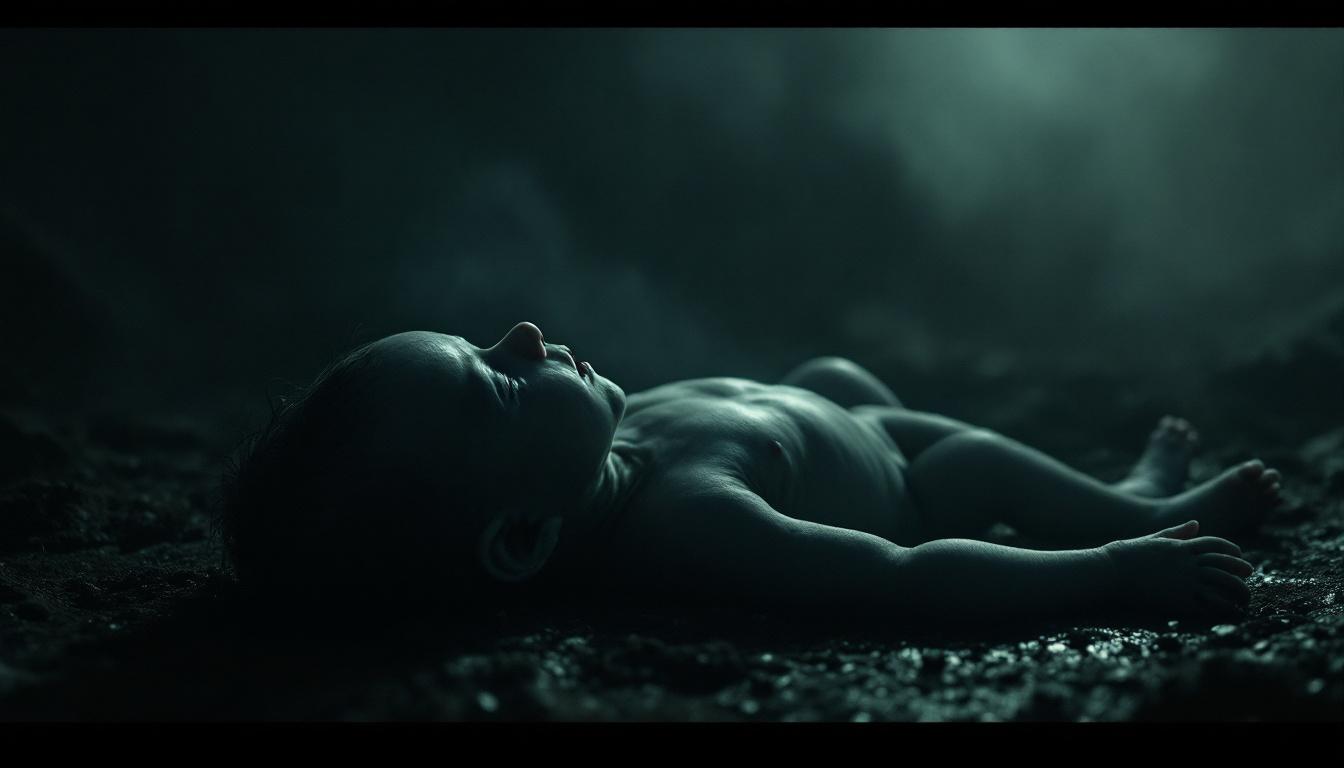
On January 18, 1955, a group of men sat down in a conference room and had a conversation that stayed classified for forty years. They were chemists and physicists and military officers, some of the smartest people the United States had, and they were trying to solve a problem. The problem was that they did not have enough dead children.
I want to say that again, slowly, because the first time you read it your brain does the thing where it assumes you misunderstood. They were short on samples. The samples they needed were human bones. And the human bones they needed most urgently came from the young — infants, toddlers, kids — because young bones, still growing, soak up a particular kind of poison faster than anything else. So the men in that room were sitting around openly discussing how to get more of them.
Now sit down, because this one is going to take a minute.
The program was called Project Sunshine. It started in 1953, jointly run by the U.S. Atomic Energy Commission and the Air Force’s RAND think tank, and on its face it was something close to noble. The United States had been detonating nuclear weapons in the atmosphere for years, and every detonation flung radioactive debris into the sky, where the wind carried it everywhere and the rain eventually brought it back down. One of the nastier things in that debris was strontium-90. Strontium-90 has a chemical habit that makes it uniquely cruel: the body mistakes it for calcium. It goes where calcium goes. It goes into bone. And it goes most eagerly into bone that is still being built — which is to say, into children.
Project Sunshine wanted to measure how much strontium-90 had already settled into the human race. That is a legitimate question. It is arguably an important one. You cannot tell people whether nuclear testing is poisoning them unless you actually go and look. The trouble was the looking. To measure strontium-90 in a human skeleton, you need a human skeleton, and the program needed thousands of them, from every continent, across every age group, and it needed them on a schedule.
That is where the conversation in that 1955 room went somewhere most people would never let it go.
The man driving it was Willard Libby — and you should know who Willard Libby was, because it makes the whole thing worse. Libby was a chemist of genuine, historic talent. He invented radiocarbon dating, the technique archaeologists still use to put a date on anything that was once alive. Five years after this meeting, he would win the Nobel Prize in Chemistry for it. He was, at the time of this conversation, a Commissioner of the Atomic Energy Commission. He was not a fringe figure or a villain in a film. He was the establishment.
And here is what he said, on the record, in a transcript that the government would keep secret until 1995. Libby told the room that the program’s biggest gap was human material: “We have been reduced to essentially zero level on the human samples.” He stressed that what he needed most was the young. And then he said the sentence that, once you have read it, you do not get to un-read: “So human samples are of prime importance, and if anybody knows how to do a good job of body snatching, they will really be serving their country.”
He used the words. Body snatching. Out loud, in an official meeting, a future Nobel laureate framed the procurement of dead children as a patriotic duty. And it was not loose talk. Libby went on to mention that back when the program was being designed at RAND in the summer of 1953, “we hired an expensive law firm to look up the law of body snatching.” They had lawyers on it. They had researched, formally and in advance, exactly how far they could go.
Then a Columbia University geochemist named J. Laurence Kulp explained how far they already had gone. Kulp told the room the program had working pipelines — he called them “channels” — in several cities. “These three are Vancouver, Houston, and New York,” he said. And then he described Houston in a way that should make the hair on your arms stand up. “Down in Houston they don’t have all these rules,” Kulp said. “They claim that they can get virtually — and they intend to get virtually — every death in the age range we are interested in that occurs in the City of Houston.”
Every death. In the age range they were interested in. In an entire city.
The age range they were interested in was the young. And the way you collect a child’s body without the family’s knowledge is you find someone inside the system — a coroner, a pathologist, a hospital staffer — who has access to the dead and is willing to quietly hand over a piece of them. The Advisory Committee that eventually investigated all of this concluded, in its final report, that researchers “employed deception in the solicitation of bones of deceased babies.” The doctors and officials who actually supplied the remains were often told the samples were for radium surveys or nutritional studies. One internal memo defended that cover story with a phrase worth keeping: it argued the explanation was “merely incomplete, not false,” because, technically, radium tests would be run on some of the bones too.
This was not a handful of cases. Over its run, Project Sunshine and its sister programs gathered more than 1,500 human samples, pulled from somewhere around twenty countries — Australia, South America, Scandinavia, Britain. The British end of it ran infant remains out of hospitals and coroners’ offices, including London’s Middlesex Hospital, to Harwell, the United Kingdom’s main atomic research center, and onward to American laboratories. The Australian version became a formal program that ran from 1957 well into the 1970s and collected thousands of bones, most of them from children. In a great many of these cases — nobody knows the true number, because the records are incomplete and some were destroyed — the mothers and fathers were never told. They buried their babies believing they had buried all of them.
And here is the part that lands the hardest. The science was not even wrong. Project Sunshine worked. The strontium-90 measurements it produced became some of the earliest hard evidence that atmospheric nuclear testing really was salting the entire planet with radioactive fallout, and that evidence fed directly into the public alarm that led, in 1963, to the Partial Test Ban Treaty — the agreement that finally drove nuclear testing underground. The bones of those children genuinely did serve their country, exactly as Libby promised. They helped prove the bombs were dangerous. The families just never got a vote, or a warning, or, in most cases, the truth.
The whole thing surfaced in 1995, when the Advisory Committee on Human Radiation Experiments — convened to dig through the entire ugly catalog of Cold War radiation research on Americans — pulled that 1955 transcript out of the classified files at the National Archives and had it declassified. Forty years after Willard Libby asked a room full of scientists who among them knew how to do a good job of body snatching, the public finally got to read his answer to his own question. The transcript exists. It has a date on it. You can find it today.
I’m not here to tell you these men were monsters. Some of them clearly believed they were saving lives, and in a strange, sideways accounting, they may have. I’m just telling you what’s in the file. And what’s in the file is a Nobel Prize winner, an expensive law firm, a city where “they don’t have all these rules,” and a quiet, decades-long, worldwide effort to gather up the bones of dead children — and the parents who, to this day, were never told their child came home one piece short.
Conspiracy Confirmed
