
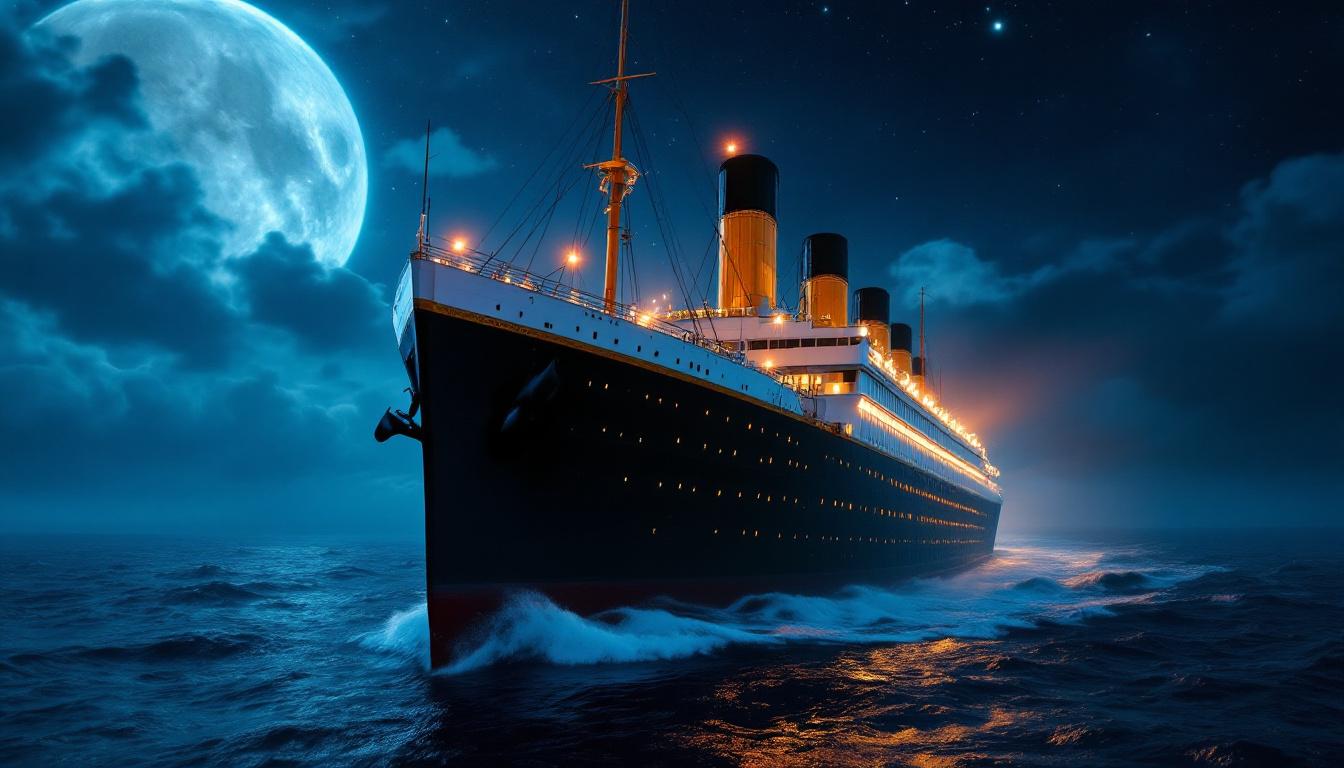
I thought I knew the Titanic. Big ship, hit an iceberg, the band played, Leonardo DiCaprio froze. Then I went down the rabbit hole and found out the “unsinkable” line was invented after it sank, a novel predicted the whole thing 14 years early, and the ship is currently being eaten alive at the bottom of the ocean.
1. A novel published 14 years earlier described the disaster in eerie detail.
In 1898, author Morgan Robertson wrote a novella called Futility about a “largest ship ever built” named the Titan — which sinks in the North Atlantic in April after striking an iceberg, with too few lifeboats to save everyone aboard. The real Titanic launched 14 years later and managed to hit nearly every one of those notes: same ocean, same month, same iceberg, same lifeboat shortage, nearly the same name. Robertson spent the rest of his life insisting it wasn’t a vision, just an experienced sailor doing the math on where shipbuilding was headed.
2. Nobody actually called the Titanic “unsinkable” — until after it sank.
The single most famous fact about the Titanic is a myth. White Star Line never officially advertised the ship as “unsinkable.” A few trade publications called it “practically unsinkable,” with that crucial qualifier attached. The bold, confident, no-asterisk version of the claim only took hold after the disaster, when newspapers and grieving survivors retold the story — because a ship that was sworn to be unsinkable makes for a far more haunting tragedy than a ship that was merely “practically” so.
3. One of its four giant funnels was a fake.
The Titanic’s four towering smokestacks were its signature look — but only three of them did the real job of venting smoke from the boilers. The fourth was there mostly for show. Engineers used it to vent galley exhaust and air out the ship, but it didn’t need to be a full-size funnel. White Star Line added it anyway because the traveling public had decided that serious, powerful ocean liners had four funnels — and three would have looked second-rate.
4. The ship received seven separate iceberg warnings that day.
This wasn’t a case of one unlucky surprise in the dark. Titanic’s wireless operators received seven warnings of ice on April 14 alone. One of the last and most detailed — the Mesaba‘s warning about a field of heavy pack ice and large icebergs directly in Titanic’s path — never even made it from the radio room to the bridge. The operators were swamped sending passengers’ personal telegrams, and the message got set aside.
5. Hitting the iceberg head-on probably would have saved the ship.
Here’s the cruel irony. The crew did the instinctive thing — they turned hard to avoid the iceberg, which scraped a long line of damage down the ship’s side and flooded compartment after compartment. Naval engineers have argued for decades that a direct, head-on collision would have crumpled the bow, flooded only the first two or three compartments, and very likely left the Titanic damaged but afloat. The attempt to dodge the iceberg is what doomed her.
6. The lifeboats left with hundreds of empty seats.
The lifeboat shortage is famous — the Titanic carried 20 boats for a ship designed to hold 64. What gets less attention is that the boats they did have weren’t even filled. All told, lifeboats rowed away with more than 400 empty seats. Lifeboat No. 1 left with just 12 people aboard a boat built for 40. Crew members, unsure the lowering ropes could handle a fully loaded boat’s weight, launched them half-empty into the night.
7. Three dogs survived the Titanic.
At least twelve dogs were aboard, and three of them made it off alive. The survivors had two things in common: they were small enough to hide, and they were being kept in their owners’ staterooms rather than down in the ship’s kennel. The lucky three were a Pekingese and two Pomeranians — little enough to be tucked into a coat or smuggled onto a lifeboat without anyone making a fuss.
8. The “RMS” in RMS Titanic means it was a working post office.
The Titanic wasn’t just a passenger liner — it was a Royal Mail Ship, contracted to carry the mail across the Atlantic. On board was a full Sea Post Office staffed by five mail clerks, sorting through roughly 3,400 sacks holding millions of letters and parcels. When the ship struck the iceberg, those five clerks reportedly stayed below, hauling mail sacks toward higher decks to save them. None of the five survived.
9. The wreck wasn’t found for 73 years — and the search was secretly a Navy mission.
The Titanic sank in 1912, but its resting place wasn’t located until 1985, two and a half miles down on the Atlantic floor. The expedition that found it, led by Robert Ballard, had a hidden purpose: the U.S. Navy was secretly funding him to inspect two sunken nuclear submarines, and the Titanic hunt was the cover story he was allowed to pursue with whatever time remained. The most famous shipwreck discovery in history was, on paper, a side quest.
10. The Titanic is being eaten — and may completely vanish within our lifetimes.
A species of metal-munching bacteria discovered on the wreck — fittingly named Halomonas titanicae — is slowly consuming the ship’s iron hull, devouring it into “rusticles” that crumble away. Scientists estimate the bacteria are dissolving the Titanic so steadily that the wreck could largely collapse and disappear within the next few decades. The ship that took two and a half hours to sink is taking only a little over a century to be erased entirely.
Which one made you go “wait, what?” Send this to the friend who’s seen the movie six times.
