
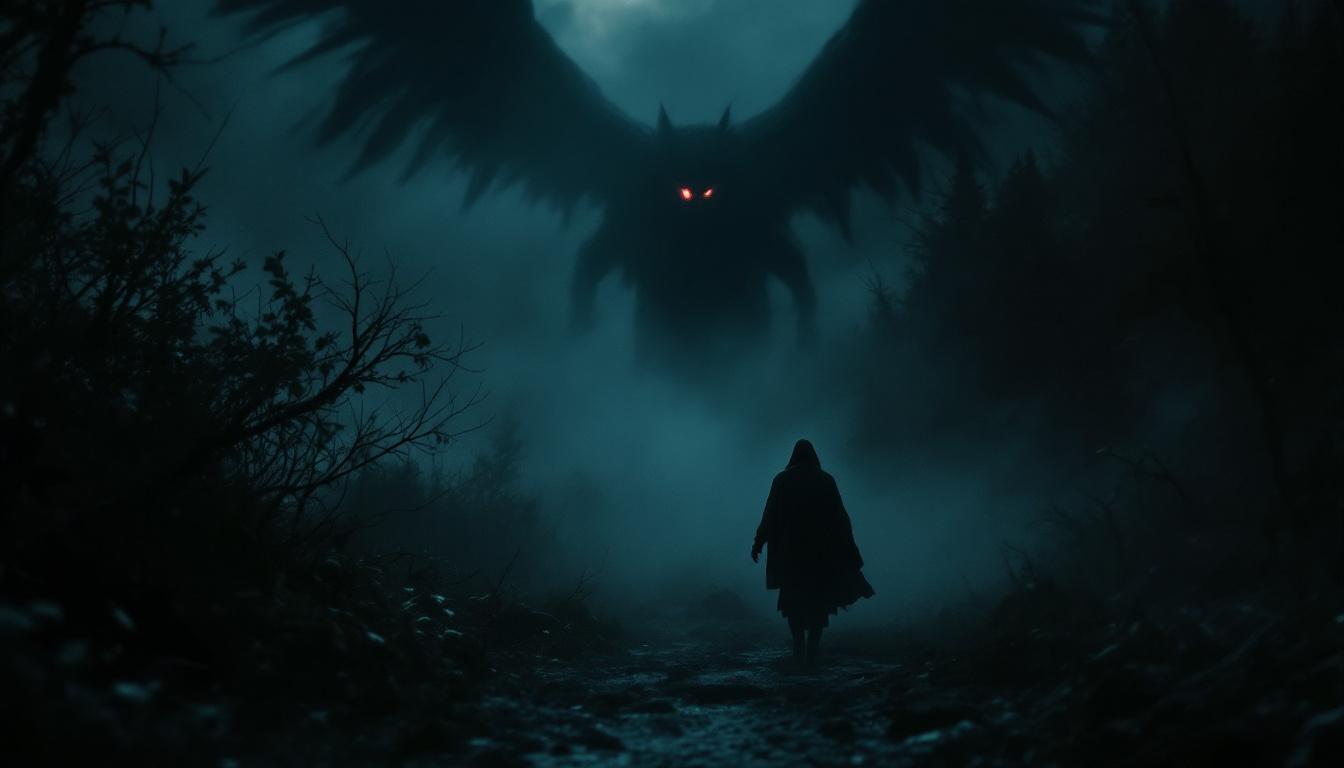
Two married couples were out driving around eleven o’clock at night, the way young people in small towns did in 1966 when there was nothing else to do. They were headed out State Route 62, past the edge of Point Pleasant, West Virginia, into a stretch of overgrown country the locals called the TNT area — a few thousand acres of woods and concrete bunkers left over from a World War II munitions plant. Their headlights swept across an old generator building. And standing next to that building were two red lights, side by side, about six feet off the ground.
Now I want you to hear me out before you decide anything, because everything about these four people checks out. Roger and Linda Scarberry. Steve and Mary Mallette. Ordinary names, ordinary jobs, an ordinary night. They were not the type to go looking for attention, and what they did next was not the behavior of people running a hoax. They drove straight to the Mason County courthouse and reported it to a sheriff’s deputy, and the deputy — this is the part I love — took them seriously enough to drive back out there with them. So sit down, because this one is going to take a minute.
Here is what those four people described, and it never wavered in the retelling. The two red lights were not lights at all. They were eyes — set into the body of something gray, somewhere between six and seven feet tall, shaped roughly like a man but wrong in every detail that mattered. It had wings folded against its back. On the ground it was clumsy, shuffling toward them in a way Roger Scarberry called a “waddle.” So they did what you would do. They got in the car and they ran. And the thing opened its wings and came after them. They said it never flapped — it just rose straight up like a helicopter and paced their car down Route 62 at speeds Roger swore touched a hundred miles an hour, and the whole time it was making a sound none of them could describe except to say it was like a record played at the wrong speed, a high mechanical squeal. It followed them all the way to the city limits and then it was gone.
The next morning, November 16, 1966, the local paper — the Point Pleasant Register — ran the story under a headline that has become legendary in its own right: “Couples See Man-Sized Bird … Creature … Something.” The editors genuinely did not know what to call it. That problem got solved fast. Within a day or two, a copy editor somewhere along the wire reached for the obvious gag — Batman was the biggest show on television in 1966 — and christened the thing the Mothman. The name was a joke. It did not stay a joke for very long.
Because the sightings did not stop. Over the next thirteen months, by the count of the Mothman Museum’s own historian, somewhere around a hundred people reported seeing the same creature in and around Point Pleasant. A volunteer firefighter and his crew saw a “giant bird with red eyes.” A contractor working out near the TNT bunkers watched it lift straight off the ground twenty feet in front of him. People reported their car radios and televisions cutting to static when it was near. The TNT area — all those abandoned igloos and tunnels, the ground still soaked with old chemical runoff — became the place nobody wanted to drive past after dark. And here I have to be honest with you, the way a good storyteller has to be. A lot of those hundred accounts come to us secondhand, through children’s books and excited paperbacks, and were never tied to a named, identifiable witness. The legend grew faster than the documentation. But the first four — the Scarberrys and the Mallettes — those were real people who walked into a courthouse and put their names on a police report, and they never took it back.
Into all of this walked a man named John Keel. Keel was a New York journalist, a UFO writer, and he came down to Point Pleasant and more or less stayed. He worked alongside a local reporter named Mary Hyre, who covered the town for the Athens Messenger out of a little office on Sixth Street, and between the two of them they collected everything — the sightings, the strange phone calls, the men in dark suits who reportedly turned up asking witnesses unsettling questions. Keel came to believe something stranger than a monster. He believed the creature was not the danger itself. He believed it was a warning. A harbinger. He claimed that during 1967 he was receiving what he could only describe as predictions — that something terrible was going to happen in Point Pleasant, and soon, and near the river.
Then came December 15, 1967. It was the Friday before Christmas, five-something in the evening, and the Silver Bridge — a graceful old eyebar-chain suspension bridge that had carried U.S. Route 35 across the Ohio River since 1928 — was packed bumper to bumper with rush-hour traffic and last-minute shoppers. And it came down. The entire span dropped into the cold river in under a minute. Forty-six people died. Two of them were never found.
Here is the turn, and I want to be precise about it, because the truth and the legend run side by side here and you deserve to know which is which. The collapse of the Silver Bridge was not supernatural. Engineers spent three years on the final report and traced the whole catastrophe to a single component — an eyebar, the one cataloged as number 330, in the suspension chain on the Ohio side. A crack had formed in it. A crack about a tenth of an inch deep. Stress corrosion did the rest, and when that one link let go, the bridge had no backup, and forty-six people went into the river two weeks before Christmas. That is the verified, documented cause. The disaster reshaped American law — the federal government created the nation’s first mandatory bridge inspection standards directly because of it. There is nothing folklore about eyebar 330.
But here is what folklore did with the dates, and you can sit with this however you want. The first Mothman sighting was November 15, 1966. The Silver Bridge fell on December 15, 1967 — thirteen months later, almost to the day. And after the bridge came down, the sightings simply… stopped. The red-eyed thing in the TNT woods was never reliably reported again. In 1975, John Keel published a book that tied all of it together — the creature, the strange visitors, the warnings, the bridge — and he called it The Mothman Prophecies. Whatever you make of Keel’s theories, that title is the reason a small Ohio River town became a permanent fixture in American mythology.
Now, the people whose job it is to be skeptical have a perfectly reasonable answer, and it deserves a fair hearing. Back in 1966, a wildlife biologist at West Virginia University named Robert L. Smith pointed out that the descriptions matched the sandhill crane almost uncomfortably well — a crane stands nearly as tall as a man, carries a wingspan close to seven feet, and has a patch of bare reddish skin around its eyes that would flare like two red coals in a pair of headlights. Cranes wander off-course. Nobody in that part of West Virginia would have recognized one. Later investigators, including the veteran skeptic Joe Nickell, leaned toward the barred owl — an owl’s eyes throw a startling crimson “eyeshine” when light hits them, and Nickell’s point was a sharp one: in the dark, at an unknown distance, a frightened person cannot judge the size of anything. Misjudge the distance and you misjudge the height by the exact same amount. A two-foot owl ten feet up becomes a seven-foot man.
So that is where it sits, and I am not going to tie a bow on it for you. Maybe it was a crane that took a wrong turn over the wrong woods at the wrong moment in a town’s history. Probably it was. But Point Pleasant decided the harbinger belonged to them. In 2003 the town commissioned a retired welder named Bob Roach to build a twelve-foot Mothman out of polished stainless steel, and it stands on Main Street to this day, the most photographed thing in the county. Every September around fifteen thousand people make the pilgrimage there for the Mothman Festival. They come for the monster. But if you stand in that town long enough, you start to understand that the statue is not really about a bird. It is about forty-six neighbors who went to the river one December evening and did not come home — and a town that decided the only way to carry something that heavy was to wrap it inside a story.
Cryptid
