
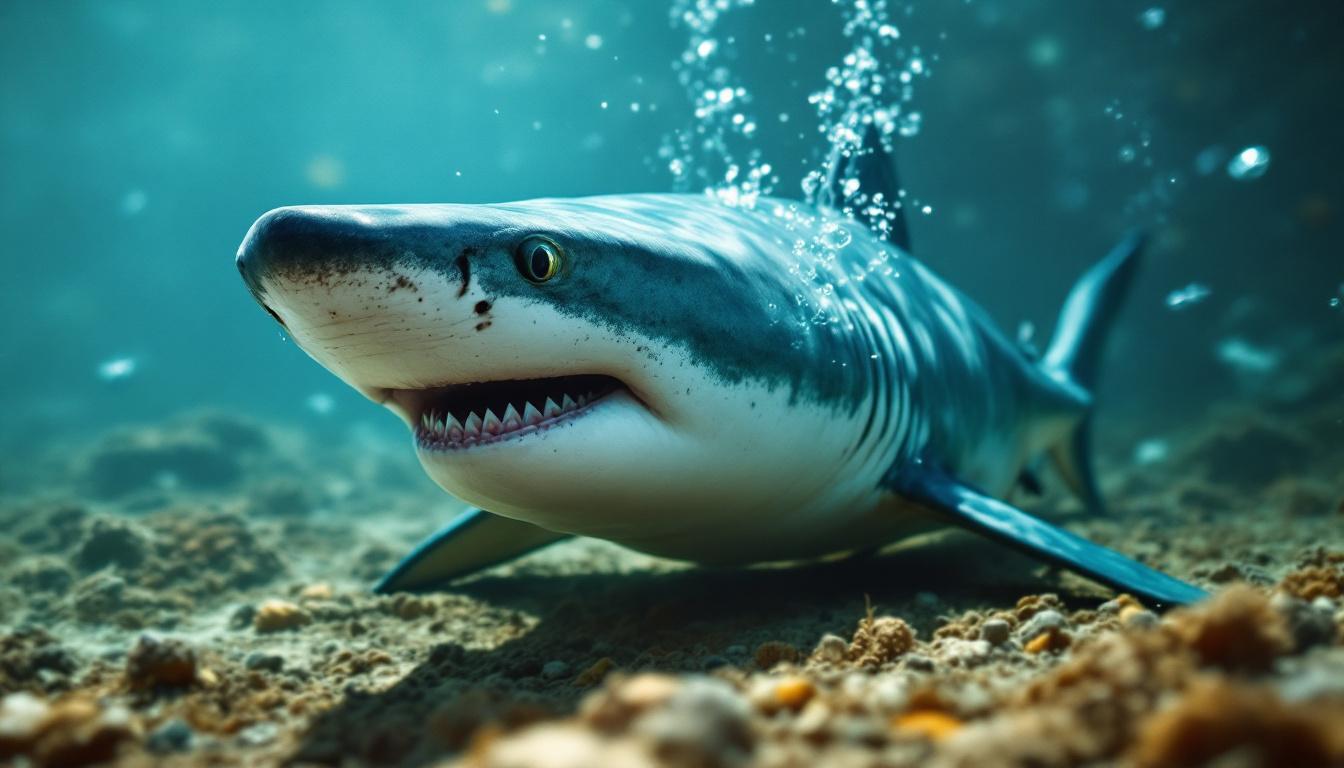
I grew up thinking sharks were basically swimming chainsaws that wanted to eat me. Then I learned they have no bones, some of them glow in the dark, and a few are older than the rings of Saturn. The most famous predator on Earth turns out to be far weirder — and far more interesting — than the movies ever told you.
1. Sharks aren’t actually hunting you.
Despite a certain 1975 movie’s best efforts, sharks have no interest in eating people. Most bites are cases of mistaken identity — a surfer’s silhouette looks a lot like a seal from below, and humans are simply not on the menu. We taste wrong to them, closer to balsamic vinegar than to a juicy seal, which is why a shark that does bite usually lets go almost immediately and swims off. You are roughly 75 times more likely to be killed by lightning than by a shark.
2. Sharks don’t have a single bone in their bodies.
A shark’s entire skeleton is made of cartilage — the same flexible, gristly stuff in your ears and the tip of your nose. That’s why you’ll never find a shark skeleton in a fossil bed the way you find dinosaur bones; cartilage rarely survives the ages. The trade-off is a body that’s lighter and more flexible than bone would allow, which helps a creature that has to keep moving for most of its life.
3. Sharks can sense your heartbeat.
Scattered across a shark’s snout are hundreds of tiny jelly-filled pores called the ampullae of Lorenzini — an electrical “sixth sense” that detects the faint voltage given off by every living thing. It’s sensitive enough that a shark can find a fish completely buried under the sand just by feeling its heartbeat. Every muscle twitch in your body produces a tiny electric signal, and to a shark, that’s a beacon.
4. Whale sharks have teeth on their eyeballs.
The whale shark is the biggest fish in the ocean — up to 60 feet long — and scientists discovered its eyeballs are armored with thousands of tiny tooth-like scales. One eyeball can carry more than 3,000 of these “eye-teeth,” clustered around the iris like a protective shield. For a gentle giant with no eyelids, it’s the closest thing to built-in safety goggles nature could manage.
5. A tiny shark once forced the U.S. Navy to redesign its submarines.
The cookiecutter shark is barely the size of your forearm, but it feeds by latching onto larger animals and twisting out a perfectly round plug of flesh, like a living ice-cream scoop. In the 1970s, the Navy found that around 30 nuclear submarines had come home with their rubber sonar domes chewed up — the little sharks were biting the soft neoprene, mistaking it for prey. The bites blinded the subs’ sonar, and the Navy ultimately had to switch to fiberglass coverings to stop them.
6. Some sharks glow bright green — and only other sharks can see it.
Catsharks like the swell shark soak up the blue light of the deep ocean and re-emit it as a glowing green pattern across their skin, a trick called biofluorescence. Here’s the kicker: the glow is invisible to most ocean animals, but the sharks’ own eyes are tuned to see it perfectly. They’re essentially running a private visual channel, lighting up in patterns unique to each species and sex — a secret signal nobody else is invited to read.
7. Sand tiger sharks eat their siblings before they’re even born.
Inside a pregnant sand tiger shark, the embryos start out as a litter — and then the largest, fastest-developing pup turns on the rest and devours them in the womb. By the time of birth, just one survivor emerges from each of the mother’s two uteruses. It sounds gruesome, but it’s a strategy: the lone survivor is born big, strong, and almost too large for other predators to bother with.
8. Sharks don’t have a swim bladder — they’re held up by a giant, oily liver.
Bony fish use a gas-filled swim bladder to float, but sharks never evolved one. Instead, a shark’s liver is enormous — up to a quarter of its entire body weight — and packed with a lightweight oil called squalene that keeps the animal from sinking. Because oil doesn’t compress the way gas does, a shark stays evenly buoyant whether it’s gliding near the surface or diving hundreds of feet down.
9. The Greenland shark can live 400 years — and doesn’t even start dating until it’s 150.
The Greenland shark, a slow-moving Arctic giant, is the longest-living vertebrate known to science, with individuals estimated at up to 400 years old. That means a Greenland shark alive today could have been swimming the seas before the United States existed. The strangest part: they don’t reach sexual maturity until around age 150, so a 149-year-old Greenland shark is, biologically speaking, still a teenager.
10. Sharks are older than trees, the North Star, and the rings of Saturn.
Sharks have been cruising the oceans for roughly 450 million years — they showed up about 65 million years before the first trees ever grew on land. They predate the dinosaurs by well over 200 million years, they’re older than the North Star, and they’re even older than the rings of Saturn, which only formed somewhere between 10 and 100 million years ago. Sharks have survived all five mass extinctions. They were here long before the forests, and odds are they’ll outlast them too.
Which one made you rethink the scariest fish in the sea? Send this to the friend who still won’t go in past their knees because of a movie from 1975.
