
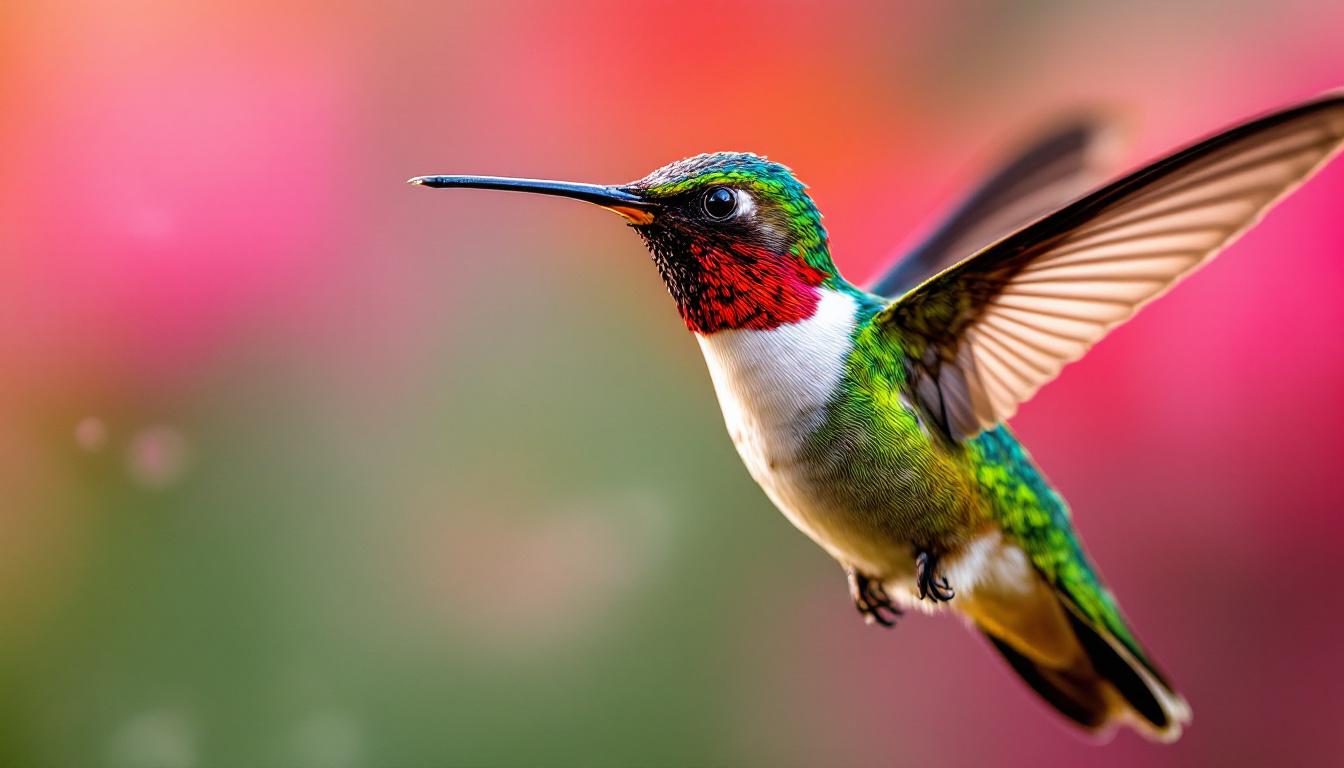
There is a bird outside your window the size of your thumb, and it is doing things that should not be physically possible. I started reading about hummingbirds expecting “cute and tiny.” I came away genuinely unsettled, in the best way. Here are five facts that turned a backyard novelty into the most over-engineered animal I know of.
Did you know a hummingbird’s courtship dive is, by one measure, the fastest movement of any animal on Earth?
When a male Anna’s hummingbird wants to impress a female, he climbs about 100 feet into the air and then dives straight down at her. He hits roughly 60 miles per hour — which sounds fast but not insane. The insane part is the math relative to his size: at the bottom of that dive he covers 385 times his own body length every single second. A peregrine falcon’s famous attack dive manages about 200. A fighter jet with its afterburners lit hits 150. A space shuttle re-entering the atmosphere clocks 207. The tiny bird at your feeder out-accelerates all of them, then pulls out of the dive at nearly nine times the force of gravity — enough G-force to make a trained pilot black out.
Did you know hummingbirds don’t sip nectar through their tongues — they pump it?
For about a hundred years, science assumed a hummingbird tongue worked like a straw, drawing nectar up through capillary action. In 2011, high-speed cameras proved everyone wrong. The forked tip of the tongue actually splits open underwater and snaps shut around the nectar, trapping it like a tiny spring-loaded jaw. The bird flicks that tongue in and out of a flower up to 20 times a second. Best part: the trap is powered entirely by the tongue’s own structure, so it costs the bird zero extra energy. If they relied on the old “straw” method, they’d pull in only about a third as much fuel — and a hummingbird simply cannot afford that.
Did you know a hummingbird can fly nonstop across the Gulf of Mexico — 18 to 22 hours over open water?
Every spring and fall, ruby-throated hummingbirds migrate between the eastern U.S. and Central America, and a huge number of them refuse to take the safe route along the coastline. Instead they launch straight out over the Gulf of Mexico and fly up to 500 miles without a single rest stop, beating their wings the entire way. To survive it, the bird nearly doubles its body weight beforehand — going from about 3 grams to over 6 — by gorging on bugs and nectar for a week, basically packing a fuel tank made of fat. And when storms hit mid-crossing, exhausted hummingbirds have been found taking shelter on offshore oil rigs and passing boats, catching their breath before launching back out over the water.
Did you know the smallest bird on Earth weighs less than a U.S. penny?
It’s the bee hummingbird of Cuba, and the name is not an exaggeration — people genuinely mistake it for an insect. A male weighs about 1.95 grams. A penny weighs 2.5. So the entire bird, beak to tail, comes in lighter than the coin you’d flip to call heads. Its eggs are the smallest of any bird in the world, roughly the size of a coffee bean, laid in a nest you could cover with a quarter. And that miniature body still contains a working heart, lungs, and a brain sharp enough to remember every flower it has visited. Evolution looked at “bird” and asked how small it could possibly go. The answer was: this small.
Did you know a hummingbird can drop its heart rate from over 1,200 beats a minute to under 50 — basically every single night?
A hummingbird’s metabolism runs so hot it would starve to death in its sleep — a single night of normal resting would burn through more fuel than its tiny body can store. So every night it does something extraordinary: it enters a state called torpor, a kind of nightly mini-hibernation. Its heart rate crashes from well over 1,000 beats per minute down to as few as 50. Its breathing can briefly stop entirely. Its body temperature plunges by nearly 50 degrees, and its metabolism drops as much as 95%. To anyone watching, the bird looks dead — cold, stiff, hanging upside down from a branch. Then, an hour or two before sunrise, it shivers itself back to life and goes hunting like nothing happened. The most frantic animal on the planet survives by switching itself off and on again, every night of its life.
Send this to the hummingbird person in your life — they think they know everything about these birds, and the torpor fact is going to get them.
