
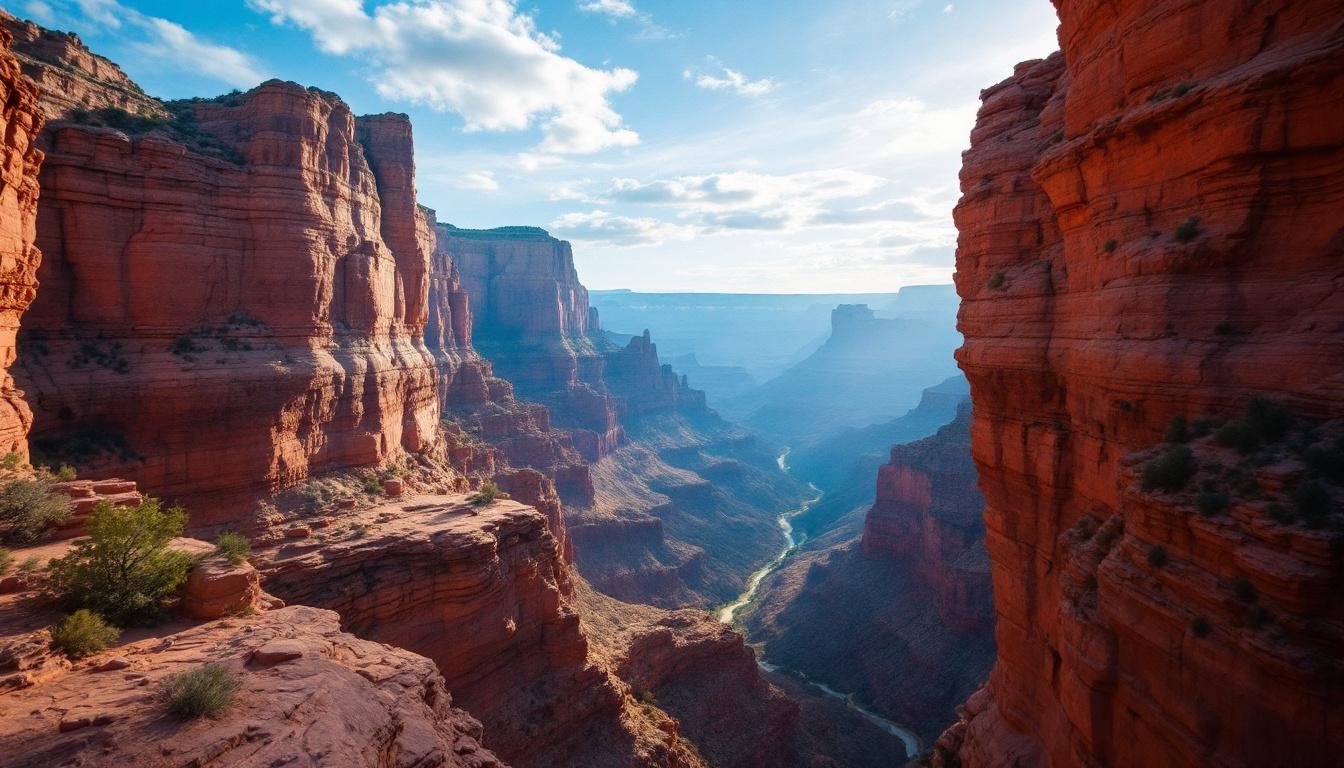
I always assumed the Grand Canyon was the world’s deepest, that the Colorado River carved it, and that it was crawling with dinosaur bones. Turns out it isn’t the deepest, the dinosaurs missed it entirely, and there’s a town at the bottom where your mail still arrives by mule. The biggest hole in the ground you’ve ever seen is full of surprises.
1. The Grand Canyon is not the deepest canyon in the world. It’s not even close.
At about one mile deep, it feels like the ultimate hole in the planet — but several canyons leave it in the dust. Hells Canyon on the Oregon-Idaho border is nearly 8,000 feet deep, and the Yarlung Tsangpo Canyon in Tibet plunges almost 20,000 feet, roughly three times deeper. The Grand Canyon’s real claim to fame isn’t depth — it’s the staggering width and the layer-cake walls that show off nearly two billion years of Earth’s history at a glance.
2. You will never find a dinosaur bone in the Grand Canyon.
This seems impossible — it’s a giant rocky pit in the desert, the exact place a brain pictures dinosaur fossils. But the rock making up the canyon walls is far older than the dinosaurs, in some spots a full billion years older, and the canyon itself didn’t carve out until long after the dinosaurs were gone. The timing missed both ways. Plenty of ancient sea creatures and trilobites, though — the canyon was underwater more than once.
3. There’s a town at the bottom where mail is still delivered by mule.
Supai, Arizona, sits deep inside the canyon on the Havasupai Reservation, eight miles from the nearest road with no cars and no way in except by foot, horse, or helicopter. It’s the most remote community in the lower 48, and it’s the only place in the entire United States where the U.S. Postal Service still delivers mail by mule train. The mules haul letters, bills, groceries, and medicine down the switchbacks five days a week — up to 200 pounds per animal.
4. The Grand Canyon is the reason the FAA exists.
In the 1950s, airlines liked to detour over the canyon so passengers could enjoy the view. On June 30, 1956, two airliners doing exactly that collided in the open sky above the canyon, killing all 128 people aboard both planes. The disaster exposed how dangerously outdated American air traffic control was, and the public outcry led directly to the 1958 law that created the Federal Aviation Administration. Every time a controller guides your flight, you can thank a tragedy over the Grand Canyon.
5. The canyon has its own weather, and it can be 25 degrees hotter at the bottom.
It’s not one climate — it’s three stacked on top of each other. The temperature climbs roughly 5.5°F for every 1,000 feet you descend, so a pleasant 85°F morning at the rim becomes a brutal 110°F at the river. Hikers have been caught completely off guard by this. The South Rim gets close to 60 inches of snow a year while, on that very same day, the bottom of the canyon can be sweltering past 100°F.
6. Once in a blue moon, the entire canyon fills up with clouds.
During a rare event called a total cloud inversion, cold air gets trapped down in the canyon and a thick blanket of fog rises up until it brims at the rim like a bowl of milk. It looks like the canyon vanished and was replaced by an ocean. Park rangers who see the canyon every single day can wait years to witness one — a full inversion like this usually happens only about once a decade.
7. There’s a snake here that’s bright pink, and it lives nowhere else on Earth.
The Grand Canyon pink rattlesnake is found exclusively within the canyon and nowhere else in the world. Its rosy, salmon-colored skin is perfect camouflage against the canyon’s pink and tan rock, which makes it one of six rattlesnake species in the park you really don’t want to surprise. Evolution basically color-matched a venomous snake to the local décor.
8. The fastest animal on the planet lives here, and it’s a bird.
Nearly 450 bird species pass through the Grand Canyon, since it sits on a major migratory highway — but one resident outclasses them all. The peregrine falcon nests in the canyon’s cliffs and, in a hunting dive, can exceed 200 miles per hour, making it the fastest animal alive. Cheetahs get all the credit, but a falcon dropping out of the Grand Canyon sky would smoke one without trying.
9. More people have walked on the Moon than have hiked the full length of the canyon.
Plenty of visitors hike down into the canyon, but doing a continuous end-to-end traverse along its 277-mile length is so brutal — no marked trail, scarce water, punishing terrain — that the number of people who’ve ever completed it is astonishingly small. It’s a smaller club than the group of astronauts who have set foot on the lunar surface. Most visitors never even attempt the inner canyon: only about 10% of the millions who come every year ever go below the rim at all.
10. There’s a stretch of the canyon where 250 million years of Earth’s history is simply missing.
In the canyon walls, geologists can point to a spot where 250-million-year-old rock sits directly against rock that’s 1.2 billion years old — with nothing in between. That’s a gap of more than a billion years of history that should be there and just isn’t. They call it the Great Unconformity, and nobody is entirely sure where all those missing layers went. The most famous canyon on Earth has a billion-year hole in its own story.
Which one made you rethink the big hole in the ground? Send this to the friend who still calls it the deepest canyon in the world.
