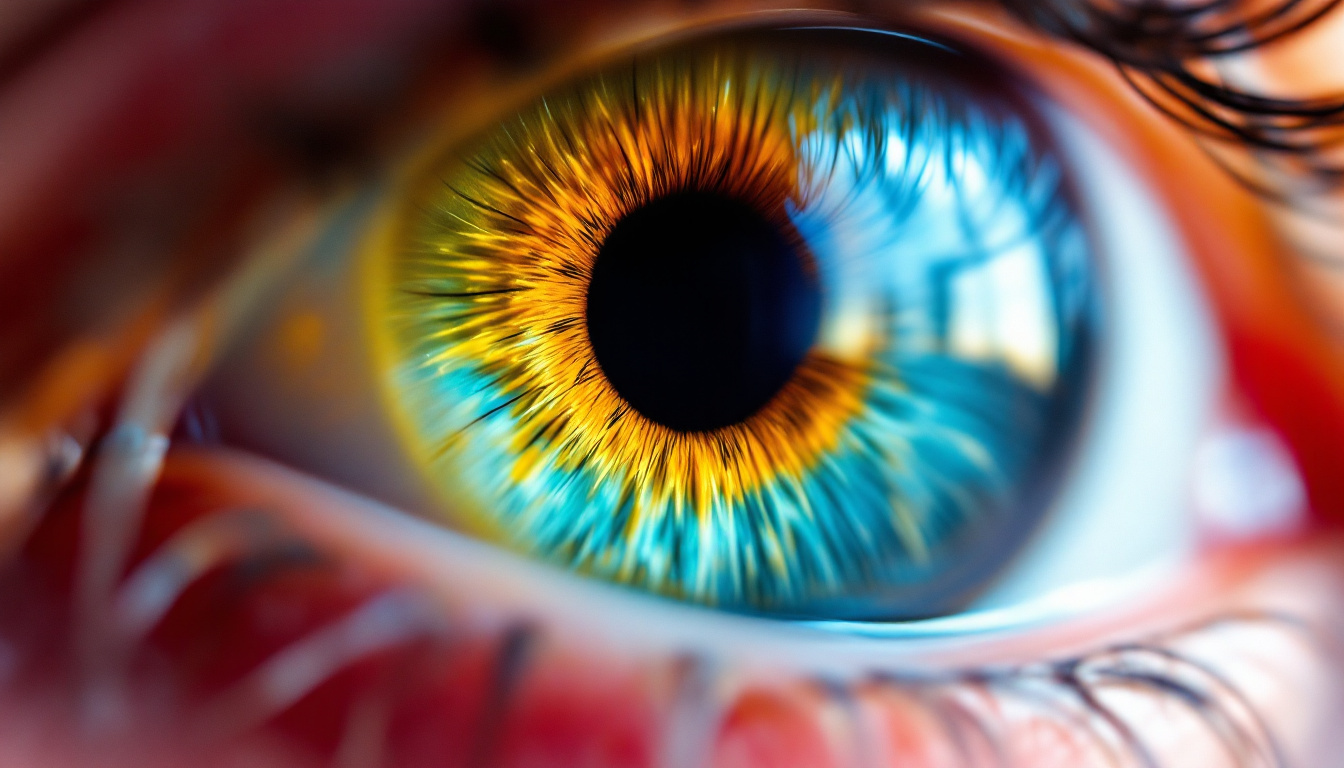
I’ve had eyes my whole life and have spent exactly zero seconds thinking about how weird they actually are. Turns out the two squishy orbs running your entire visual experience are doing some genuinely bizarre stuff behind the scenes — including handing your brain an upside-down picture and quietly editing out a hole in your vision you didn’t know was there. Here are five facts that completely changed how I think about looking at things.
Did you know your eyes see everything upside down?
The lens at the front of your eye works like the lens in a camera, and just like a camera, it flips the image as it passes through. The picture that lands on your retina — the screen at the back of your eyeball — is upside down and backward. Your brain quietly rotates it right-side up before you ever become aware of seeing anything, which is wild enough on its own. Even wilder: in 1890s experiments, scientists wore special goggles that flipped their vision upside down, and after about a week, their brains adjusted and the world looked normal again. When they took the goggles off, everything was upside down for another week.
Did you know you have a blind spot in each eye — and your brain just makes up what should be there?
There’s a spot on the back of each of your eyes where the optic nerve connects, and that spot has zero light-detecting cells. Which means there’s a literal hole in your field of vision at all times — a small patch of the world your eye is not seeing. You don’t notice it because your brain takes a guess at what should be there based on the surrounding area and fills it in, like a Photoshop clone-stamp tool running in the background of your life. You can prove this to yourself with the classic “dot and cross” test on a piece of paper — close one eye, focus on the cross, and at the right distance the dot just vanishes.
Did you know your eyes are technically part of your brain?
This one took me three reads to accept. During fetal development, your eyes grow as direct outpouchings of the developing brain — they bud out from the front of the brain and end up sitting in your skull connected by the optic nerve, which is itself made of brain tissue, not regular nerve tissue. Neurologists can sometimes diagnose brain conditions by looking through the pupil at the back of the eye, because they’re literally looking at exposed brain. You are walking around with two small pieces of your brain on the outside of your face.
Did you know your eyes can distinguish about 10 million different colors?
The human eye has three types of color-detecting cone cells — red, green, and blue — and your brain blends their signals into roughly 10 million distinguishable shades. That sounds like a lot until you meet the mantis shrimp, which has 16 different types of color receptors and may perceive colors humans literally cannot imagine. Even more interesting: a small percentage of women carry a genetic variation that gives them a fourth type of cone cell, which in theory lets them see about 100 million colors. Scientists call them tetrachromats, and most of them have no idea they’re seeing a different world than everyone else.
Did you know your eyes move constantly — even when you think they’re perfectly still?
Stare at one spot on the wall and your eyes feel locked in place. They aren’t. Your eyes are constantly making tiny, involuntary jitters called microsaccades — micro-movements happening multiple times per second that you’d never feel. The reason is genuinely strange: if your eyes ever held perfectly still, the image on your retina would actually fade to gray and disappear within seconds, because your visual system is wired to detect change, not constant input. The little jitters keep “refreshing” the scene so your brain doesn’t shut the picture off. Your steady gaze is a lie. You are vibrating at all times.
Send this to whoever in your life wears glasses — they’re going to want to know their brain has been filling in a hole in their vision this entire time.
