
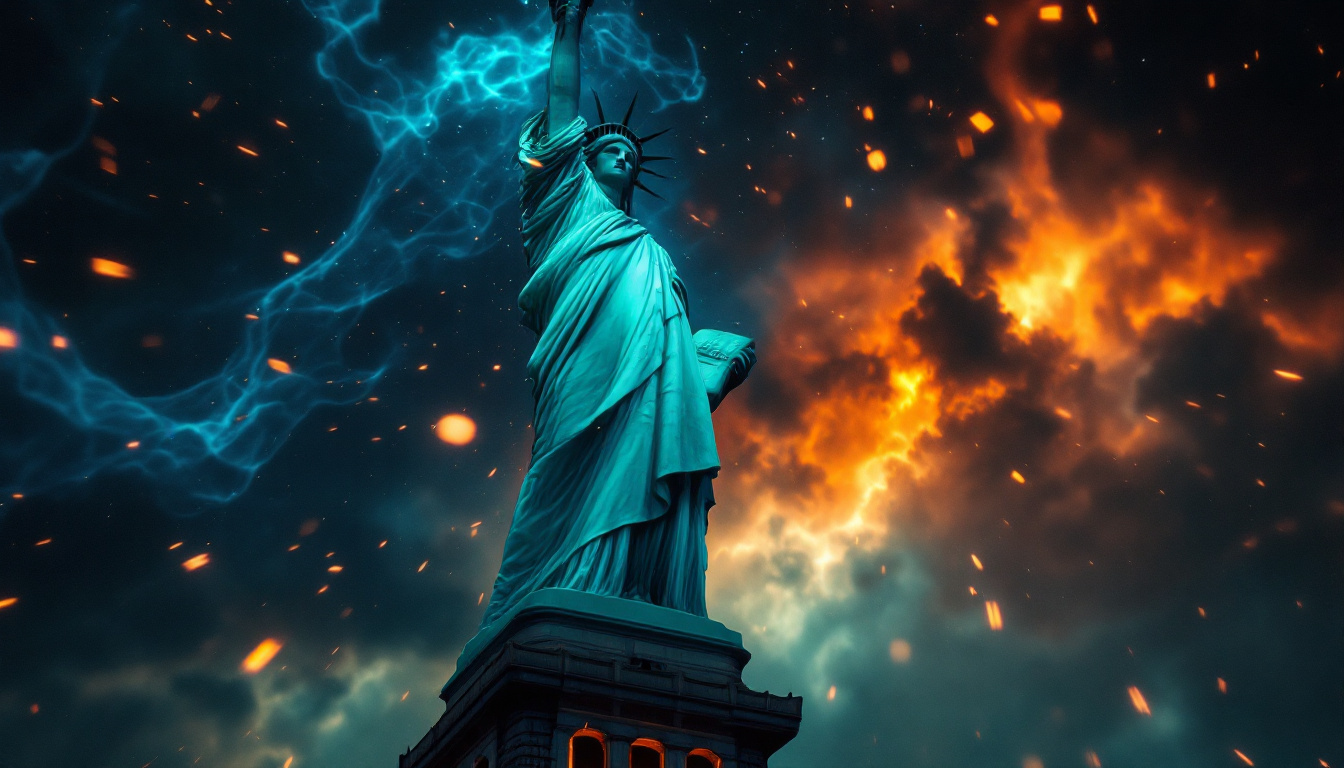
I assumed I knew the Statue of Liberty: big copper lady, gift from France, holds a torch, stands in New York Harbor. Then I found out she used to be a shiny penny color, her face might be modeled on the sculptor’s mother, and the torch she’s holding today isn’t the original one. The most recognizable woman in America is hiding a lot under that crown.
1. She wasn’t always green.
When the statue was unveiled in 1886, she was a gleaming reddish-brown — the color of a brand-new penny. That’s the natural color of copper. Over the next 30 years or so, exposure to the air slowly oxidized her surface into the pale green patina we know today. People at the time actually complained about the color change, and the War Department briefly considered painting her.
2. The seven spikes on her crown represent the seven seas and seven continents.
It’s not a fashion choice. The rays on Lady Liberty’s crown were designed to symbolize light radiating out to the seven seas and the seven continents — the idea being that liberty shines on the entire world. Look closely and you’ll see they’re not random; they’re carefully arranged. It’s one of those details that’s been hiding in plain sight on every postcard, magnet, and snow globe for a century and a half.
3. The torch she’s holding right now is not the original.
The original torch was damaged in 1916 during the Black Tom explosion — a massive act of sabotage by German agents who blew up a munitions depot across the harbor in New Jersey during World War I. The blast was so powerful it shattered windows in Manhattan and peppered the statue with shrapnel. The torch was repaired and rebuilt over the years, but the entire flame assembly was eventually replaced in the 1980s. The original sits inside the pedestal museum.
4. The face is reportedly modeled on the sculptor’s mother.
Sculptor Frédéric Auguste Bartholdi never publicly confirmed it, but the long-standing story — backed by people who knew him — is that he based Liberty’s stern, serene face on his own mother, Charlotte. There’s a competing theory that the face was inspired by a woman who survived the Franco-Prussian War. Either way, the most famous face in America is almost certainly French.
5. France paid for the statue. America had to pay for the pedestal — and almost couldn’t.
The deal was that France would build the statue and the U.S. would build the base she stood on. Fundraising in America stalled badly, and the project nearly collapsed before Joseph Pulitzer, the newspaper publisher, ran a front-page campaign in his paper begging ordinary citizens to chip in. Over 120,000 people donated — most giving less than a dollar — and the pedestal got built. The Statue of Liberty was essentially saved by a crowdfunding campaign in 1885.
6. She has her own zip code.
Liberty Island has a dedicated U.S. zip code: 10004. So if you ever wanted to send Lady Liberty a letter, you technically could. The island also has its own post office and even a small full-time staff who live on the grounds. She’s not just a monument; she’s an address.
7. The statue was originally proposed as a lighthouse — and was a working one for 16 years.
When she opened in 1886, the torch wasn’t just symbolic. It actually housed an electric light operated by the United States Lighthouse Board, and Lady Liberty served as an official aid to navigation in New York Harbor until 1902. Ships could see her glow from up to 24 miles out at sea. The problem: the light was too dim to be very useful, and the Coast Guard eventually decommissioned her as a lighthouse and handed her over to the War Department.
8. There are broken chains at her feet that almost nobody sees.
Tourists rarely notice them because they’re hidden by the folds of her robe at ground level, but Liberty is standing on — and stepping out of — a pile of broken shackles and chains. They symbolize escape from tyranny and oppression, and they were a deliberate, central part of Bartholdi’s design. The statue isn’t just standing there; she’s walking forward, mid-stride, away from bondage. Once you know they’re there, you can never un-see them.
9. She sways. On purpose.
The Statue of Liberty was engineered by Gustave Eiffel — yes, that Eiffel, the tower guy — and her internal iron skeleton is built to flex in the wind. In a strong gust, the statue can sway up to about three inches at the body and her torch can move as much as six inches. If she were rigid, she’d crack. The flexibility is exactly what’s kept her standing in coastal hurricanes for almost 140 years.
10. The tablet she’s holding is dated July 4, 1776 — in Roman numerals.
The book in her left hand isn’t blank. It reads “JULY IV MDCCLXXVI” — July 4, 1776 — the date of American independence, etched in stone in Roman numerals. It’s the only inscription on the entire statue. France’s gift, sculpted in Paris, shipped across the Atlantic in 350 pieces, reassembled in New York Harbor, has exactly one piece of writing on it, and it’s the birthday of the United States. I think about that a lot now.
Which one made you look at the postcard version differently? Send this to the friend who’s been to Liberty Island and still didn’t know about the chains.
