
On the afternoon of December 4, 1872, a British brig called the Dei Gratia was making a routine Atlantic crossing about four hundred miles east of the Azores when her crew spotted another ship on the horizon, moving strangely. She wasn’t running with the wind. She wasn’t running against it either. Her sails were set in a confused, sloppy way no working captain would have allowed — some torn, some missing, the main staysail lying loose across a forward hatch — and she was yawing, drifting, sliding sideways across the swell with no hand at the wheel. The Dei Gratia‘s captain, a careful man named David Morehouse, watched her for two hours before he was sure of what he was looking at. Then he gave the order to send a boarding party over.
What they found, when they climbed onto her deck, is the part that has bothered people for a hundred and fifty years. The ship was the Mary Celeste. She was seaworthy. Her cargo — 1,701 barrels of denatured industrial alcohol bound for Genoa, Italy — was still in the hold, intact. There was about three and a half feet of water sloshing in the bilge, which sounds bad but isn’t, not for a ship that size. The galley stove had been knocked off its chocks. A few hatches were open. The chronometer, the sextant, the ship’s papers, and the captain’s navigational instruments were gone. The lifeboat was gone. And every single person who had set sail on that ship — Captain Benjamin Briggs, his wife Sarah, their two-year-old daughter Sophia, and seven crew — was gone too. The boarding party went through every cabin, every passageway, the hold, the forecastle. There was nobody aboard. Living or dead. Just a ship sailing herself across the ocean with the door open.
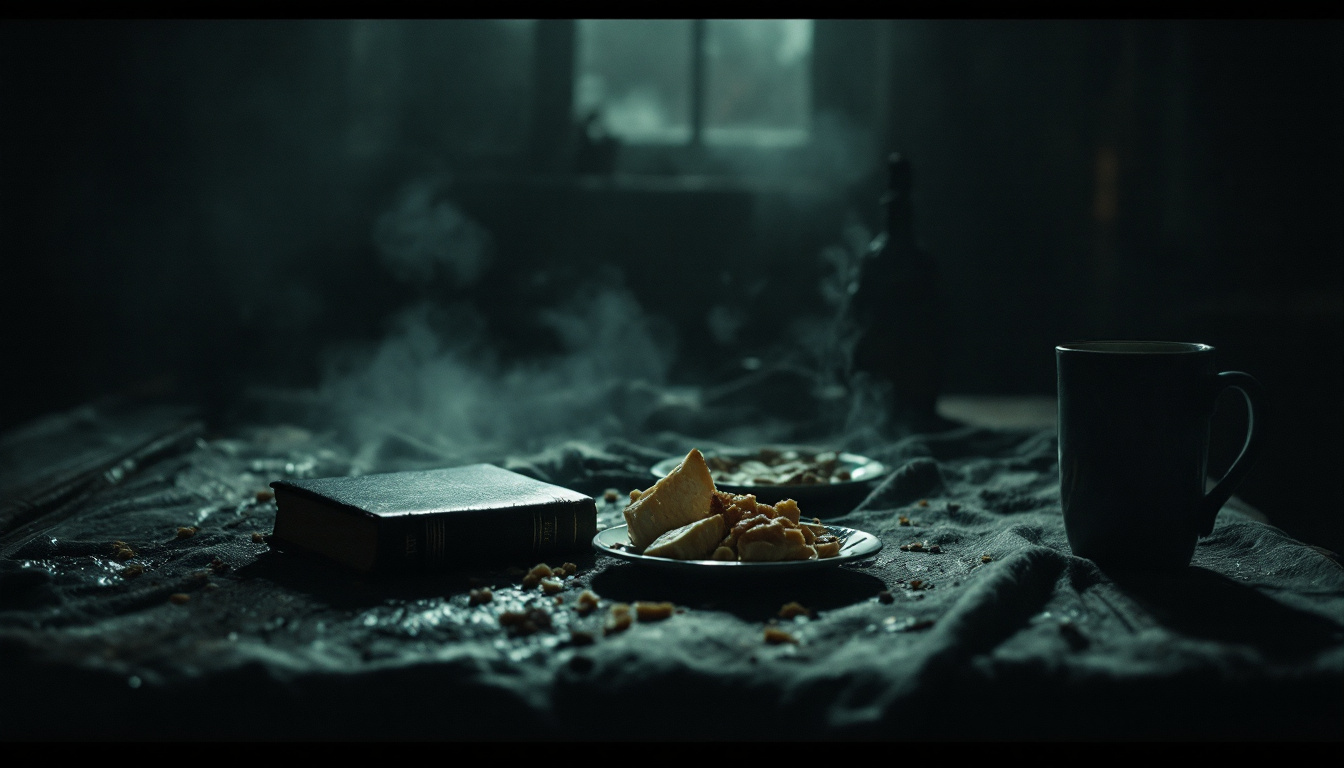
Sit down for a second, because I want you to picture what they walked into. The captain’s cabin was tidy. The bed had been slept in. There were toys on the floor — a child’s playthings, left where she’d dropped them. There was a sewing machine with a piece of work still set in it. On the galley table, according to one early account that has since been embroidered into a thousand retellings, the remains of a meal were laid out. A vial of oil on a sewing table was upright. A bottle of medicine in another cabin was upright, with its cork still beside it. Now I have to be honest with you, because this is where the legend has been polished smooth by retelling — the famous business about “the breakfast still warm on the plates” and “the coffee still steaming in the cups” is almost certainly something writers added later to make a strange story stranger. The actual log of the Dei Gratia‘s mate, Oliver Deveau, was more sober. But even his sober account is bewildering. The ship had been at sea, abandoned, for at least nine days. The weather between her last log entry and her discovery hadn’t been pleasant, but it hadn’t been catastrophic either. Other ships had come through those same waters that week without losing a soul. The Mary Celeste had simply been given up — by experienced sailors, in the middle of the Atlantic, in a ship that was perfectly capable of carrying them to Genoa — and nobody can say why.
The last entry in her own logbook was dated November 25, nine days before she was found, and it placed her about six miles north of an island in the Azores called Santa Maria. After that, nothing. No note. No struggle. No bodies, ever, anywhere — not on the ship, not in the lifeboat she was missing, not washed up on any beach in the Azores, not in any port from there to Gibraltar. Ten people walked or were forced off a working ship in the middle of the ocean and the sea closed over them and never gave a single one of them back.
Now, when the Dei Gratia sailed the Mary Celeste into Gibraltar a few weeks later to claim her as salvage, the British authorities did what authorities do — they got suspicious. The man running the hearing, an Admiralty official named Frederick Solly-Flood, was certain there had been foul play. He had a theory that the Dei Gratia‘s crew had murdered everyone aboard the Mary Celeste to claim the salvage money, and he hunted for evidence to prove it. He found marks on the railings he insisted were axe cuts. He found what he thought were bloodstains on the deck and on one of the captain’s swords. He grilled witnesses for three months. And in the end, none of it held. The “blood” came back from chemical analysis as not blood. The marks on the railings were consistent with ordinary wear and the splintering you’d expect on an old wooden hull. The Dei Gratia‘s crew had no realistic way to overpower a full crew, scrub a ship that clean, and then sail it for hundreds of miles still looking innocent. The court paid out a small, suspicious-feeling salvage award — about a sixth of what the cargo and ship were worth — and washed its hands of the whole thing. No charges. No conclusion. Just a verdict-shaped hole where an answer ought to have been.
And once a story has a hole in it that big, people will fill it. Every generation since 1872 has had its own preferred explanation for the Mary Celeste. Pirates. Mutiny. A sudden waterspout that scared them into the lifeboat. A rogue wave. A seaquake on the Azores ridge that shook the ship hard enough to convince the captain she was breaking apart. The leading “respectable” theory today is the alcohol theory: that nine of the 1,701 barrels in the hold had ruptured and vented fumes into the cargo space, that a small, soundless flash of vapor — what chemists call a “non-explosive deflagration” — burst out of an opened hatch with enough noise and flame to terrify a captain into thinking his cargo was about to blow, and that he ordered everyone into the lifeboat with the chronometer and the papers, planning to tow alongside on a long line until the danger passed. That tow line, the theory goes, parted in a gust. The Mary Celeste sailed away from them with the wind. The lifeboat, small and open, was left behind in the swell, with ten people in it and nowhere to go. And the Atlantic did the rest. It’s a reasonable theory. It fits a lot of the facts. It doesn’t explain all of them. There was no scorching in the hold. The barrels were the kind that vent slowly. And no captain that experienced — Briggs was a temperance Christian, a Mason, a man who’d taken his own wife and child along because he trusted the ship — should have abandoned a sound vessel for an open boat that easily.
Then there are the touches that make the story refuse to die. The captain’s bible was found open on the cabin table — some accounts say to the Book of Psalms, some don’t. The two-year-old’s small dress was found folded neatly across her parents’ bed. Captain Briggs had been an old friend of Captain Morehouse, the man who found his ship — they’d dined together in New York the very week before both ships sailed for Europe on the same general route. There has never been any evidence Morehouse had anything to do with it, but the coincidence has eaten at the story for a century and a half. The Mary Celeste herself was, by all accounts, a hard-luck ship — her first captain died of pneumonia on her maiden voyage, she’d been wrecked once, run aground twice, sold and renamed (her original name was Amazon) — and her hard luck didn’t end at Gibraltar. She went back into service under a new owner, changed hands repeatedly over the next thirteen years as crews refused to sail her, and in 1885 her last captain ran her deliberately onto a coral reef off the coast of Haiti in a clumsy insurance scam. He was caught. He was tried. The ship was abandoned to the reef. Even her ending was disreputable.
So here is where the story stands today, more than 150 years after a brig was found sailing herself across the Atlantic with no one aboard. Treasure hunters and archaeologists have actually located what they believe is the Mary Celeste‘s wreck on that Haitian reef, with timbers and copper sheathing consistent with her construction — so the ship herself, at least, has a known grave. But Benjamin and Sarah Briggs, and little Sophia, and the seven sailors who set out with them from New York Harbor in November of 1872, do not. The ocean kept them. Whatever happened on the Mary Celeste between her last logbook entry and the moment a stranger climbed aboard her empty deck nine days later is a conversation that ten people had, made a decision about, acted on — and then took with them, in an open boat, into water that has never given any of it back. The ship sailed on alone. And one hundred and fifty-three years later, the rest of us are still trying to finish a sentence that was cut off mid-word in 1872.
Unsolved Mystery
