
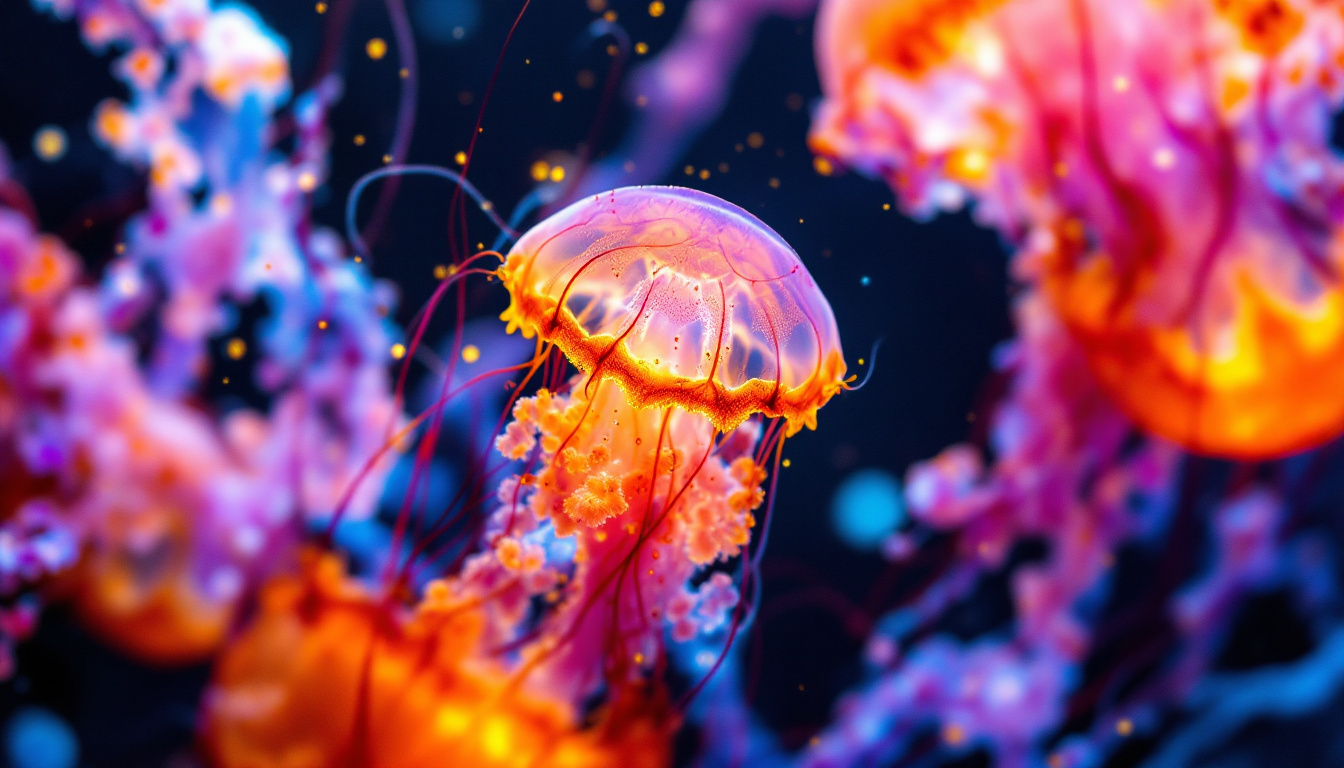
I always filed jellyfish under “blob that ruins a beach day” and never thought about them again. Big mistake. These things are older than the dinosaurs, run their entire lives without a single organ you’d consider essential, and one of them has basically figured out how to cheat death. Here are five facts that completely rewired how I think about the squishiest creature in the ocean.
Did you know one species of jellyfish might be biologically immortal?
There’s a tiny jellyfish called Turritopsis dohrnii — no bigger than your pinky nail — that scientists nicknamed the “immortal jellyfish,” and the nickname is not marketing. When it gets injured, starved, or just old, instead of dying it reverts its cells back to an earlier stage of life and starts over as a baby polyp, like a butterfly turning back into a caterpillar. Then it grows up again. And again. As far as researchers can tell, it can do this indefinitely, meaning it has no built-in expiration date the way the rest of us do. The catch: in the wild they still get eaten or sick all the time, so “immortal” really means “doesn’t die of old age.” Which is still a sentence I had to read about four times.
Did you know jellyfish have no brain, no heart, and no blood — and they’re 95% water?
A jellyfish is one of the simplest animals on the planet, and somehow it’s been crushing it for half a billion years. It has no brain — just a loose net of nerves that handles everything. No heart, because it doesn’t have blood to pump in the first place; oxygen just diffuses straight through its thin body. No bones, no lungs, no real organs to speak of. And roughly 95% of the whole thing is water, which is why a jellyfish washed up on the beach pretty much vanishes once it dries out — there’s barely anything left. The animal is essentially a self-aware bag of seawater, and it’s been running that operating system longer than trees have existed.
Did you know jellyfish are older than the dinosaurs — by hundreds of millions of years?
We think of dinosaurs as the ancient ones, but jellyfish make them look like the new kids. Fossil evidence shows jellyfish have been drifting through the oceans for at least 500 million years — possibly longer — which puts them on Earth hundreds of millions of years before the first dinosaur ever showed up around 230 million years ago. They were here before plants moved onto land. They were here before fish had backbones figured out. The dinosaurs came, ruled for ages, and got wiped out — and the jellyfish just kept on floating, completely unbothered. When you can survive five mass extinctions with no brain and no skeleton, clearly you’re doing something right.
Did you know a group of jellyfish is called a “smack”?
For an animal this strange, it would be a crime to give it a boring collective noun, and thankfully somebody agreed. A group of jellyfish is officially called a “smack.” A smack of jellyfish. (They can also be called a bloom or a swarm, but smack is the one I’m choosing to live by.) And these smacks can get genuinely enormous — some blooms stretch for miles and contain so many jellyfish that they’ve clogged the cooling intakes of power plants and forced them to shut down. There’s something deeply funny about a brainless bag of water taking an entire nuclear facility offline. A smack, indeed.
Did you know jellyfish are among the most venomous creatures on Earth — and we’ve sent them to space?
Two wild facts about the same animal. First, the box jellyfish carries venom potent enough to rank it among the most dangerous animals in the ocean — its sting can be life-threatening, and it has up to 24 eyes scattered around its body despite, again, having no brain to process what they see. Second, and I promise this is real: in 1991, NASA sent about 2,500 jellyfish into orbit aboard the Space Shuttle Columbia to study how they’d develop in zero gravity. They reproduced just fine up there, but the space-born jellyfish came back unable to properly tell up from down on Earth — their gravity-sensing organs never learned how the planet works. So somewhere out there is a generation of jellyfish that were technically astronauts. I don’t know what I expected from the ocean’s simplest animal, but it wasn’t a space program.
Send this to anyone who still thinks jellyfish are just beach blobs — they’re immortal, brainless, half-billion-year-old astronauts, and the truth is way weirder than the sting.
