
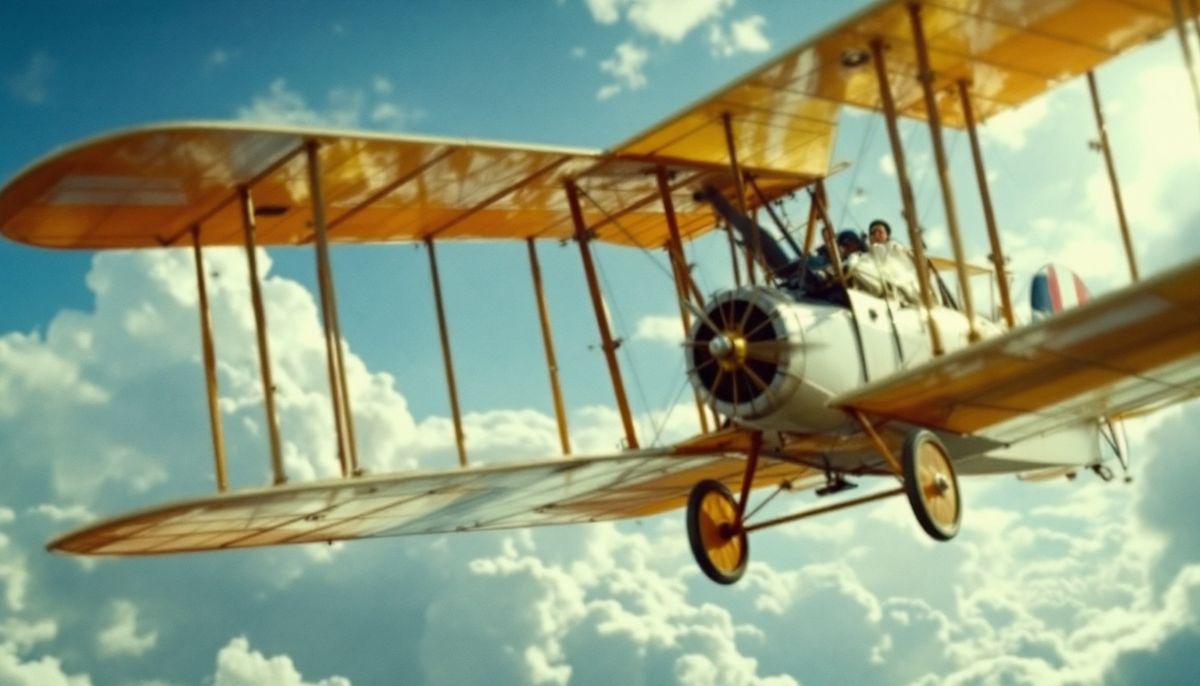
You know the photo — the flimsy flying machine, the man lying flat on the wing, December 1903. But here’s what they don’t put in the caption: the most important 12 seconds in aviation history almost went to the other brother, the famous flight nearly didn’t get photographed at all, and the airplane that started everything spent decades exiled in a museum in England. Two bicycle mechanics from Ohio cracked a problem that had beaten humanity for thousands of years. Here’s the stuff you never learned in school.
1. The first flight lasted just 12 seconds and covered 120 feet.
On the morning of December 17, 1903, on the windswept dunes near Kitty Hawk, North Carolina, the Wright Flyer lifted off and stayed airborne for all of 12 seconds, traveling about 120 feet before settling back onto the sand. That’s shorter than the wingspan of a modern Boeing 747. The most world-changing flight in history would have fit inside a hardware-store parking lot — and it was over before you could finish reading this sentence.
2. They flipped a coin to decide who flew first — and the loser made history.
The brothers tossed a coin to settle who’d take the first crack at piloting, and Wilbur won the toss. But on his attempt a few days earlier, he pulled the nose up too sharply, stalled, and the machine flopped back down after barely getting off the rail. That meant when the famous successful flight finally happened on December 17, it was Orville at the controls. The man in that iconic photograph won immortality because his brother won a coin flip and then blew it.
3. They weren’t scientists or engineers — they ran a bicycle shop.
Wilbur and Orville Wright were two self-taught brothers who owned and operated a bicycle sales and repair shop at 1127 West Third Street in Dayton, Ohio. No college degrees, no government funding, no team of PhDs. They taught themselves aeronautics on the side, bankrolling their flying experiments with profits from selling and fixing bikes. Working from their tinkering with chains, gears, and balance gave them an instinct for a machine that had to stay stable in the air.
4. They built their own wind tunnel because the existing data was wrong.
When the published tables on lift and wing shapes kept steering them wrong, the brothers didn’t give up — they built their own wind tunnel in 1901 and tested some 200 model wing designs themselves. The data they generated was more accurate than anything in print at the time, and it’s a huge reason they beat far better-funded rivals into the air. They didn’t just borrow the science of flight. They rewrote it from scratch in the back of a bike shop.
5. They built their own engine, too — in just six weeks.
No engine maker would supply a motor light and powerful enough for the Flyer, so the brothers turned to their shop mechanic, Charlie Taylor. Working from rough sketches, Taylor designed and hand-built a lightweight aluminum four-cylinder engine in about six weeks. It produced a whopping 12 horsepower — less than a modern riding lawnmower. That tiny homemade engine pushed humanity into the age of flight.
6. They picked Kitty Hawk for the wind, the soft sand, and the privacy.
Dayton, Ohio, was home — so why launch the world’s first airplane on a remote North Carolina beach? The brothers wrote to the U.S. Weather Bureau and chose Kitty Hawk specifically for its steady, strong winds (great for getting airborne), its soft sand (great for crashing without dying), and its isolation (great for keeping nosy competitors and reporters away). It was less a tourist destination than a secret outdoor laboratory.
7. Only five people watched the most important flight in history.
There was no crowd, no press, no dignitaries. Just five witnesses stood on the cold sand that morning: three men from the local U.S. lifesaving station, a nearby businessman, and a teenage boy from the area. One of history’s defining moments unfolded in front of an audience smaller than a backyard cookout. The world wouldn’t fully grasp what had happened for years.
8. The famous photo was taken by a man who’d never used a camera.
Orville set up his camera on a tripod, aimed it at the launch rail, and handed the shutter bulb to John T. Daniels, one of the lifesaving crew — a man who had never operated a camera in his life. Wilbur told him to squeeze it if anything interesting happened. Daniels got so caught up watching the Flyer rise that he wasn’t even sure he’d squeezed the bulb. He had. That accidental snapshot became one of the most reproduced photographs in human history.
9. Neither brother ever married.
Wilbur and Orville both went to their graves as bachelors, married instead to their work. Wilbur reportedly joked that he didn’t have time for both a wife and an airplane. Behind the scenes, their sister Katharine was their fierce supporter — running the household, helping manage the bicycle shop, and nursing them through illness and injury while they chased the sky. The pioneers of flight were a tight-knit family operation, not a romance story.
10. The original 1903 Flyer was exiled to England for decades.
Here’s the strangest twist: the Smithsonian originally credited someone else’s machine as the first capable of flight, in a bitter dispute with the Wrights. Furious, Orville shipped the original 1903 Flyer across the ocean to a museum in London in protest, where the most important airplane ever built sat in exile for years. The Smithsonian finally admitted the Wrights came first, and the Flyer came home — taking its rightful place in Washington, D.C., in 1948. You can still see it there today.
Which one got you — the coin flip, or the airplane that got shipped overseas in a fit of spite? Forward this to the history buff in your life…
