
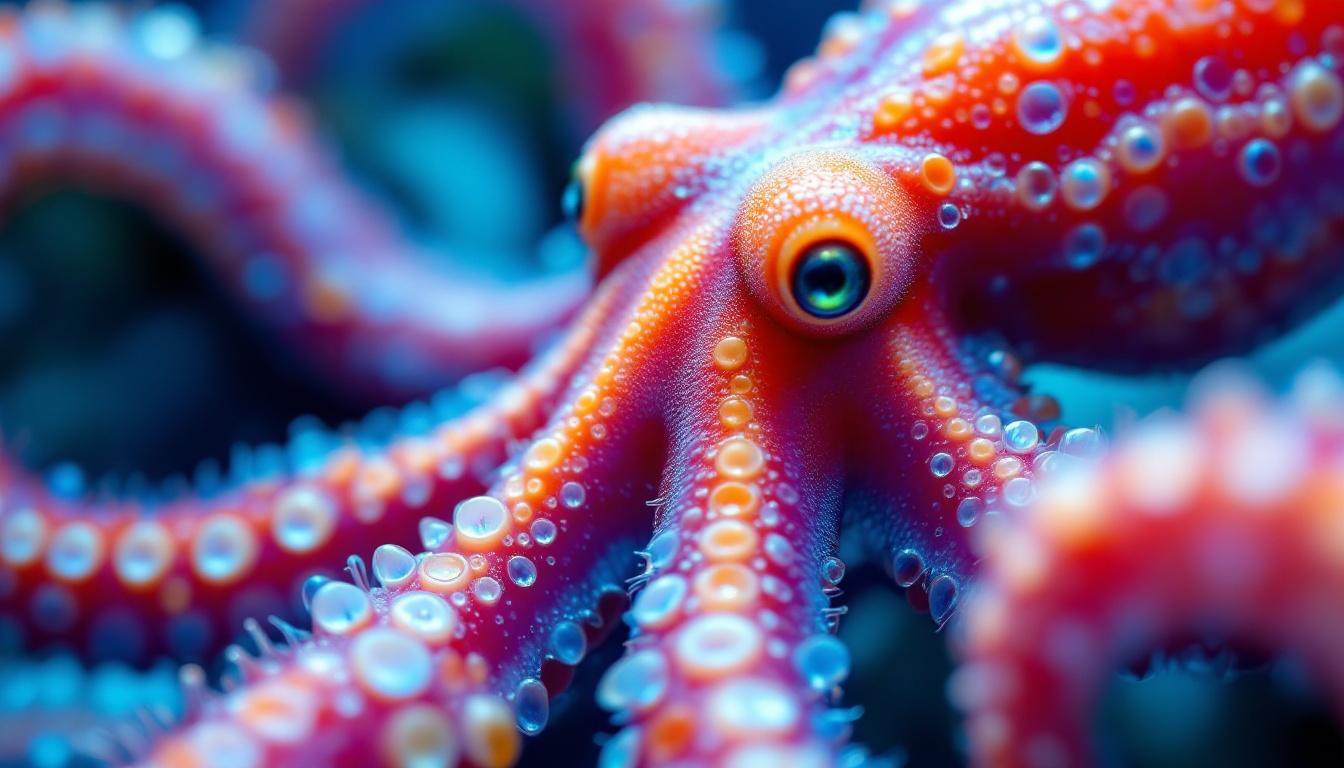
I thought I knew the deal with octopuses. Eight arms, squirts ink, surprisingly smart. Then I started reading, and within twenty minutes I had to put my phone down and stare at the wall for a bit. This is one of the strangest animals on Earth, and almost nothing about it works the way you’d expect.
Did you know an octopus has three hearts — and one of them stops beating every time it swims?
Two of the hearts pump blood through the gills to pick up oxygen. The third pumps that blood out to the rest of the body. Here’s the weird part: that third heart stops beating whenever the octopus swims. Swimming literally exhausts them at the cardiovascular level, which is why octopuses overwhelmingly prefer to crawl along the seafloor instead. An animal that gets winded by its own heart skipping out on the job — and its solution is just to walk everywhere.
Did you know octopus blood is blue, not red?
Our blood is red because it carries oxygen using hemoglobin, which is built around iron. Octopus blood uses a copper-based protein called hemocyanin instead, and copper turns the blood blue when it meets oxygen. It’s not a fashion choice — copper is far better at hauling oxygen around in cold, low-oxygen water, which is exactly where a lot of octopuses live. So the blue blood, the three hearts, and the crawling all connect: it’s one big system built for squeezing every drop of oxygen out of a cold, dark ocean.
Did you know an octopus has nine brains — one central brain and a separate brain in each arm?
About two-thirds of an octopus’s neurons aren’t in its head at all. They’re spread out through its eight arms, with each arm running enough of its own neural circuitry to taste, touch, grab, and make decisions on its own. An arm can be cracking open a clam while the central brain is off investigating a cave, and the two don’t necessarily need to check in with each other. Scientists genuinely debate whether an octopus experiences its arms as part of “itself” or as eight semi-independent partners. Imagine your hand solving a problem and only telling you about it afterward.
Did you know octopuses are colorblind — yet they’re the best camouflage artists on the planet?
Octopuses can match the color, pattern, brightness, and even the texture of their surroundings in under a second. The thing is, their eyes only have one type of light-sensitive pigment, which means they almost certainly can’t see color the way we do. So how do they color-match a world they can’t see in color? Researchers think the answer is partly in their oddly-shaped pupils, and partly in their skin itself — octopus skin contains the same light-detecting protein found in eyes, meaning their skin can, in a real sense, “see” light all on its own. They’re painting a perfect match of a picture they’re not allowed to look at.
Did you know an octopus can rewrite its own genetic instructions on the fly?
This is the one that made me put the phone down. Most animals are stuck with the proteins their DNA tells them to build. Octopuses and their cephalopod cousins can edit their RNA — the working instructions copied from DNA — at tens of thousands of sites, where humans edit maybe a thousand. When the water gets cold, an octopus can crank up this editing and physically retune the proteins in its own nervous system, essentially adjusting its brain to the temperature within about a day. It’s not waiting millions of years for evolution to catch up. It’s doing a software update on itself, this afternoon, because it got a little chilly.
Send this to the friend who thinks an octopus is just a squishy eight-armed sea snack. Three hearts, blue blood, a brain in every arm, perfect camouflage it can’t even see, and the ability to edit its own genetic code on demand. We are not the only clever thing on this planet.
