
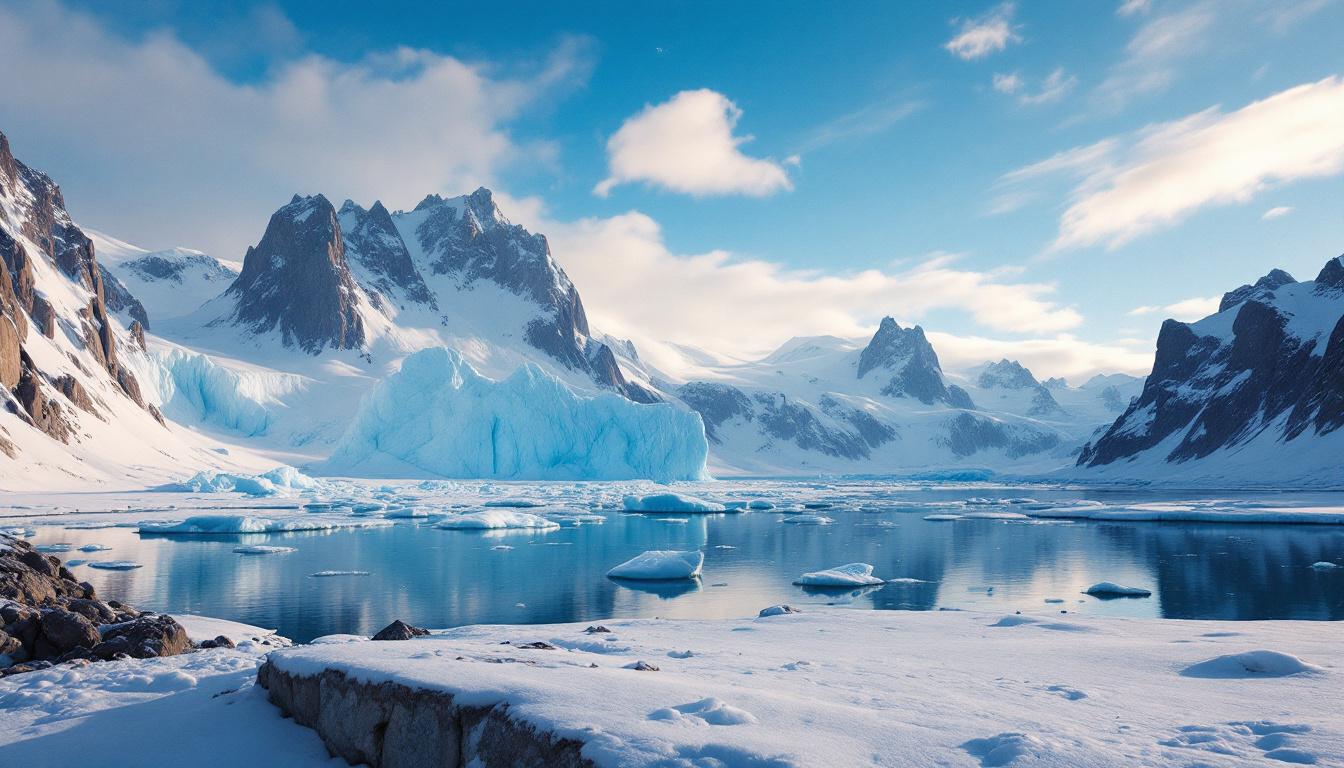
I always pictured Antarctica as one big, boring sheet of white — cold, empty, and basically the same in every direction. Then I found out it’s technically a desert, it has a waterfall that runs blood-red, and 90 million years ago you could have walked through a rainforest there. The bottom of the world is a lot weirder than the bottom of the world has any right to be.
1. Antarctica is the largest desert on Earth.
A desert isn’t defined by sand or heat — it’s defined by how little precipitation falls. Antarctica’s interior gets less than 50 millimeters of moisture a year, drier than Death Valley, which makes the whole frozen continent one giant 5.5-million-square-mile desert. It beats the Sahara by a wide margin. The driest place on the planet is also the one with 90% of the planet’s ice.
2. There’s a waterfall in Antarctica that runs blood-red.
It’s called Blood Falls, and it pours a vivid rust-red liquid out of the Taylor Glacier. For a century nobody knew why — early explorers blamed red algae. The real answer is iron-rich, super-salty water from a lake sealed under the ice for around two million years; when that ancient brine hits the air, the iron oxidizes and the water literally rusts on its way out.
3. It hasn’t rained or snowed in part of Antarctica for about 2 million years.
The McMurdo Dry Valleys are a stretch of bare rock and gravel with almost no ice at all — the largest ice-free zone on the continent. Brutal, dry winds scour away any moisture before it can settle, and scientists believe no significant precipitation has fallen there for roughly two million years. NASA uses these valleys as a stand-in for the surface of Mars.
4. Antarctica has no time zone — and you can walk through all 24 in seconds.
Every line of longitude on Earth converges at the South Pole, so technically the Pole sits in every time zone at once. There’s no natural “right” time, so research stations just use whatever time zone is convenient — often whichever country supplies them. Stand at the exact South Pole and you can shuffle in a tiny circle and cross every time zone on the planet.
5. There are no polar bears in Antarctica — and you can blame the soda ads.
Polar bears live only in the Arctic, at the top of the world. Penguins live in the Southern Hemisphere. The two have never met in the wild and are separated by the entire planet. The reason so many people picture them together is decades of holiday advertising — including a famous soda brand — that cheerfully ignored geography.
6. The coldest temperature ever found on Earth was about -135°F.
Satellites scanning the high East Antarctic plateau clocked surface temperatures near -94°C — roughly -135°F. The official record from a ground thermometer is -89.2°C at Russia’s Vostok Station, set back in 1983. For comparison, that’s a cold so extreme that exposed skin would be in serious trouble in well under a minute.
7. Antarctica has the only ATM at the bottom of the world.
McMurdo Station, the continent’s largest base, has a Wells Fargo ATM — actually two of them, one running and one kept for spare parts. They’re officially the southernmost ATMs on Earth. McMurdo also has a fire department, a hospital, a chapel, and a bowling alley, because a thousand people stuck on the ice still need somewhere to go on a Friday night.
8. Penguins didn’t lose flight because they had no predators — they traded it for swimming.
The popular theory is that penguins forgot how to fly because nothing was chasing them. Research points somewhere else: penguins are spectacular swimmers, and the same body that makes them great underwater — dense bones, stiff flipper-wings, heavy muscle — makes them far too heavy to get airborne. You can be a champion flyer or a champion diver. You can’t be both.
9. Most of Antarctica’s land is actually below sea level.
The ice on top of Antarctica is so staggeringly heavy that it has pushed the bedrock underneath it down — in places more than 8,000 feet below sea level. If you somehow removed all that ice, the land would slowly rebound and rise back up over thousands of years. Right now, a huge chunk of the continent is a landmass being squashed underwater by its own frozen blanket.
10. Antarctica was once a warm rainforest with dinosaurs.
Around 90 million years ago, the South Pole region wasn’t ice — it was a lush, swampy temperate rainforest. Scientists drilling into the seabed pulled up fossilized roots, pollen, and traces of a forest floor, with ancient temperatures estimated around 12°C. Dinosaurs roamed it. The coldest, whitest, emptiest place on Earth used to be green, and that still doesn’t feel real to me.
Which one made you rethink the bottom of the planet? Send this to the friend who still thinks penguins and polar bears are neighbors.
