
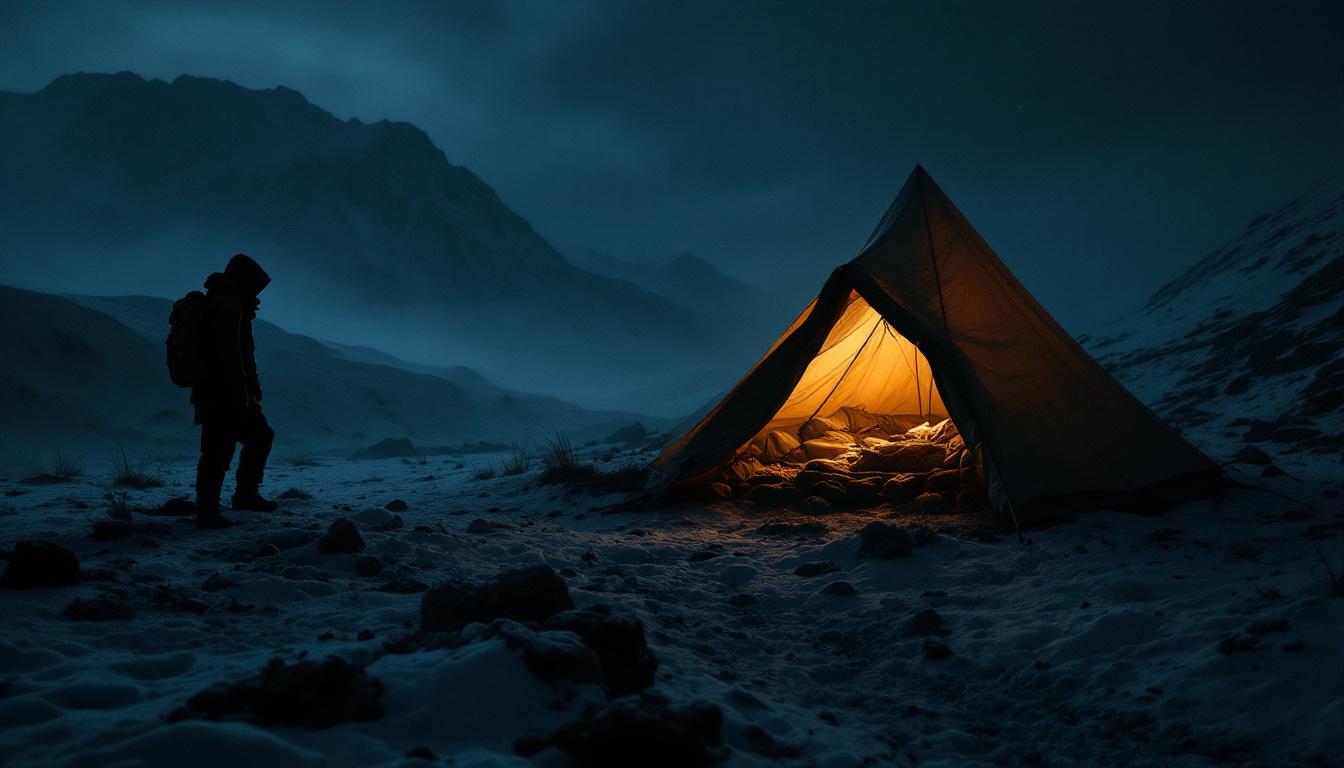
It is the last day of January, 1959, somewhere in the northern Ural Mountains of the Soviet Union. Nine young people are pitching a tent on an open, treeless slope, into a steady wind, with night coming down. They are not lost. They are not amateurs. They are students and graduates from the Ural Polytechnical Institute, every one of them an experienced ski-tourist, and the man whose name we still use for all of this — Igor Dyatlov, twenty-three years old — has led trips harder than this one. They eat. They write in their diaries. Someone snaps the last frames on the cameras they carried. Then they go to sleep.
At some point in the dark, in temperatures that may have reached 40 degrees below zero, every one of them gets up, and instead of unlacing the tent flap the normal way, somebody takes a knife and slashes the canvas open from the inside. And then all nine of them walk out into the snow and the wind, down the slope, away from shelter, away from their boots, away from their warm coats — and not one of them ever comes back to the tent.
Now I want you to sit with that for a second, because that is the whole knot of this thing right there. People do not do that. People who freeze to death do it slowly, miserably, clawing toward warmth. They do not calmly slice a hole in their own tent and stroll off into a polar night in their socks. So before we even get to the bodies — and we do have to get to the bodies — you should understand that the strangeness of the Dyatlov Pass incident is not some legend that grew in the retelling. The strangeness is in the very first facts. It was strange to the people who found them. It was strange to the Soviet prosecutor. It is still strange today.
Here is how it came apart. The group set out in late January with ten members. On January 28, the tenth — a young man named Yuri Yudin — turned back because of joint pain and a bad knee. He hugged his friends goodbye, watched them ski off toward a mountain called Gora Otorten, and went home. That bad knee made him the only one of the eleven who would live a long life. He died in 2013. The other nine pressed on, and on the night of February 1 they made camp on the slope of a peak the local Mansi people called Kholat Syakhl. The name translates, more or less, to “Dead Mountain.” I am not adding that for color. That is genuinely what it is called, and it was called that long before any of this happened.
The group was due back in the town of Vizhay around February 12. When they did not turn up, nobody panicked right away — delays happen on a trip like that. But by February 20 families were demanding action, and on February 26 the searchers found the tent. It was half-buried in snow, and it was empty, and it had been cut open from the inside — that detail was confirmed later by a seamstress who examined the canvas and could tell which way the blade had gone. Inside, everything was eerily orderly. Boots lined up. Clothing folded. Food laid out on a plate as if a meal had been interrupted mid-thought. Whatever sent those nine people running, it had not given them time to dress, but it had not been a fight or a robbery either. They simply left.
The first two bodies turned up about a mile downslope, at the edge of a stand of forest, beneath an old cedar tree. Yuri Doroshenko and Yuri Krivonischenko were lying near the remains of a small fire, stripped down to their underclothes. There were broken branches on the cedar as high as fifteen feet up, as if someone had climbed it — maybe to look back toward the tent, maybe just for firewood. Between the cedar and the tent, scattered along the line of retreat, they found three more: Dyatlov himself, Zinaida Kolmogorova, and Rustem Slobodin. All three were positioned as though they had died trying to climb back up the slope, toward the shelter they had fled. They had died of hypothermia. So had the first two. Five down, four to go — and the last four did not surface until May, when the snow finally melted enough to find them.
And this is the part that turned a tragedy into a 67-year argument. The last four were in a ravine, deeper into the woods, buried under twelve feet of snow, in what looked like a hand-dug snow den. They were better dressed than the others — some of them wearing clothing that had been cut from the bodies of the friends who died first, which tells you these four had outlived the others and were trying, grimly, to survive. But three of those four had injuries that hypothermia does not cause. Nikolai Thibeaux-Brignolles had a fractured skull. Semyon Zolotaryov and Lyudmila Dubinina had massive chest fractures — the kind of crushing force, one investigator said, you would expect from a car crash. And there was almost no external bruising to match. Whatever broke them had pressed, not struck. On top of that, Dubinina’s body was missing its tongue, its eyes, and part of the soft tissue of the face. Zolotaryov was missing his eyes too.
The Soviet investigation, led by a prosecutor named Lev Ivanov, did something else that has fueled six decades of theories: it tested the clothing for radiation. And it found some — beta contamination on a few of the garments, low-level but real. Then, after about three months, the case was closed with one of the great unsatisfying sentences in the history of official paperwork. The cause, the file said, was “a compelling natural force” that the hikers had been unable to overcome. And then the case was sealed, the area was closed to hikers for three years, and the Soviet state more or less changed the subject.
So here is where I have to do my job and separate what is spooky from what is simply sad, because the legend has had decades to grow teeth and not all of them are real. The radiation? It is almost certainly explainable. Two of the men had connections to a nuclear facility — one had lived in a contaminated zone, another had reportedly helped with cleanup work — and the levels found were nowhere near what a weapon test would leave. The missing tongue and eyes are grim, but forensically ordinary: those soft tissues are the first to go to scavengers and decomposition, and Dubinina was found face-down in a meltwater stream for months. The horror of it is real. The mystery of it mostly is not. That leaves the true hard core of the thing — the cut tent, the barefoot flight into lethal cold, and the three crushed-but-not-bruised bodies. That is the part that genuinely resisted explanation for sixty years.
And then, slowly, the explanation arrived — though I would not call the case closed, and I will tell you why. In 2019 Russian authorities reopened the investigation, and in July 2020 a prosecutor named Andrey Kuryakov announced the official modern conclusion: an avalanche. Specifically, a small one, in the dark, that did not bury the tent but threatened to — enough to make nine people cut their way out and retreat downhill to safety in the trees, exactly as they would have been trained to do. The killer, Kuryakov said, was not the snow itself but the visibility: somewhere between 6 and 16 meters that night. They got to the trees. They built a fire. They dug a snow den. And then they could not find their way the 50 or so meters back up to the tent, because they simply could not see it. They froze. Then in early 2021 two scientists, Johan Gaume and Alexander Puzrin, published a study in a Nature journal modeling exactly how a rare “slab” avalanche — a heavy plate of wind-packed snow shearing loose on that particular slope — could have come down on sleeping people and produced precisely those crushing chest and skull injuries, with very little surface bruising, while they lay in their sleeping bags on hard ground.
That is a good answer. It is, honestly, probably the answer. Three separate expeditions since then have confirmed that avalanches really do happen at that spot, which the early skeptics swore was too gentle a slope to slide. But I will be straight with you the way the file never quite was: a model is a model. No one alive saw what happened on that mountain. The 2021 study explains how an avalanche could have done it; it does not prove an avalanche did. The questions the slab theory still has to wave a hand at — why the tent showed no clear avalanche debris, why a trained group fled so far and never made it back — have answers, and the answers are plausible, and they are still answers built after the fact for a night nobody witnessed. So you can take the avalanche, and I think you probably should. But nine experienced people cut open their own tent on Dead Mountain and walked into the dark, and the last word the Soviet Union ever officially gave us for why was “a compelling natural force.” Sixty-seven years later, science has finally told us, with real confidence, what that force most likely was. It has just never quite been able to tell us for certain.
Unsolved Mystery
