
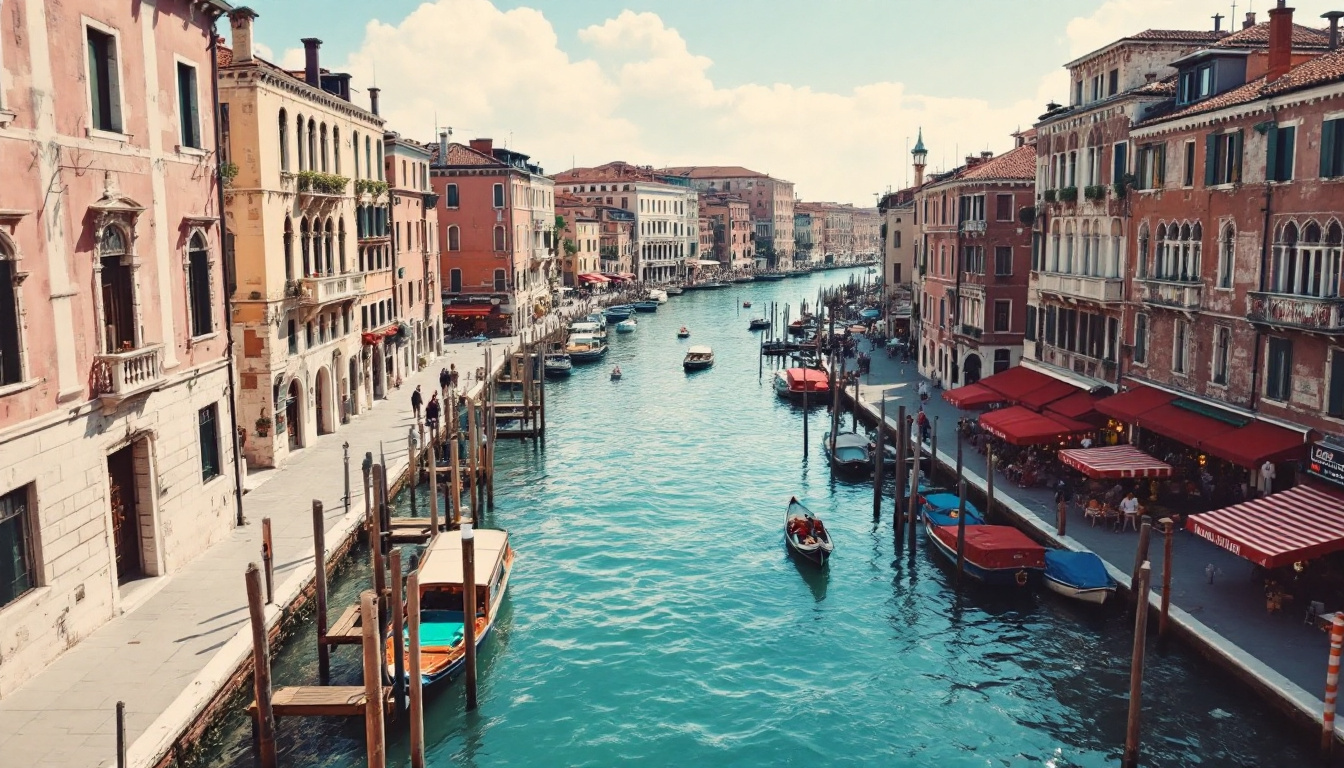
I always pictured Venice as a romantic old city that happened to have water running through it. Turns out it’s stranger than that. The entire city is standing on a forest of tree trunks pounded into mud. The gondolas are deliberately lopsided. And the body of the man the main church is named after was reportedly smuggled out of Egypt by hiding it under a pile of pork. The most photographed city on Earth is a lot weirder than the postcards let on.
1. The entire city is built on millions of wooden poles driven into the mud.
Venice doesn’t sit on solid ground — there isn’t any. The builders drove millions of wooden pilings down through the soft lagoon mud until they hit a firmer clay layer, then laid stone platforms on top and built the city on that. The wild part: because the poles are submerged with almost no oxygen reaching them, they never rotted. Instead, minerals in the water slowly hardened them into something almost like stone. The Basilica di Santa Maria della Salute alone is said to stand on more than a million of these petrified trunks. A whole city held up by a sunken forest.
2. There are no cars. None. Anywhere in the old city.
The historic center of Venice is completely car-free — not “limited traffic,” not “pedestrian-friendly downtown,” but zero automobiles. There’s nowhere to put a road, so everything moves by foot or by boat. Ambulances are boats. Police ride boats. Garbage gets collected by boat. The UPS guy hauls your package up the canal. Visitors drive in, park at the edge of the city, and walk in like they’re entering a different century.
3. Gondolas are deliberately built crooked.
A gondola isn’t symmetrical, and that’s on purpose. The left side is built several inches wider than the right. The reason is brilliantly simple: the gondolier stands and rows from one side only, so the boat is shaped lopsided to counteract that off-center push and keep it gliding straight. Without the built-in tilt, a gondola would just spin in lazy circles all day. The lopsided look you can’t quite see is the whole reason the thing works.
4. By law, gondolas have to be black.
That solemn glossy black isn’t a style choice — it’s the law, and has been for centuries. Back when Venice was rich, nobles competed to out-bling each other with gondolas dripping in gold, silk, and carvings. It got so out of hand that the city passed sumptuary laws ordering all gondolas painted plain black to stop the showing off. The rule basically stuck. So every gondola you see is the result of a centuries-old crackdown on flexing.
5. The word “ghetto” was born in Venice.
In 1516, Venice ordered its Jewish residents to live in one walled-off area of the city. That area sat on the site of a former foundry — and the Venetian word for foundry, or for the slag it produced, was “geto.” The name stuck to the neighborhood, and over the centuries the word spread across Europe and the world to mean any segregated quarter. One small island in Venice gave a word to the entire planet, and not a happy one.
6. The body of Saint Mark was reportedly smuggled out of Egypt under a pile of pork.
St. Mark’s Basilica is named for the evangelist Mark — and the story of how his remains got to Venice is something else. In the 9th century, two Venetian merchants are said to have stolen his body from Alexandria, Egypt, and snuck it past the Muslim customs inspectors by burying it in a barrel under layers of pork, which the inspectors wouldn’t touch or search closely. The relics made it to Venice, the city adopted Mark as its patron saint, and his winged-lion symbol is on flags all over the city to this day.
7. There are around 400 bridges and only about 150 canals.
Venice is famous for its canals, but the bridges actually outnumber them by more than two to one — roughly 400 bridges stitching together a city threaded by about 150 canals. The whole place is built across some 118 small islands, so getting anywhere on foot means a constant up-and-over rhythm of steps and stone arches. For most of history, hardly any of those bridges had railings. You just watched your step or you went for a swim.
8. Venice is slowly sinking AND tilting.
The city is losing the battle with the lagoon on two fronts. It’s gradually subsiding into the soft sediment beneath it, and the whole region is also tilting ever so slightly toward the east. On top of that, the sea around it is rising. Add it up and Venice floods more often than it used to, especially during the high-water events locals call “acqua alta,” when St. Mark’s Square can turn into a literal pond and people cross it on raised wooden walkways.
9. To save it, they built giant flood gates that rise up out of the seafloor.
Venice’s defense against the rising water is straight out of science fiction. It’s a system of huge mobile barriers — 78 enormous hinged gates lying flat on the seabed across the lagoon’s inlets. When a dangerous high tide is coming, they pump air into the hollow gates so they swing up out of the water and form a temporary wall, sealing the lagoon off from the open sea. When the tide passes, they fill with water again and sink back down out of sight. The city literally hides a wall under the ocean and raises it when it needs to.
10. The world’s first state-run public casino opened in Venice 400 years ago.
If you’ve ever lost money in a casino, you can thank Venice. In 1638, the city opened a government-sanctioned gambling house called the Ridotto inside a wing of a palace — widely considered the first public, state-run casino in the world. There was a catch worthy of Venice: to get in, men were required to wear the city’s traditional masks. Everyone gambled anonymously, faces hidden, which is somehow the most Venetian detail imaginable.
Which one made you rethink the postcard version of Venice? Send this to the friend who still thinks it’s just pretty canals and pigeons.
