
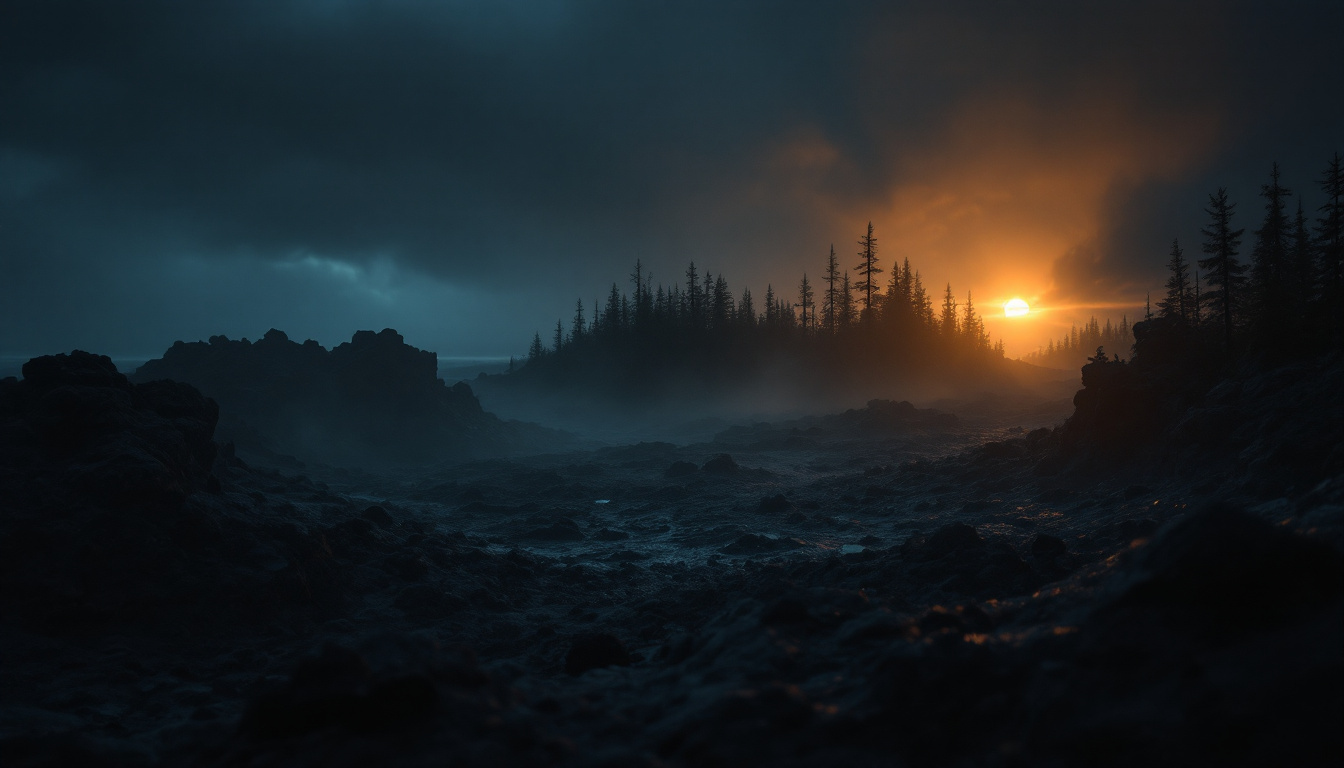
In the summer of 1795, a teenager named Daniel McGinnis rowed out to a little island off the coast of Nova Scotia and went for a walk in the woods. Oak Island isn’t much to look at — about 140 acres, mostly trees, a stone’s throw from the mainland in a place called Mahone Bay. But McGinnis, the story goes, came across something odd in a clearing. There was a depression in the ground, a circular dip in the earth maybe twelve feet across, like the dirt had once been dug up and then filled back in and settled over the years. And right above it, hanging from the branch of an old oak tree, was a ship’s tackle block — a pulley, the kind you’d use to lower something heavy into a hole. A boy on an empty island, standing over a man-made dent in the ground, with a pulley hanging over it. You can guess what a teenager in 1795 thought that meant. Pirate gold. Captain Kidd himself had reportedly sailed these waters. McGinnis went back to the mainland and came back the next day with two friends and a pair of shovels.
Now I want you to sit with what they found, because this is where a kid’s treasure fantasy starts turning into something nobody has ever fully explained. They dug down two feet and hit a layer of flagstones — flat stones that don’t naturally occur on that part of the island. They pulled those up and kept digging. At ten feet down, they hit a platform of oak logs, jammed tight into the walls of the shaft. They pried the logs out and kept going. At twenty feet, another oak platform. At thirty feet, another one. Every ten feet, a floor of logs, deliberately placed, sealing the shaft below it. Three boys with hand shovels eventually gave up — but they were absolutely certain now. Nobody builds a thirty-foot shaft with a fresh log floor every ten feet to hide nothing. Somebody had gone to enormous trouble to bury something on this island, and they’d built it to keep people out. The hole would come to be called the Money Pit. It has never given up its secret, and it has cost at least six men their lives trying.
So here’s the part where the story stops being a campfire tale and becomes a 230-year-long obsession.
The boys came back as grown men with a real company behind them — the Onslow Company, around 1804. This time they had money, crews, and equipment, and they went back down the same shaft. And the platforms kept coming. Oak logs every ten feet. But now they were finding other things between the layers — charcoal, then a layer of putty, then a layer of coconut fiber. Coconut fiber. In Nova Scotia. The nearest coconut palm to Oak Island is roughly fifteen hundred miles south. Somebody had hauled tropical material up the Atlantic coast to line a pit in the cold Canadian north. And then, somewhere around ninety feet down, they hit a flat stone covered in strange carved symbols — figures and markings nobody in the crew could read. The legend says that when the inscription was finally “translated” decades later, it read: Forty feet below, two million pounds are buried. I’ll be honest with you about that translation, because a storyteller has to be — most serious researchers think it was either invented or wildly embellished, and the stone itself vanished generations ago. But the men who were actually standing in that shaft in 1804 saw a carved stone they couldn’t read, ninety feet underground, and it told them to keep digging.
They kept digging. And the next morning, the pit was full of water.
This is the thing that has defeated everyone, for two centuries, and it’s the detail that elevates Oak Island from “an old hole” to a genuine engineering mystery. The water wasn’t groundwater. The crews bailed and bailed and could never get ahead of it — the harder they pumped, the faster it came back, and the water was salt water, rising and falling slightly with the tide. Years later, searchers traced it and made a discovery that still doesn’t have a fully satisfying explanation: there appear to be flood tunnels — channels running from the shoreline at a beach called Smith’s Cove, hundreds of feet away, engineered to carry seawater straight into the pit. At Smith’s Cove itself, low tide revealed something that shouldn’t be there: an elaborate filtering system, layers of that same coconut fiber and eelgrass over a network of stone drains, like a giant man-made sponge feeding water through buried conduits toward the Money Pit. If that’s real — and people have dug it up and stood in it — then somebody didn’t just bury something deep. They built a booby trap. They rigged the entire island so that the moment a digger got close to the prize, the sea would rush in and drown the shaft. Whoever did this had the engineering skill, the manpower, and the sheer patience to weaponize the ocean against anyone who came after them. And nobody knows who they were, or when, or why.
Now think about what it takes to keep men coming back to a hole that fills with seawater every time they reach the bottom. Because they kept coming. For over two hundred years, expedition after expedition has gone after the Money Pit, and the island has slowly eaten them. The original shaft collapsed and got lost — there are now so many overlapping pits and tunnels and bore holes in that one patch of ground that the area is called the “glory hole,” a churned-up mess where nobody can even agree anymore exactly where the first pit was. Drilling crews in the 1800s reported their augers passing through what felt like a chamber, bringing up flecks of gold chain and bits of parchment with old handwriting on them. In the twentieth century, a borehole camera lowered into a flooded cavity supposedly showed what looked like chests and — in one breathless account — a severed human hand floating in the dark water. Take that one however you want; I’m just telling you what the men running the camera said they saw. Six people have died on Oak Island chasing this thing. The first was in 1861, when a treasure-hunt boiler burst and a man was scalded to death. The other five came in 1965, when a searcher named Robert Restall, working at the bottom of a shaft, was overcome by fumes — and his son went down to save him, and then a third man, and then a fourth, one after another, each one collapsing trying to rescue the last. Four men dead in a single afternoon, in a hole on a quiet island, doing nothing more sinister than looking. There’s an old legend on Oak Island that the treasure won’t be found until all the oak trees are gone and seven men have died. Make of that what you will. The count stands at six.
So what’s actually down there? The honest answer is that nobody knows, and the theories run from the believable to the wild. The oldest and simplest is pirate treasure — Captain Kidd, or Blackbeard, or some unnamed crew burying their haul where no government could touch it. Others say it’s the lost payroll of the British or French army, or the looted gold and jewels of the French at Louisbourg, spirited away before the fortress fell. The more romantic theories go bigger: that the pit holds the treasure of the Knights Templar, smuggled out of Europe and hidden in the New World; or the lost manuscripts proving Francis Bacon wrote Shakespeare’s plays, sealed in mercury to preserve them; or even the Ark of the Covenant. Skeptics, meanwhile, make a case that deserves a fair hearing — that there’s no treasure at all, that the “platforms” and the flooding are natural features of a region full of limestone sinkholes and underground caverns, and that two centuries of digging have just been men finding the wreckage of the previous men’s digging and mistaking it for ancient engineering. That theory is tidy, and it might even be right. But it has to explain the coconut fiber, and the worked stones at Smith’s Cove, and the carved inscription, and the fact that the deeper anyone digs, the more the sea fights back. I’m not telling you there’s gold under that island. I’m telling you that a fifteen-year-old found a filled-in shaft with a pulley over it in 1795, and that 230 years, untold millions of dollars, and six lives later, the smartest people who’ve ever looked still can’t agree on whether there’s nothing down there at all — or something so well-defended that the ocean itself was hired to guard it. The hole is still there. It still floods. And it still hasn’t said a word.
Unsolved Mystery
