
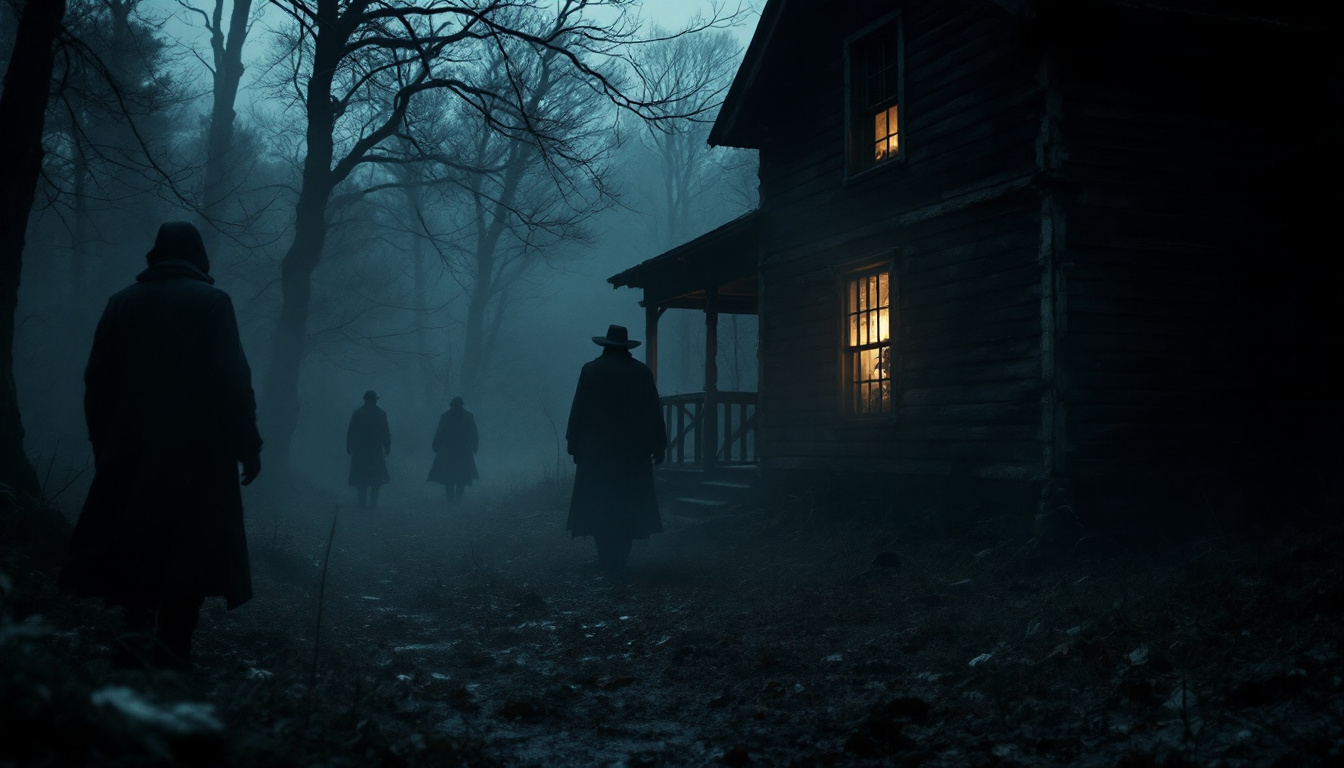
I want you to picture a small farmstead in the dead of a Bavarian winter. It’s called Hinterkaifeck, which isn’t even a town — it’s a single farm, sitting alone behind a hamlet called Kaifeck, about 43 miles north of Munich, hemmed in on one side by dense, dark woods. There’s no electricity. The nearest neighbors are a walk away. And in the last days of March 1922, something began to go wrong out there that, more than a hundred years later, no one has ever been able to explain. So sit with me a minute, because this one gets under your skin.
It started with footprints. The farmer, Andreas Gruber — 63 years old, by most accounts a hard and unpleasant man — told neighbors in the days before the killings that he’d found a set of tracks in the fresh snow. They led out of the forest, straight to the farm. None led back. He found the lock on one of the outbuildings broken. He heard footsteps in the attic at night and went up to search, and found no one. The household keys went missing. A newspaper turned up that no one in the family had bought. And here’s the detail that I’ll be honest with you about — the most famous piece of the legend, the part where the previous maid supposedly quit six months earlier because she believed the house was haunted and heard voices in the attic. That’s widely repeated, and it may well be true, but it lives more in the realm of retelling than hard documentation. What is documented is bad enough: a man telling his neighbors, in the days before his entire family was wiped out, that someone was already inside his house.
On the evening of Friday, March 31, 1922, the killer struck. And the layout of it is what makes the hair on your neck stand up. The investigators later pieced together that the victims were lured, one by one, into the barn — through the stable — and killed there as they came. Andreas. His 72-year-old wife, Cäzilia. Their widowed daughter, Viktoria Gabriel, 35. And Viktoria’s little girl, seven-year-old Cäzilia, named for her grandmother. The weapon was a mattock — a heavy farming pick — and it belonged to the family. It was already on the property. Then the killer walked into the house. In a back bedroom, the new maid, Maria Baumgartner, 44, was murdered in her bed. And in his bassinet, two-year-old Josef.
Now here is the part I genuinely can’t shake, and neither could the people who found them. The new maid, Maria, had arrived that very afternoon. She had been at Hinterkaifeck for a single day. She unpacked her things, met the family, and was dead within hours of walking through the door. Six people. The last of the household to arrive became one of the first to die.
And the killer did not leave. That’s the thing. Whoever did this stayed on the farm. For days. The bodies wouldn’t be discovered until April 4 — four days later — when concerned neighbors finally walked out to check, because the family hadn’t been seen, the children hadn’t shown up at school, and the postman had been leaving mail that nobody collected. When they got there, they found the animals had been fed. Recently. They found that bread had been eaten, that meat had been cut from the pantry, that smoke had been seen rising from the chimney during those silent days. Someone had been living in that house. Cooking in it. Sleeping in it. With six dead bodies stacked in the barn under a layer of hay, and the baby and the maid in the rooms where they fell. The family dog was found alive, tied up. Whoever the killer was, they had been comfortable. Unhurried. At home.
Who would do that? The investigation chased its tail for decades, and the suspect list is its own kind of grim. There were rumors — and these are in the record — that Andreas had been convicted years earlier of an incestuous relationship with his daughter Viktoria, which threw a long, ugly shadow over the question of the children’s parentage and gave the region plenty to whisper about. There was Viktoria’s husband, Karl Gabriel, reported killed in action in France during the war — but his body was never recovered. You can imagine what the theorists did with that one: a dead soldier who was never actually buried, returning to a farm that had moved on without him. There were neighbors, suitors, drifters. More than a hundred people were questioned over the years. The police even sent the victims’ skulls to Munich, where, as the story goes, clairvoyants were consulted over them — and then the skulls themselves were lost during the chaos of the Second World War, so that today the dead can’t even be re-examined with modern forensics. The case was officially closed in 1955. In 2007, a class of police academy students took the whole file apart again with modern investigative methods and reportedly settled on a most-likely suspect — but the police declined to name them, out of respect for living descendants. So even the answer, if there is one, is sealed.
Here’s where I leave you, out on that lonely farm with the woods at your back. They tore Hinterkaifeck down in 1923, the year after — the place erased from the map as if the ground itself were guilty. There’s a small shrine there now, and the woods, and the silence. Six people died there in a single night. And for four days, somebody walked those same floorboards, ate at that table, fed those cows at dawn, watched that chimney smoke curl up into a winter sky — knowing exactly what was waiting out in the barn. We don’t know who. We don’t know why. We don’t even know if they were a stranger from the forest or a face the Grubers had welcomed in. All we know is the footprints went one way: out of the woods, toward the house. And nobody ever found the ones that led back out.
Unsolved Mystery
