
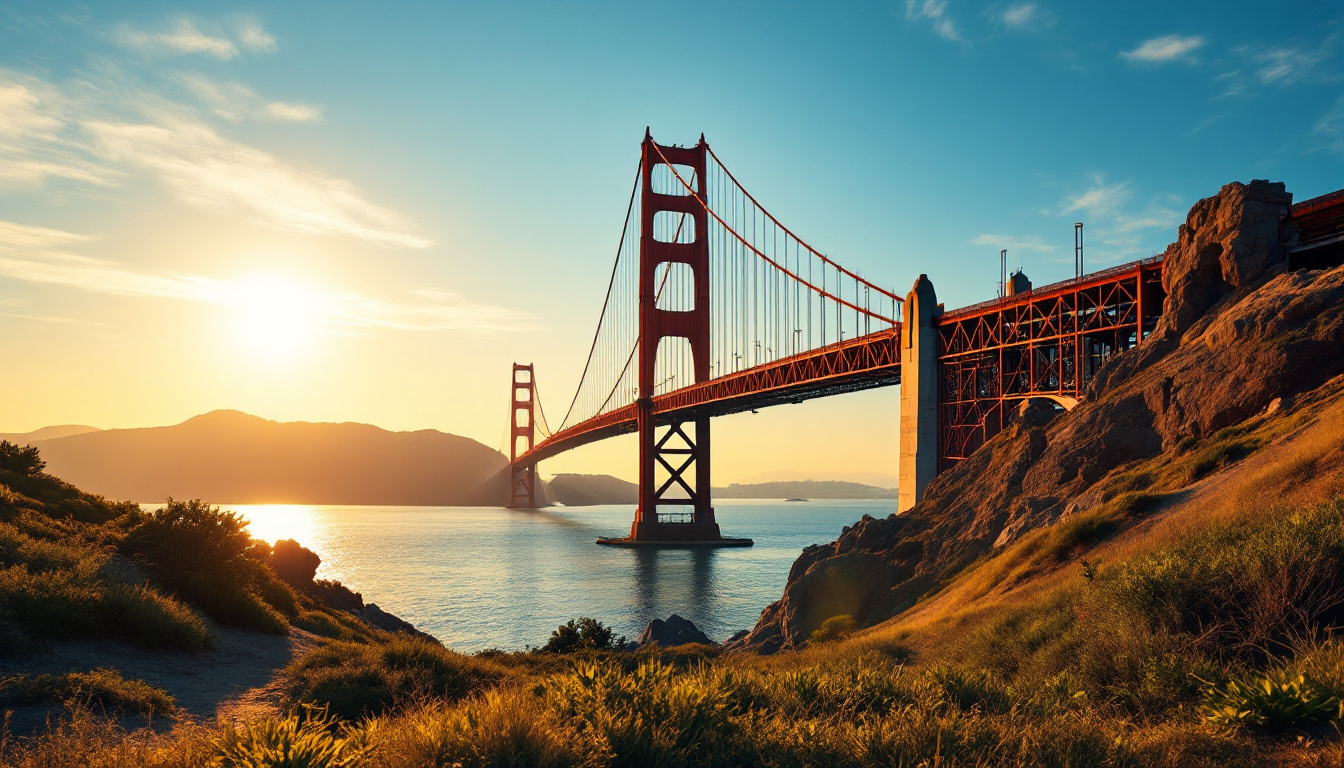
I always assumed that famous orange color was some carefully chosen branding decision. It wasn’t. It was basically an accident nobody bothered to fix. And that’s just the start. The military wanted to paint this thing like a giant bumblebee, the bridge once visibly sagged seven feet under a crowd of humans, and the men who fell off it during construction started their own club. Here are ten things about America’s most photographed bridge that I bet you never learned.
1. The famous “International Orange” color started as a temporary primer nobody meant to keep.
When the steel arrived in San Francisco, it came coated in a burnt reddish-orange primer to protect it from the salt air. Consulting architect Irving Morrow took one look and decided he liked the primer better than any “real” paint color on the table. So the accident became the icon. The most recognizable color in American architecture exists because one guy refused to paint over the undercoat.
2. The U.S. Navy wanted it painted black and yellow with stripes.
For real. The Navy pushed hard for a black-and-yellow striped scheme so ships and planes could spot it in the fog. The Army Air Corps had its own bright idea: red and white candy-cane stripes. Picture pulling up to one of the most beautiful vistas on Earth and seeing a 1.7-mile barber pole. We dodged that one by a hair.
3. The bridge is NOT repainted end to end every year.
This is one of the most repeated “facts” about the bridge, and it’s flat wrong. There’s no parade of painters that finishes one end and immediately starts over at the other. Crews simply spot-paint wherever the salt air has chewed through the coating. The bridge has only been fully stripped and repainted one single time, a project to remove the original lead paint that started in 1968 and didn’t wrap up until 1995. That’s 27 years for one coat.
4. Eleven workers died building it, but a safety net saved nineteen others.
Joseph Strauss insisted on a giant net strung beneath the work deck, which was revolutionary for the era. Nineteen men who slipped and fell were caught by it, and they proudly named themselves the “Halfway-to-Hell Club.” The net wasn’t foolproof, though. Ten of the eleven construction deaths happened in one horrifying instant when a section of scaffold tore straight through the netting.
5. Experts insisted the bridge couldn’t be built at all.
Before a single cable was strung, plenty of engineers declared the project impossible. The strait had ferocious tides, brutal winds, deep frigid water, and fog that swallows everything. Building a span across it was considered a fantasy. They were wrong, but they weren’t crazy. The conditions really were that bad.
6. In 1987, a crowd of people flattened the bridge by seven feet.
For the 50th anniversary, officials opened the deck to pedestrians, expecting a nice walk. Roughly 300,000 people surged on at once, packed so tight nobody could move. The center span, which normally arches upward, sagged seven feet flat under the human weight. Officials slammed the gates shut on the half-million more people still waiting. Suspension bridges don’t snap under load. They bend like a paperclip.
7. The original toll was 50 cents.
When it opened in 1937, crossing cost you 50 cents each way. Today a car pays around $9 or more to make the same trip, and there’s no toll booth left to hand your coins to. It’s all cameras and electronic billing now. Progress, I suppose.
8. Joseph Strauss got the fame, but he didn’t really design it.
Strauss is the name in every history book as the bridge’s chief engineer, and he was a relentless promoter of the project. But the elegant suspension engineering came largely from Charles Ellis, and the gorgeous Art Deco styling came from architect Irving Morrow. Ellis in particular got squeezed out and spent years uncredited. The genius behind the look and the math wasn’t the guy whose statue stands there.
9. More than 1,500 people have died jumping from it.
It’s the heavy truth behind the beauty. Since 1937, the bridge has been one of the most common suicide sites on the planet, with well over 1,500 deaths. Astonishingly, more than 30 people have actually survived the fall.
10. They finally built a net to stop the jumps, and it’s working.
After decades of debate, a stainless-steel suicide barrier net was completed in early 2024, stretching about 20 feet out on each side. The results came fast. Deaths dropped sharply the following year, down from an average of around 30 a year, and thwarted attempts fell off as well. Nearly nine decades after it opened, the bridge finally got its second safety net.
Which one surprised you the most? Send this to the friend who swears they know everything about San Francisco…
