
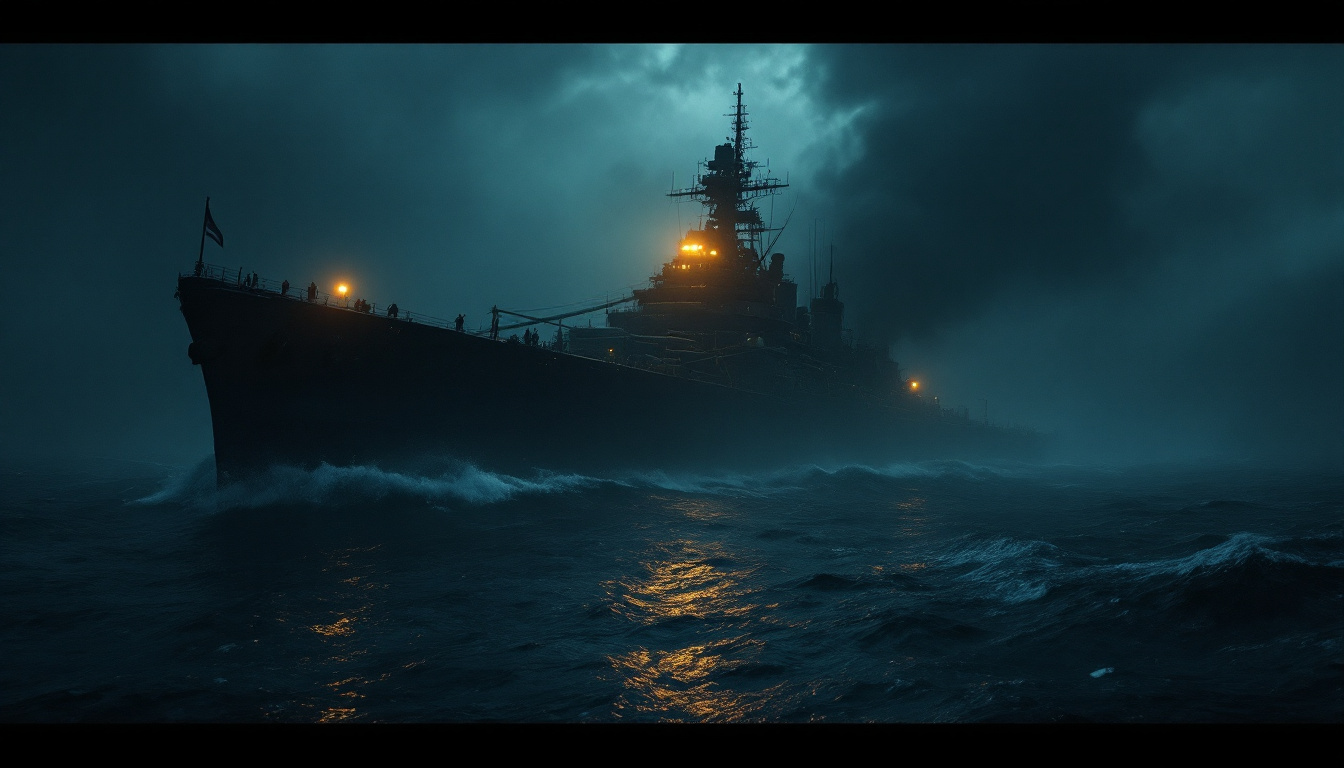
Let me set the scene for you, because this one still gives me a chill. It’s March 1918. The world is at war, German U-boats are prowling the Atlantic, and a hulking American collier — a coal-and-cargo ship — called the USS Cyclops is steaming north out of the Caribbean, riding low and heavy in the water. She’s enormous: 542 feet of riveted steel, one of the largest fuel ships in the Navy, with 306 men aboard and a belly full of dense manganese ore bound for Baltimore. On March 4th, she pulls out of Bridgetown, Barbados, points her bow toward home, and slides over the horizon. And then — nothing. No distress call. No oil slick. No lifeboat. No body. Not one rivet of her has ever been found. To this day she remains the single largest loss of life in U.S. Naval history not directly tied to combat, and the Navy itself, more than a century later, will tell you flatly: we don’t know what happened.
Here’s what we do know, and I want to be careful to keep the facts and the folklore on separate shelves, because this is a story people love to dress up. The Cyclops had crossed the Atlantic to ferry coal to British ships off Brazil, then loaded a heavy cargo of manganese ore at Rio de Janeiro and Salvador. She made an unscheduled stop in Barbados — and that detail matters, because the ship was sitting suspiciously low, her waterline pushed past the Plimsoll mark that warns of overloading. The consul there noted she seemed overburdened, though officials in Rio insisted she’d been loaded and secured properly. She also had a known mechanical fault: her commander had reported that the starboard engine had a cracked cylinder and was running on one engine. So picture her limping homeward, overloaded, half-powered, into a stretch of ocean known for sudden squalls. Then she simply ceases to exist. On June 1st, 1918, a young Assistant Secretary of the Navy named Franklin D. Roosevelt — yes, that FDR — formally declared her lost with all hands.
Now, every great mystery needs a strange captain, and the Cyclops delivered one straight out of central casting. Lieutenant Commander George W. Worley was, by many accounts, a hard, eccentric, and deeply unpopular man — a heavy drinker said to roam the decks at night in his underwear and a derby hat, brandishing a cane, terrorizing his crew. And here’s the part that lit the war-paranoia fuse: Worley was German-born, his real name reportedly Johan Frederick Wichmann, and his closest friends and associates were Germans or Americans of German descent. In a nation gripped by anti-German hysteria, the whispers wrote themselves. Did Worley betray his own ship? Did he steer her to a waiting U-boat, or scuttle her, or sail her quietly to Germany? It’s a delicious theory. It’s also one the records can’t support — no German archive ever recorded taking the Cyclops, and after the war their own naval logs showed no U-boat operating in that area at that time. But you can see how it took root.
So let’s lay the suspects out on the table, the way investigators did. Theory one: a storm. The Naval History & Heritage Command’s official line is that she “probably sank in an unexpected storm.” A weather system did move through the area. Overloaded, listing, running on one engine — a violent enough sea could have rolled her or snapped her overburdened hull. It’s the boring answer, which usually means it’s the right one. But — and here’s my hesitation — a storm bad enough to take down a 19,000-ton ship usually leaves something: a debris field, a swimmer, a body washed ashore weeks later. The Cyclops left none of it.
Theory two is more sinister and, frankly, more mechanically persuasive. That manganese ore was extraordinarily heavy and dense, and there’s evidence it may have been loaded improperly or have shifted. If a heavy cargo slides in heavy seas, a ship can capsize in minutes — too fast to radio, too fast to launch a single boat. And there’s a darker structural twist: the Cyclops had two sister ships, the Proteus and the Nereus. In 1941 — twenty-three years later — both of those sisters also vanished without a trace in the North Atlantic, both carrying heavy metal-ore cargoes. Three nearly identical ships, three identical heavy loads, three disappearances into thin air. That is not the signature of a curse. That, to my eye, is the signature of a fatal design flaw — a class of ship that could break its own back under the right cargo in the wrong sea. The engineers later suspected the longitudinal beams could fail catastrophically. It’s the most rational explanation we have. It’s also, maddeningly, unprovable, because the evidence is at the bottom of the ocean and no one has ever located it.
And then, of course, there’s the legend — because the Cyclops vanished inside what would later be christened the Bermuda Triangle, and the mystery-mongers seized her like a trophy. Sea monsters. Rogue waves swallowing ships whole. Magnetic anomalies. Even, in the wilder corners, alien abduction or a portal to somewhere else. I’ll be honest with you: I don’t buy a lick of it, and you shouldn’t either. The “Triangle” framing came decades after the fact and explains nothing. But I’ll grant the legend this much — it survives because the real answer is missing. Nature abhors a vacuum, and so does the human mind. When the official record says “cause unknown,” we rush to fill the silence with monsters.
What haunts me most isn’t the monsters, though. It’s the ordinary, unbearable absence. Three hundred and six men — sailors, officers, a few passengers including a U.S. consul general heading home — wrote letters, ate breakfast, joked on deck, and then ceased to exist between one horizon and the next. The Navy searched. It investigated for years. The wreck-hunters and the divers and the sonar teams have looked for over a century. And the deep Atlantic has kept every single secret. So when people ask me what really happened to the USS Cyclops, I give them the only honest answer there is — the same one the United States Navy gives. She sailed out of Barbados on the 4th of March, 1918. And nobody has ever known what happened next.
Unsolved Mystery
