On this exact day in 1863, two armies stumbled into each other near a quiet Pennsylvania farm town and accidentally started the bloodiest battle ever fought on American soil. Three days later, the course of the entire Civil War had changed. You probably know the name Gettysburg — but here’s a closer look at the battle, the town, and the hallowed ground it became. Number 6 is the speech that took two minutes and outlived the two-hour speech that came before it.
1. The battle began 163 years ago today — on July 1, 1863.
The Battle of Gettysburg was fought July 1–3, 1863, when Confederate and Union forces collided just outside the small town of Gettysburg, Pennsylvania. Neither commander had planned to fight there. It started almost by accident, as advancing Confederates ran into Union cavalry, and it snowballed into three days that would decide the fate of the nation. So if you’re reading this on July 1, you’re reading it on the very anniversary of the first shots.
2. It was the bloodiest battle in American history.
Over those three days, the two armies suffered somewhere between 46,000 and 51,000 combined casualties — killed, wounded, captured, or missing. That made Gettysburg the bloodiest single battle of the Civil War and the costliest battle ever fought on American ground. To put it in perspective, that’s a small city’s worth of men cut down in 72 hours, on farm fields and rocky hills that are mostly quiet pasture again today.
3. It’s widely considered the turning point of the Civil War.
Up to Gettysburg, Confederate General Robert E. Lee had been winning. His invasion of the North was meant to be the knockout blow. Instead, his army was beaten back and forced into a long retreat to Virginia, and it never mounted another major offensive into Union territory. Historians have called Gettysburg the high-water mark of the Confederacy for good reason — after this, the momentum of the entire war shifted to the Union.
4. The whole thing may have started partly over shoes — but it’s debated.
One of the most famous legends about Gettysburg is that Confederate troops marched into town looking for a supply of shoes and ran into Union forces by surprise. The story traces back to General Henry Heth, whose men engaged first and who later wrote that he’d sent troops to “search the town for army supplies (shoes especially).” Historians have argued about it ever since — there was no actual shoe warehouse — but the colorful tale of a world-changing battle sparked by a hunt for footwear has never quite died.
5. A college professor and a bayonet charge may have saved the Union’s flank.
On July 2, the 20th Maine regiment, led by Colonel Joshua Lawrence Chamberlain — a soldier who in civilian life was a college professor — held the extreme left end of the entire Union line on a hill called Little Round Top. Running low on ammunition after beating back wave after wave of attacks, Chamberlain ordered a bayonet charge that drove the Confederates off. He was later awarded the Medal of Honor for holding that position. If the line had broken there, the whole battle might have gone differently.
6. Lincoln’s famous Gettysburg Address was only about 272 words and lasted around two minutes.
When the battlefield’s national cemetery was dedicated on November 19, 1863, President Abraham Lincoln stood up and delivered a speech of roughly 272 words in about two minutes. The featured speaker that day, Edward Everett, had just spoken for two hours. Yet it’s Lincoln’s brief remarks — “Four score and seven years ago…” — that became one of the most famous speeches in human history. Everett himself later told Lincoln he wished he’d come as close to the heart of the occasion in two hours as Lincoln had in two minutes.
7. Pickett’s Charge sent roughly 12,000 men across open ground — and half didn’t make it back.
On the third day, Lee gambled everything on a massive frontal assault. About 12,000 Confederate soldiers stepped out and marched nearly a mile across open fields toward the Union center on Cemetery Ridge, straight into artillery and rifle fire. The charge — forever known as Pickett’s Charge — was bloodily repulsed in roughly an hour, with about half the attacking force lost. The farthest point they reached is still marked today as the “High-Water Mark of the Confederacy.”
8. The only civilian killed in the battle was a 20-year-old baking bread.
Among tens of thousands of soldiers, just one Gettysburg resident died from the fighting: Mary Virginia “Jennie” Wade, age 20. On the morning of July 3, she was kneading dough to bake bread in her sister’s house when a stray bullet passed through two doors and struck her, killing her instantly. She remains the only direct civilian casualty of the entire battle — an ordinary young woman caught in an extraordinary catastrophe.
9. The battlefield is now one of the largest outdoor sculpture collections on Earth.
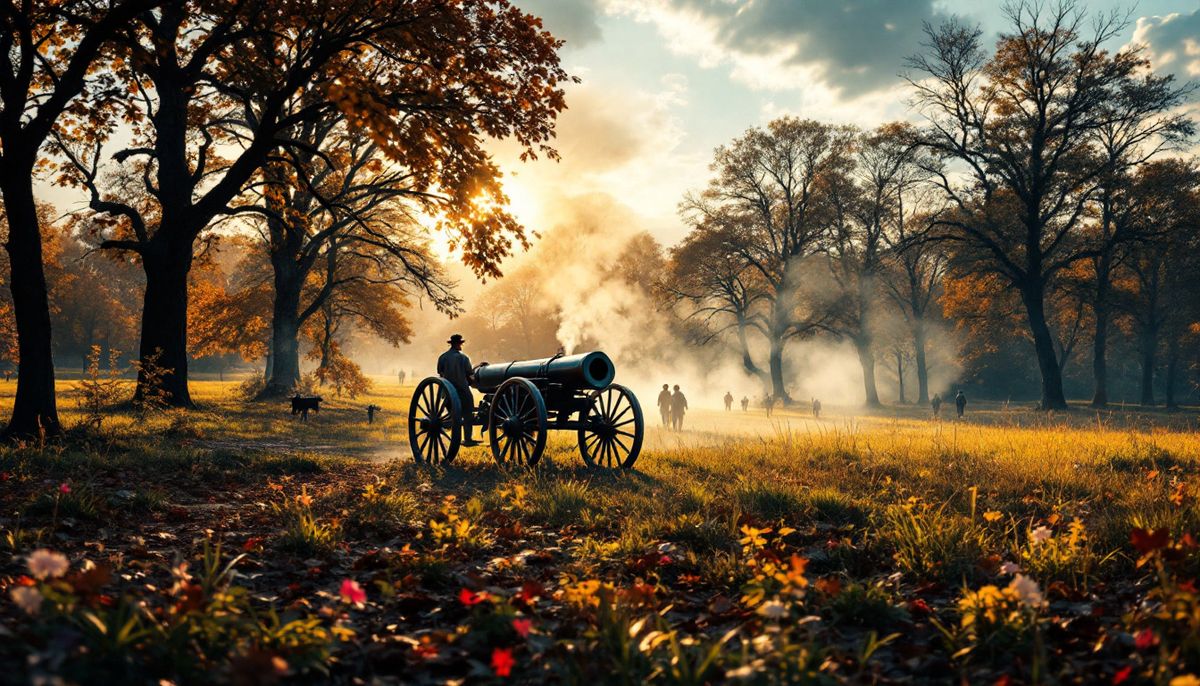
Today the site is Gettysburg National Military Park, established back in 1895. It’s dotted with roughly 1,300 monuments, markers, and memorials — along with hundreds of cannons — placed over the decades by veterans, states, and families to honor the men who fought there. That makes the battlefield one of the largest collections of outdoor sculpture anywhere in the world. People come from all over the globe to walk it.
10. The town of Gettysburg was tiny — and it had to bury the dead for months.
Gettysburg was a modest farming town of only about 2,400 people when the armies arrived. After the battle, those residents were left to cope with thousands of dead soldiers and horses, plus wounded men filling nearly every home, church, and barn. The grim work of burials and care stretched on for months. The need to properly lay the fallen to rest is exactly why the national cemetery was created — and why Lincoln came to dedicate it that November.
Which fact stopped you in your tracks — the two-minute speech, or the only civilian lost? Forward this to the history buff in your life who’d appreciate it…
