
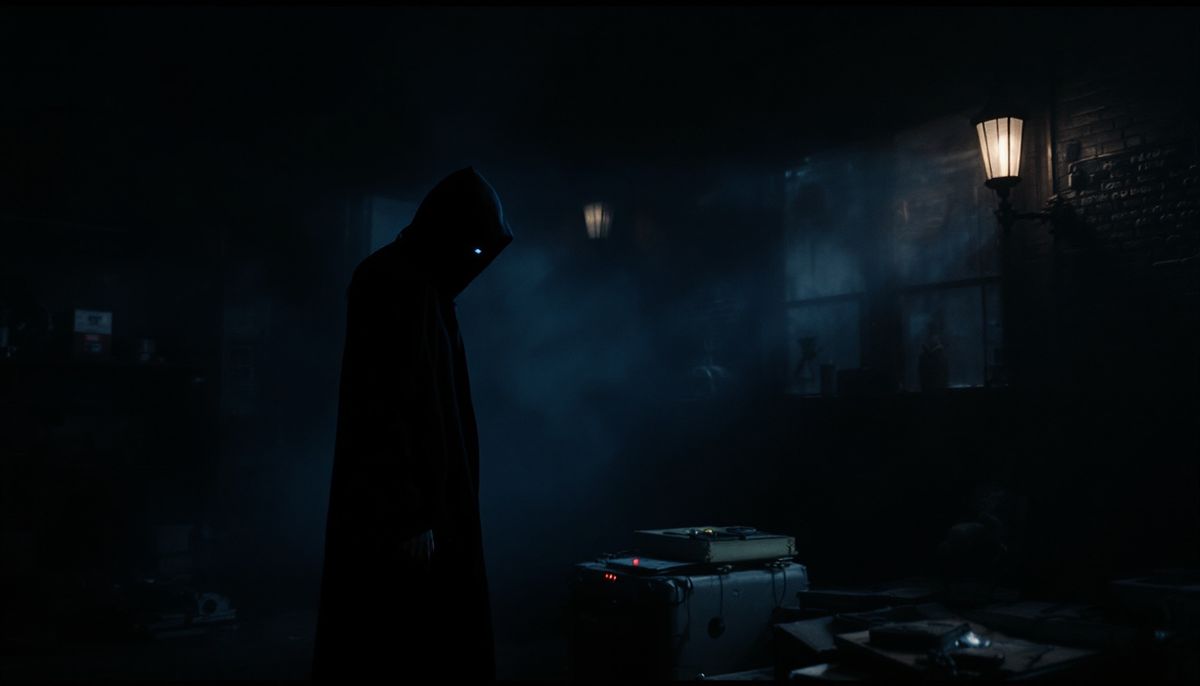
Picture a Sunday night in Chicago — November 22, 1987 — and a city settling in front of the TV the way the whole country still did back then. No streaming, no second screens. Just a few channels and whatever they decided to show you. At 9:14 that evening, WGN-TV was rolling through the sports segment of its Nine O’Clock News when something happened that, almost forty years later, still has no solid answer. The picture didn’t glitch. It didn’t go to static. It went black — and then it surrendered. For about fifteen seconds, the signal beaming into tens of thousands of Chicago living rooms no longer belonged to the station at all. It belonged to a stranger in a mask.
What appeared was a figure wearing a rubber Max Headroom mask — that grinning, plastic-faced computer character who was everywhere in the late ’80s, hawking Coca-Cola and starring in his own show. Behind him, a sheet of corrugated metal spun and swayed, an unsettling backdrop that made the whole thing look like it was broadcasting from somewhere it absolutely shouldn’t be. The figure bobbed and jerked. There was no audio that came through — just the image, lurching, for fifteen long seconds. Then, just as suddenly, WGN was back. The sportscaster, momentarily knocked off the air, did his best to play it off. “Well,” he said on returning, “if you’re wondering what’s happened, so am I.” Nobody in that studio had the faintest idea what they’d just witnessed. And here’s the part that should make the hair stand up: the stranger wasn’t finished for the night.
Let me explain what it actually takes to do what this person did, because once you understand the mechanics, the story stops being a prank and starts being something closer to a heist. A TV station doesn’t broadcast straight from its studio. It sends its program by a focused microwave beam up to a transmitter perched on top of a skyscraper — in WGN’s case, the John Hancock Center — and that tower is what blankets the city. To hijack the signal, you don’t break into the building. You don’t touch a single piece of the station’s equipment. You aim your own microwave transmitter at that tower and you simply overpower the station’s beam. Radio engineers call it the “capture effect”: when two signals arrive on the same frequency, the stronger one wins and the weaker one vanishes, as if it were never there. So somewhere out in the Chicago night, this person had a dish antenna pointed at a downtown skyscraper, pushing out more raw transmitting power than a professional television station — and for those fifteen seconds, the city watched what they wanted the city to watch.
WGN’s engineers, scrambling, managed to fight the intruder off by changing the frequency of the link feeding their transmitter, snapping the city back to the news. But two hours later, the stranger returned — and this time, with the volume up. Around 11:15 p.m., over on WTTW, Chicago’s public television station, viewers were deep into an episode of the British sci-fi classic Doctor Who when the masked figure broke through again. WTTW’s tower sat atop the Sears Tower, a different building entirely, and yet the hijacker reached it just the same. This intrusion ran roughly ninety seconds, and it had sound. The Max Headroom figure rambled and babbled — distorted, hard to follow, weaving in references to the very station he’d just knocked off the air and a popular sportscaster of the day. It got stranger and cruder as it went, ending with the masked man bending over while a partner in a French maid costume swatted his exposed backside with a flyswatter. Then it cut off on its own. Gone. And whoever did it stepped back into the dark of November 22, 1987, never to be seen again.
Here’s where the case turns from bizarre to genuinely unnerving. WTTW’s engineers, that second time, never managed to regain control — the broadcast simply stopped when the intruder decided it would stop. Two different towers. Two different skyscrapers. Two clean hijackings in a single night. This was not a teenager fooling around in a basement. The Federal Communications Commission opened a full criminal investigation, and the agency’s own experts laid out exactly what they were dealing with: someone who needed a dish antenna with a direct line of sight to those downtown towers, professional-grade transmitting equipment that ran into the thousands of dollars, real engineering knowledge, and the nerve to commit a federal crime live on the air, twice, in front of a major city. The FCC chairman at the time called it a serious violation and promised the people responsible would be found.
They never were. The FCC dug. The FBI was reportedly drawn in. Engineers and broadcast insiders were the obvious pool of suspects — who else had this kind of skill? — and yet not one name ever stuck. No tip panned out. No piece of equipment was traced. No confession held up. The five-year window the law allowed for charging anyone quietly expired in 1992, which means that even now, should the masked stranger ever step forward and admit it, there isn’t a court in the country that could touch them. The crime is, in the legal sense, permanently over. And still, after all these years, nobody can say with certainty who that person was, who helped them, or — maybe the most maddening question of all — why. Was it political? Anti-establishment theater dressed up in a cartoon mask? A dare among people who understood transmitters far better than they should have? A grudge against WGN? Take your pick. Every theory is a guess, and every guess hits the same wall.
So that’s where the story leaves us — and it really does just leave us there. A clip you can still pull up and watch today: that lurching mask, that spinning sheet of metal, that garbled voice and the absurd, almost defiant flyswatter ending. Ninety seconds of footage that a stranger forced into the eyes of a major American city across two separate towers on a single autumn night, then dissolved into thin air so completely that the full weight of the federal government couldn’t put a face behind the mask. Most mysteries leave you with a body, a wreck, a clue you can hold. This one left only a recording — proof that it happened, and absolutely nothing about who made it happen. The mask is still grinning. And almost forty years later, it’s still the only face we have.
Unsolved Mystery
