
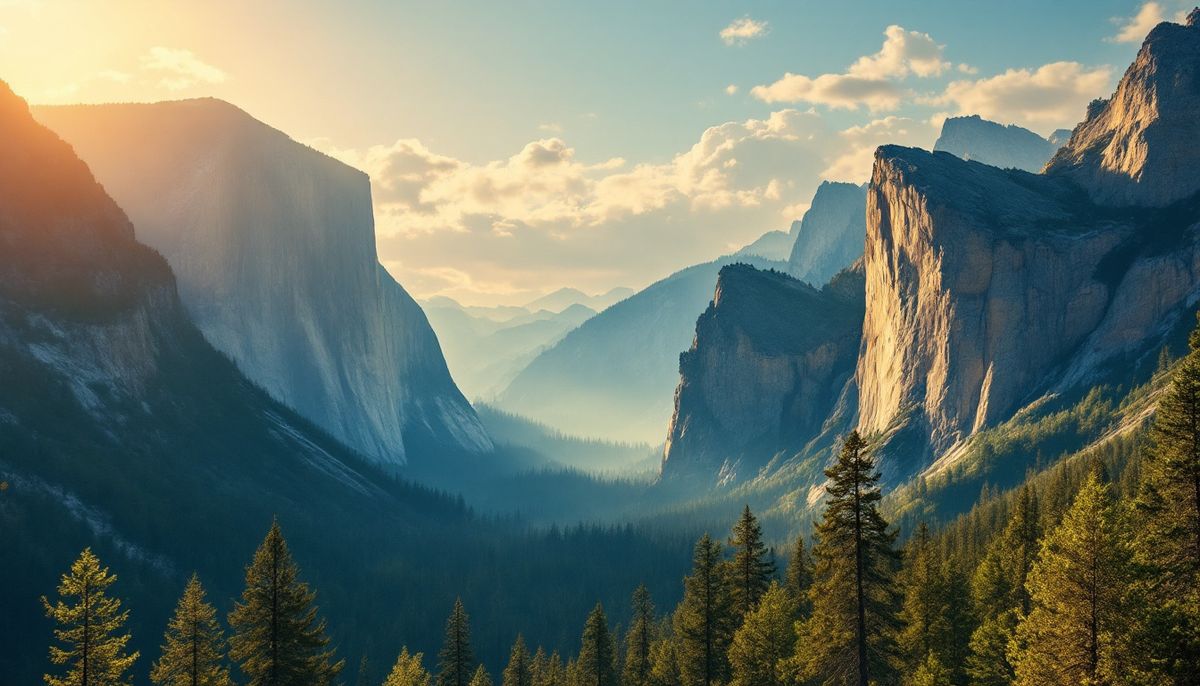
You’ve seen the postcards — the towering granite, the thundering waterfalls, the giant trees older than the Roman Empire. But Yosemite has a stranger, deeper story than its scenery lets on. A president signed it into protection in the middle of the Civil War, before Yellowstone ever existed. One man scaled its 3,000-foot rock wall with no rope and no safety net. And for a couple of weeks every February, one of its waterfalls appears to catch fire. Stick around — number 6 will make your palms sweat.
1. Yosemite is nearly 759,000 acres — and 94% of it is untamed wilderness.
The park sprawls across roughly 748,000 acres of California’s Sierra Nevada, about 1,170 square miles — bigger than the entire state of Rhode Island. But here’s the part that surprises people: 94% of it is designated wilderness, meaning no roads, no buildings, no development. The crowds you see in the famous photos are packed into a tiny sliver of the park. Step a few miles off the beaten path and you’ve got the High Sierra almost entirely to yourself.
2. It was protected by Abraham Lincoln — before Yellowstone was even a thing.
On June 30, 1864, in the thick of the Civil War, President Lincoln signed the Yosemite Grant Act. It was the first time in American history the federal government set aside land specifically to be preserved for the public’s enjoyment. That makes Yosemite the granddaddy of the entire national park idea — it beat Yellowstone, often called “the first national park,” by eight full years. Lincoln found time to save a valley while holding the country together.
3. Yosemite Falls is one of the tallest waterfalls in North America.
Plunging a staggering 2,425 feet, Yosemite Falls ranks among the tallest waterfalls on the continent — roughly the height of two Empire State Buildings stacked on top of each other. It’s actually three drops in one: the Upper Fall, the Middle Cascades, and the Lower Fall. And here’s the catch most visitors don’t know — it can run completely dry by late summer. The thundering wall of water in the spring photos is often just bare rock by August.
4. El Capitan is a single slab of granite about 3,000 feet tall.
El Capitan isn’t a mountain made of layers and rubble — it’s essentially one colossal block of granite rising around 3,000 feet of sheer vertical rock straight up from the valley floor. It’s one of the largest exposed granite monoliths on Earth and the holy grail of rock climbers worldwide. To put the scale in perspective, you could stack two Eiffel Towers against it and still have rock to spare.
5. A retired Guardian discovered the giant sequoias and gave his life to saving them.
In the 1850s, a man named Galen Clark stumbled onto the Mariposa Grove — a stand of giant sequoias, the most massive living things on the planet, some over 2,000 years old. Clark became so devoted to protecting them that when California took over the land, he was named the official “Guardian of Yosemite,” a job he held for decades. He lived to 96, much of it spent defending trees that had already stood for two millennia before he was born.
6. Alex Honnold climbed El Capitan with NO rope — in under four hours.
On June 3, 2017, climber Alex Honnold did what was considered humanly impossible: he scaled El Capitan’s 3,000-foot face completely free solo — no rope, no harness, no safety gear of any kind. One slip meant certain death the entire way up. He topped out in just 3 hours and 56 minutes. The feat was captured in the documentary Free Solo, which won the Academy Award for Best Documentary in 2019. It remains one of the most jaw-dropping athletic achievements ever recorded.
7. For a few weeks each February, a waterfall looks like it’s on fire.
It’s called the “firefall,” and it’s pure natural magic. For a brief window in mid-to-late February, the setting sun hits Horsetail Fall on the side of El Capitan at exactly the right angle — and the falling water lights up a glowing molten orange and red, like lava pouring off the cliff. The conditions have to line up perfectly: enough water, a clear sky, the right sunset. Photographers travel from around the world and line up for hours hoping to catch it.
8. Half Dome rises nearly a mile above the valley floor.
That iconic sheared-off granite dome towers about 4,800 feet above Yosemite Valley — close to a vertical mile. Daring hikers can actually summit it, but the final stretch is so steep that the park installed steel cables to haul yourself up by hand. The round-trip hike runs 14 to 16 miles and climbs nearly a mile in elevation. It’s one of the most coveted — and grueling — day hikes in all of America.
9. A camping trip here quietly reshaped the entire country.
In 1903, naturalist John Muir took President Theodore Roosevelt on a three-day camping trip through Yosemite — just the two of them, sleeping under the stars and the giant sequoias, even waking up under a dusting of snow. Around the campfire, Muir made his case for protecting America’s wild places. Roosevelt listened. The trip helped ignite his conservation crusade — he went on to protect roughly 230 million acres of public land. One campout. A nation’s worth of consequences.
10. It became a full national park in 1890 — with John Muir leading the charge.
Even after Lincoln’s 1864 grant, the surrounding land was still being chewed up by logging and grazing. Writer and naturalist John Muir campaigned relentlessly, publishing articles pleading for its protection. His advocacy paid off: in 1890, Congress established Yosemite National Park, expanding protection to the high country and forests around the valley. Today over 3 million people visit each year — most of them having no idea they owe the view to a stubborn Scotsman with a notebook.
Which one got you — the rope-less climb, or the waterfall that turns to fire? Forward this to the friend who keeps saying they’ll “finally do that Yosemite trip” this year…
