
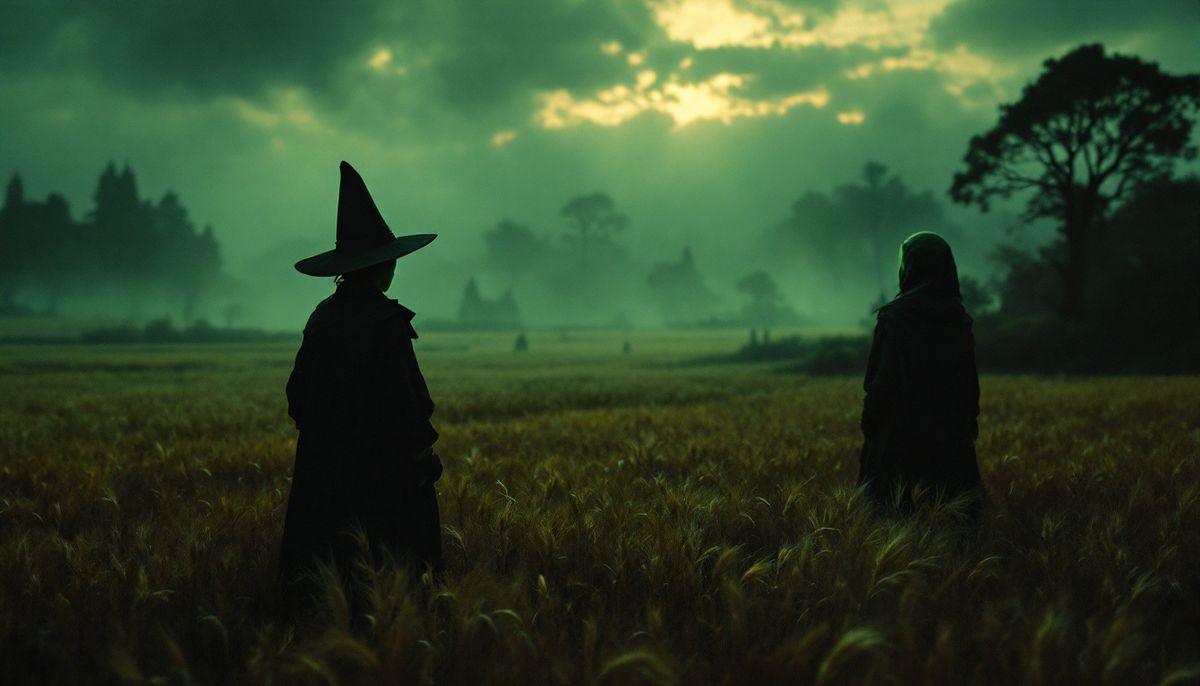
Picture a wheat field in the English county of Suffolk, sometime around the year 1150. The country is in chaos — this is the period historians call the Anarchy, a grinding civil war for the crown that left the land lawless and hungry. The village is called Woolpit, a name that comes from the Old English for “wolf pits,” the deep trenches dug nearby to trap the wolves that still roamed medieval England. It’s harvest time. And out of one of those pits, or near them, the reapers find something that will be written down, argued over, and never quite explained for the next eight hundred years.
Two children. A boy and a girl, by the look of them brother and sister. They are frightened and disoriented, dressed in clothes of an unfamiliar cut and material. They speak to each other in a rapid language no one in the village can understand. And their skin — this is the detail that has carried the story across the centuries — their skin is green. Not pale, not sickly-looking. Green. The reapers, not knowing what else to do with two strange green children who appeared out of nowhere, bring them to the home of a local knight, Sir Richard de Calne, at his manor at Wikes.
Here’s why this isn’t just a campfire tale. The story comes down to us from two real, respected medieval chroniclers — the kind of men whose other writings historians still rely on. Ralph of Coggeshall was a Cistercian abbot whose monastery sat about twenty-six miles from Woolpit; he recorded the account in his Chronicon Anglicanum, and he named his source as Sir Richard de Calne himself, the very man who took the children in. The other chronicler, William of Newburgh, was a respected historian writing far to the north in Yorkshire, who folded the tale into his Historia rerum Anglicarum — his “History of English Affairs.” Two independent men, in two different parts of England, both thought this odd little story was worth setting down in ink alongside the wars and reigns of kings. That’s what separates Woolpit from a thousand forgotten village rumors. Serious people wrote it down, and they wrote it down as something that had actually happened.
According to those accounts, the children refused to eat. The villagers offered them bread and meat and the ordinary food of the household, and the children turned all of it away — they were starving, but they would not touch any of it. Then someone brought in freshly cut beanstalks, and the children seized them eagerly, splitting open the stalks looking for the beans inside. When they found them empty, they wept. Shown that the beans were in the pods, not the stalks, they finally ate. And for a long while, raw broad beans were the only thing they would eat. The boy, described as the sickly and weaker of the two, declined and died not long after the children were baptized. But the girl lived. She slowly adjusted to ordinary food, lost her green color as the months passed, learned to speak English — and once she could be understood, she finally told them where she and her brother had come from.
This is the part of the story that turns it from strange to haunting. The girl said they were from a place called St. Martin’s Land, a country where everyone was green-skinned like them and where the sun never properly rose — it was a land of perpetual twilight, lit by a faint glow, never full day and never full night. She said they had been tending their father’s flock when they followed their animals into a cavern and heard, beyond it, the sound of bells. Drawn by the sound, they wandered through the dark until they emerged, blinking and bewildered, into the dazzling sunlight of the Woolpit harvest field — and could not find the way back. Whatever you make of it, sit with the image for a second: two children stepping out of an underground twilight into the blinding light of a strange world, and never being able to go home again.
So what really happened? The leading rational explanation is, in its own way, almost as poignant as the legend. Remember the time and place. In the twelfth century, Flemish immigrants — weavers and cloth-workers from Flanders, in what’s now Belgium — had been settling in eastern England, including the area around Bury St Edmunds, not far from Woolpit. They were foreigners. They spoke a West Germanic dialect that Anglo-Saxon English villagers would not have understood — which would account neatly for the “unknown language.” And they were not welcome for long. Flemish settlers were persecuted, displaced, and in one grim episode many were killed near Bury St Edmunds. The theory goes that these were two orphaned Flemish children, separated from their people during the violence and chaos of the Anarchy, who wandered lost and half-starved until they stumbled into Woolpit speaking a tongue no one there could place.
And the green? That likely points to a real medical condition. There’s a form of severe iron-deficiency anemia historically known as chlorosis — quite literally “green sickness” — that can tint the skin a pale greenish hue, and it was associated with malnutrition. Two children surviving on a wretched diet in the woods could plausibly have developed it. The detail that makes this theory click into place is one the chroniclers themselves recorded without realizing its significance: as the surviving girl began eating a normal, nourishing diet, her green color faded and her skin returned to ordinary tones. That’s exactly what you’d expect if the “green” was a symptom of starvation rather than a feature of some otherworldly race — heal the malnutrition, and the color disappears.
It’s a tidy explanation. Lost refugee children, an unfamiliar language, a deficiency disease that fades with good food. And honestly, it probably gets close to the truth. But notice what it leaves on the table. It doesn’t fully explain the bizarre fixation on raw broad beans to the exclusion of all other food. It doesn’t explain the strange, specific, dreamlike testimony about St. Martin’s Land and the country of perpetual twilight — a story too odd and too particular to feel like a simple lie. And it rests on accounts written down decades after the fact, by chroniclers who, however serious, were also working from secondhand memory and the credulity of their age. The records are real. What lies underneath them, we are reconstructing across eight centuries of distance.
That’s the strange gravity of the Green Children of Woolpit. It’s not a story that demands you believe in another world beneath our own — the down-to-earth answer is right there, and it’s a good one. It’s that even the down-to-earth answer can’t quite scrub away the residue of the original account: two green-skinned children, weeping over empty beanstalks, one of them dying in a strange land, the other surviving long enough to describe a twilight country she could never return to. Sir Richard de Calne believed it enough to repeat it to an abbot who wrote it in his chronicle. So did a historian a hundred miles away. They couldn’t explain it. Eight hundred years later, with all our science, we’ve explained almost all of it — almost. And it’s that last unexplained sliver, the part the tidy theory can’t quite reach, that keeps two green children walking out of a medieval wheat field and into our imaginations, again and again, year after year.
Legend & Mystery
