
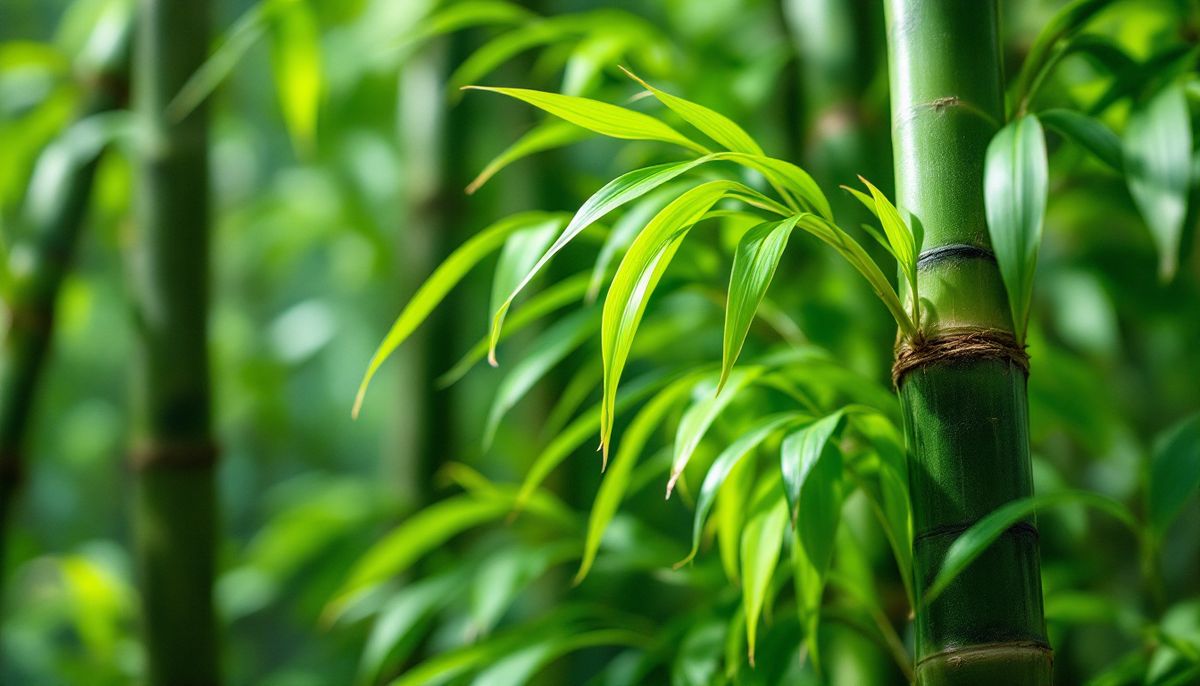
I used to lump bamboo in with trees, picture a panda gnawing on it, and call it a day. Then I started reading, and it turns out this plant is one of the strangest, most overachieving things growing on the planet. It’s not a tree, it grows fast enough that you could practically watch it, and it’s doing structural work on buildings taller than anything in your city. So before you write off the stuff in your neighbor’s backyard, here are five true things about bamboo that genuinely caught me off guard.
Did you know bamboo isn’t a tree at all, it’s a grass?
This was the one that broke my brain a little. For all its height and that hard, woody look, bamboo is botanically a grass, a member of the same big family as the stuff in your lawn, wheat, and corn. It just happens to be the giant of the family, with over 1,000 species spread across the world. That’s why it grows from a network of underground stems and shoots up in those distinct hollow, jointed canes instead of forming a trunk with rings like an oak. So technically, when you walk through a towering bamboo grove, you’re walking through really, really tall grass. Somewhere, a lawnmower is feeling very inadequate.
Did you know some bamboo can grow nearly three feet in a single day?
Bamboo isn’t just fast for a plant, it’s the fastest-growing plant on Earth, full stop. According to Guinness World Records, certain species have been clocked growing up to 35 inches in a single day. That’s almost three feet of new growth in 24 hours, which works out to roughly an inch every 90 minutes. Under ideal tropical conditions, a few of the speediest species can shoot up something like 20 feet in a single week. The reason it can pull this off is clever: a bamboo cane already has all its segments formed when it emerges, so instead of building new cells the whole time, it’s mostly just elongating segments that are already there, like a telescope extending. If your grass grew that fast, you’d need to mow it twice before lunch.
Did you know many bamboo species flower only once every several decades, then die all at once?
This one sounds made up, but it’s one of the great mysteries of the plant world. Many bamboo species spend their entire lives in a leafy, non-flowering state for decades, sometimes 65, 120, even up to 130 years. Then, in an event botanists call “gregarious flowering,” they bloom. And here’s the eerie part: every plant of that species flowers at nearly the same time, even ones planted thousands of miles apart in completely different countries. After they flower, set seed, and reproduce, the whole population dies off together, all at once. Scientists still don’t fully understand what biological clock triggers it. Imagine plants on opposite sides of the globe, separated for over a century, all deciding to bloom and die in the same season. Nature pulling off a synchronized exit and not explaining how.
Did you know a giant panda’s diet is about 99% bamboo?
Pandas and bamboo are basically a package deal. A giant panda’s diet is roughly 99% bamboo, and an adult can put away as much as 50 pounds of the stuff a day, working through the leaves, stems, and tender shoots for hours on end. Here’s the weird twist: the panda’s digestive system is actually built like a meat-eater’s, not a plant-eater’s, so it does a pretty lousy job of extracting nutrition from all that fiber. That’s exactly why pandas have to eat such enormous quantities to get by. They’ve even evolved a “pseudo-thumb,” an enlarged wrist bone, just to grip the canes while they chow down. It’s one of the strangest mismatches in nature: a carnivore’s gut committed full-time to eating grass.
Did you know bamboo is strong enough to build scaffolding on skyscrapers?
In much of Asia, and Hong Kong especially, workers wrap towering modern skyscrapers in scaffolding made entirely of bamboo lashed together by hand, no steel poles required. We’re not talking about a backyard shed here. Bamboo scaffolding has gone up around 50-story buildings and even landmark high-rises like the HSBC headquarters and parts of the 88-floor International Finance Centre. It works because bamboo is light, flexible, fast to assemble, and pound-for-pound remarkably strong, with skilled crews able to throw it up faster and cheaper than metal. The technique goes back roughly 2,000 years to the Han dynasty. So the same plant a panda is munching is rated to hold up workers hundreds of feet in the air. That’s grass doing the job of steel.
Send this to the friend who keeps calling bamboo a tree… they’re about to find out it’s just extremely ambitious grass.
