I’ve always thought of owls as the quiet, brooding professors of the forest, perched up there looking wise and judging me. Then I started reading about how they actually work, and it turns out the truth is even stranger than the storybook version. These birds are basically built like silent assassins with night-vision and surround sound. So before the next one stares you down from a fence post, here are five true things about owls that genuinely rearranged my brain.
Did you know an owl can rotate its head about 270 degrees because it can’t move its eyes at all?
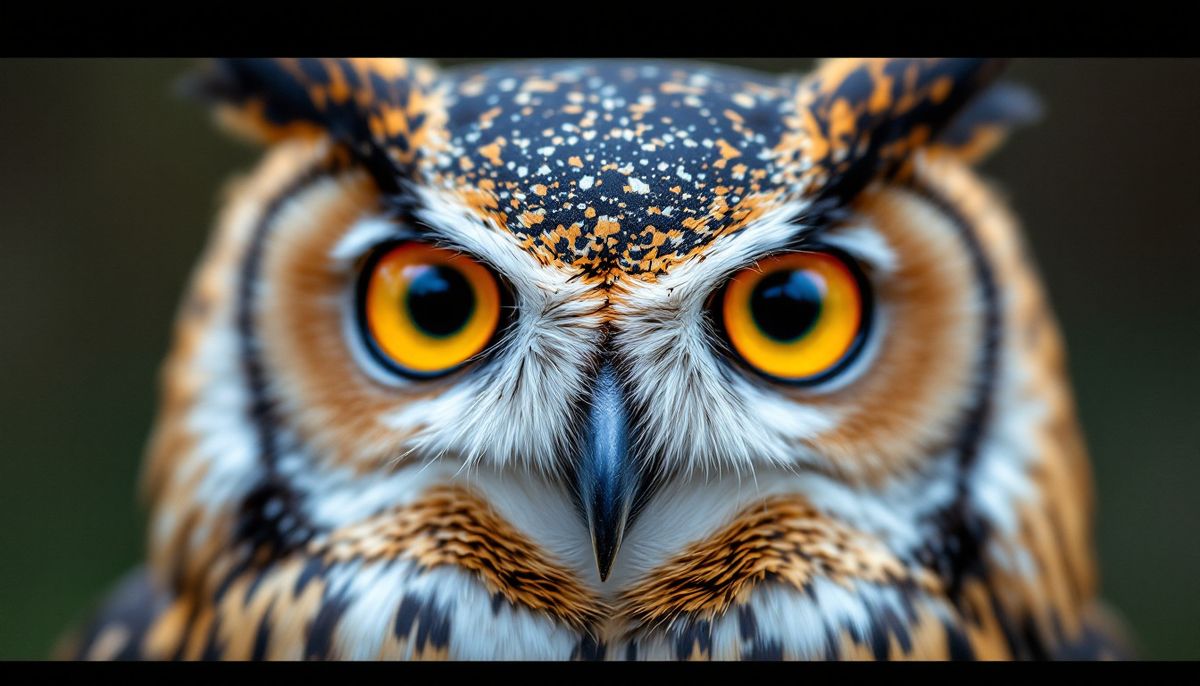
This is my favorite owl fact because it solves a mystery I didn’t know I had. An owl’s eyes aren’t round balls that swivel in the socket like ours. They’re shaped like long tubes, locked rigidly in place by a ring of bones, which means the owl literally cannot roll or dart its eyes. It can only stare straight ahead. So how does it look around? It turns its whole head, and it can crank that head roughly 270 degrees, almost three-quarters of a full circle. The wild part is that this should snap the blood vessels feeding its brain. Instead, owls evolved extra neck vertebrae (14 to our measly 7) plus special pooling chambers in their blood vessels that keep the brain supplied even when the neck is twisted hard. Nature basically gave them a workaround for a problem we’d never survive.
Did you know owls fly in almost complete silence thanks to the design of their feathers?
Most birds flap and you hear it, that papery whoosh of air. Owls have engineered that sound right out of existence. The secret is in the feathers themselves. The leading edge of an owl’s wing has tiny comb-like serrations that break up the rushing air into smaller, smoother streams instead of letting it pile up into noisy turbulence. The trailing edge has a soft fringe, and the wings are covered in a velvety down that soaks up whatever sound is left. The result is a predator that can swoop down on a mouse without that mouse ever hearing it coming. Engineers have actually studied these feathers to make quieter airplane wings and wind turbines, which tells you the owl solved a problem we’re still chasing.
Did you know some owls can hear a mouse moving under the snow and strike it without ever seeing it?
The great gray owl pulls off something that sounds like a magic trick. It can sit on a perch, hear a vole tunneling beneath a foot of snow, and plunge down to grab it completely blind. The key is the enormous bowl-shaped ring of feathers around its face, called a facial disc, which works like a satellite dish funneling the faintest sounds toward its ears. Low-frequency rustling carries through snow far better than high pitches, and that giant disc is tuned to catch exactly those low sounds. There’s even a hidden challenge: snow bends sound as it travels up, shifting the apparent location of the prey by a few degrees, an “acoustic mirage.” So the owl hovers directly overhead to cancel out the distortion before it commits. That’s not instinct so much as airborne physics.
Did you know a group of owls is called a “parliament”?
This one is pure delight. When owls gather, the proper collective term is a “parliament” of owls. The name leans on the centuries-old idea of owls as symbols of wisdom and sober judgment, the dignified council of the bird world. It got a major popularity boost in the 20th century when C.S. Lewis used “a Parliament of Owls” in his Narnia stories, and the phrase stuck. It’s not the only option, either. You might also hear a “wisdom” of owls, a “stare,” or even a “hooting.” But “parliament” is the one that won the popularity contest, and honestly, picturing a row of owls solemnly debating policy on a branch is exactly the right mental image.
Did you know an owl’s two ears are set at different heights on its head, and that’s the whole point?
We tend to assume ears come in matched pairs, but many owls are deliberately lopsided. On species like the barn owl, one ear opening sits higher than the other, hidden under the feathers. That asymmetry is a precision tool. Because the two ears are at slightly different heights and angles, a sound reaches each one at a fractionally different time and volume. The owl’s brain reads those tiny differences and triangulates the exact spot a sound came from, locking onto the location in three dimensions, both side-to-side and up-and-down. It’s the biological version of stereo sound cranked to a superpower, and it’s why an owl can nail a target in pitch darkness. Their faces are basically lopsided on purpose, and it makes them deadlier for it.
Send this to the friend who thinks owls are just cute, sleepy little birds… they have no idea they’re looking at a silent, surround-sound predator.
