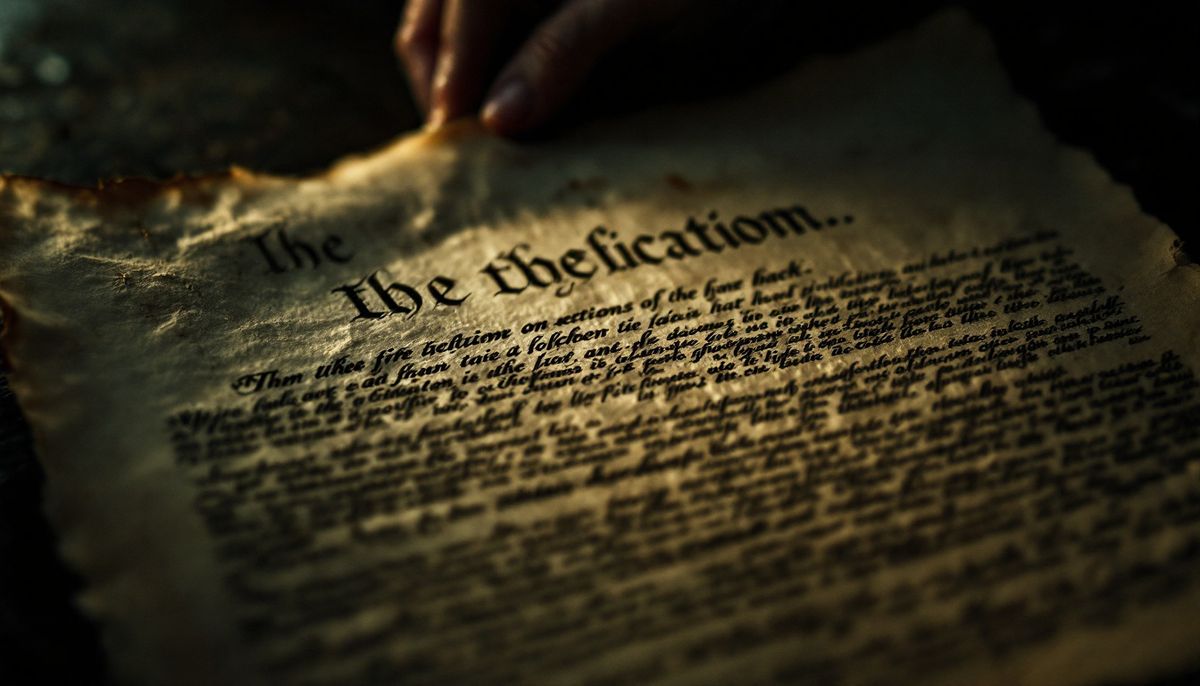
Here’s something most people don’t know about the Declaration of Independence, and it’s the perfect thing to chew on over a hot dog this Fourth of July. There really is a message on the back of it. Flip the famous parchment over — the one sealed today in a helium-filled, light-filtered case at the National Archives — and down near the bottom, written upside down in plain dark ink, are the words: “Original Declaration of Independence dated 4th July 1776.” That’s it. No invisible map. No treasure clue. No Templar riddle drawn in lemon juice and revealed by candle flame. Just a label. But oh, what that little label has done to the American imagination.
If your brain just jumped to Nicolas Cage stealing the document at a gala in National Treasure, you’re not alone — that 2004 movie hung its entire plot on the idea that a hidden map was inked on the back of the parchment, waiting for someone clever enough to find it. It’s a wonderful story. It is also, the National Archives has gently confirmed, completely made up. In 2019 they even put out a video to settle the matter for the millions of people who’d started squinting at the back of the document on field trips. There’s no map. The real writing is that mundane storage label, and historians believe it was added simply because, for much of its early life, the most important piece of paper in the country spent its days rolled up in a tube. You needed to know which roll was which. So somebody wrote the title on the outside, the way you’d label a box in the attic. The truth is almost funnier than the legend: America’s founding document was filed like a tax receipt.
But here’s where it gets genuinely interesting, because the real mysteries of the Declaration are stranger than anything Hollywood invented — starting with a simple question that trips up nearly everyone. What original are we even talking about? Most of us picture a single magic document, signed by all the Founders in a candlelit room on July 4, 1776. Almost none of that is true. The text was adopted on July 4. But the beautiful handwritten parchment we all know — the “engrossed” copy, lettered out by hand by a clerk named Timothy Matlack — wasn’t even finished yet on the Fourth. The signing didn’t begin until August 2. So the most patriotic date on the calendar is, technically, the day Congress approved the words, not the day they signed the paper.
And the very first version of the Declaration that ordinary Americans actually saw? It wasn’t the fancy parchment at all. On the night of July 4, with the ink barely dry on the approved text, Congress rushed it to a Philadelphia printer named John Dunlap, who worked through the night cranking out roughly 200 printed copies on his press. These “Dunlap Broadsides” were the ones that got read aloud in town squares, nailed to tavern walls, and galloped across the colonies to spread the news that thirteen colonies had just told the most powerful empire on earth to get lost. They were the original viral post. And here’s the mystery that makes collectors lie awake at night: of those 200, only about 26 are known to survive. The rest are simply gone — used up, tossed out, lost to time. One famous copy turned up in 1989 hidden behind a four-dollar painting somebody bought at a flea market. It later sold for over eight million dollars. So yes — there may still be one folded into an old book or stuffed behind a frame in somebody’s grandparents’ house right now.
The deeper you dig, the more the lost-original riddle thickens. The handwritten “fair copy” that Dunlap actually set his type from — the document the printer held in his hands that night — doesn’t exist anymore either. It simply vanished. The best guess of historians is that it was worn out during the printing or deliberately destroyed, because Congress was operating under strict secrecy and didn’t leave loose drafts lying around. Thomas Jefferson’s own rough draft, with all its crossings-out and Ben Franklin’s edits, survives in fragments — but the clean copy that became the printing master? Gone without a trace. For the founding document of a superpower, there’s a surprising amount of paper that history simply can’t find.
Now, about those famous fading signatures — the ones that make the parchment look like a ghost of itself. This is where the legend of careless founders gives way to a tale of well-meaning people slowly loving a document to death. The damage wasn’t caused by age alone. It was caused by us. During the Revolution, the parchment was carried around rolled up in a tight tube, packed and unpacked and toted from city to city as Congress fled advancing armies — each roll and unroll grinding the surface a little thinner. Then, in the 1820s, somebody decided America needed exact copies, so they used a “wet transfer” method: they pressed damp paper onto the original to lift the ink for reproduction. It worked. It also pulled a layer of the actual ink right off the page, draining John Hancock’s bold signature and all the others of their darkness. The final insult came in the mid-1800s, when the document was hung in a frame directly across from a window and left there for roughly thirty years, baking in the daylight until the signatures bleached to whispers. By the time anyone realized the harm, the most famous autographs in American history had faded to shadows.
And then there are the document’s great escapes — the times the Declaration itself had to run for its life. In August 1814, with British troops marching on Washington to burn the capital, a State Department clerk named Stephen Pleasonton stuffed the nation’s records into coarse linen bags he’d had specially sewn, and hauled them out of the city by cart. He noticed the Declaration still hanging forgotten on a wall and grabbed it too. That same evening, as the White House went up in flames, the Declaration sat safe in a private home in Leesburg, Virginia, thirty-five miles away — rescued by a clerk who simply refused to leave it behind. More than a century later it ran again: within weeks of the attack on Pearl Harbor in December 1941, the Declaration was packed up and sent under armed guard to the most fortified building in America — the gold bullion depository at Fort Knox, Kentucky — where it sat beside the nation’s treasure through the darkest years of World War II. It came home in 1944. America’s birth certificate has been hidden in a gristmill, a Virginia farmhouse, and a vault full of gold.
So this Fourth of July, when somebody at the cookout brings up the secret map on the back of the Declaration, you can be the one who knows the truth — and the truth is better. There’s no map, just a humble storage label. But there is a clean printing master that vanished into thin air, a hundred and seventy-odd Dunlap Broadsides still missing somewhere in the world, signatures we faded ourselves out of sheer enthusiasm, and a fragile sheet of parchment that has twice fled an enemy and once spent a war sleeping next to Fort Knox gold. The legend says the real secret is hidden on the back. Turns out the real secrets were hiding in plain sight the whole time. Happy Independence Day.
Legend & Mystery
