
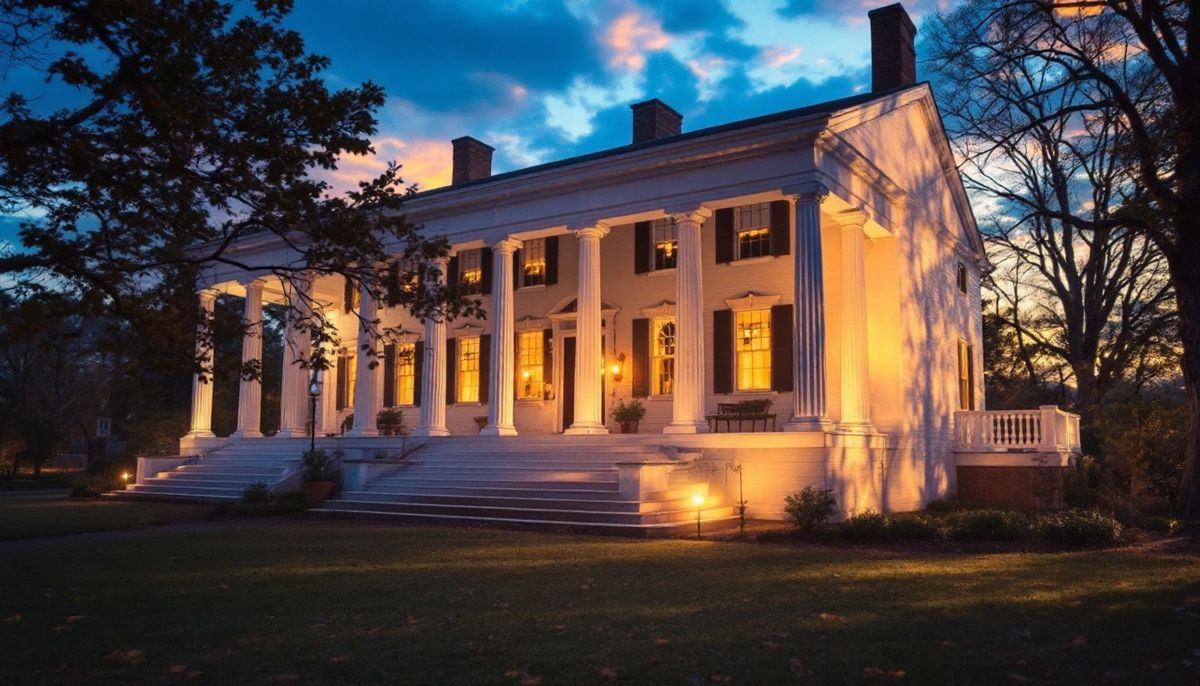
Confession time: I always pictured Mount Vernon as a stately stone mansion where George Washington sat around being dignified. Then I actually looked into it, and folks — the house isn’t even stone. It’s wood wearing a costume. The most honest man in American history (“I cannot tell a lie”) lived in a house that’s been fibbing to visitors for 250 years. And that’s before we get to the whiskey empire, the stolen skull, and the letter where Washington basically told his cousin he’d rather watch the place burn than see it saved the wrong way. Here are ten Mount Vernon facts that’ll make you the smartest person on the tour.
1. The house isn’t stone. It’s pine boards in disguise.
That elegant “stone” mansion is actually wood, treated with a trick called rustication: carpenters beveled long pine boards to look like stone blocks, painted them, then threw sand onto the wet paint to give it a gritty stone texture. From ten feet away, it fools basically everyone — which was exactly the point, since real stone was wildly expensive. So yes, the man who supposedly could not tell a lie lived in a house that tells one to every single visitor. It still gets re-sanded the same way today.
2. It’s named after a British admiral — the same guy who gave us the word “grog.”
George didn’t name Mount Vernon. His older half-brother Lawrence did, honoring Admiral Edward Vernon, the British naval commander he’d served under. Vernon’s sailors called him “Old Grog” for his grogram cloak, and when he ordered the fleet’s rum watered down, the watered rum got his nickname — that’s where the word “grog” comes from. So America’s most sacred patriotic home is named for an officer of the empire we fought a whole revolution against. History has jokes.
3. Washington ran one of the biggest whiskey operations in America.
After the presidency, Washington’s Scottish farm manager talked him into building a distillery. By 1799 it was cranking out around 11,000 gallons of rye whiskey a year, making it one of the largest distilleries in the country. The father of our country spent his final years as a whiskey magnate — and the reconstructed distillery at Mount Vernon still makes it using his recipe. Retirement goals, 18th-century edition.
4. During the Revolution, a British warship showed up — and Washington was furious his home DIDN’T burn.
In 1781, the British warship Savage anchored in the Potomac and threatened to torch the estate. Washington’s cousin Lund, managing the place, rowed out with supplies to appease the captain and saved the house. George’s thank-you? A blistering letter saying it would have been “a less painful circumstance” to have Mount Vernon reduced to ashes than to have his cousin feed the enemy. The man was prepared to lose his own house on principle. Your HOA could never.
5. The key to the Bastille hangs in the front hall.
In 1790, the Marquis de Lafayette sent Washington the main key to the Bastille — the Paris fortress-prison whose storming kicked off the French Revolution — calling it a tribute from a son to his adoptive father. Thomas Paine personally helped get it across the Atlantic. It’s still displayed in the central hall today, which means one of the most important artifacts of the French Revolution lives in a farmhouse in Virginia.
6. Grave robbers broke into Washington’s tomb — and stole the wrong skull.
In 1830, an intruder broke into the crumbling family tomb and made off with a skull. One problem: it wasn’t George’s — it belonged to a Washington relative. The break-in so rattled the family that they finally built the newer brick tomb where George and Martha rest today. Congress, meanwhile, had built a crypt for Washington under the Capitol rotunda, but the family refused to move him — his will said Mount Vernon, so Mount Vernon it stayed. The Capitol crypt sits empty to this day.
7. It was saved by an all-women rescue mission — before the Civil War.
By the 1850s, Mount Vernon was falling apart, and both Congress and Virginia refused to buy it. Enter Ann Pamela Cunningham, who founded the Mount Vernon Ladies’ Association in 1853 and rallied women across a country busy splitting in half to raise $200,000 to purchase and restore it. It was America’s first national historic preservation effort, and the same association still owns and operates the estate today — no government funding, then or now. The ladies didn’t just save a house; they invented an entire movement.
8. During the Civil War, it was neutral ground — soldiers had to check the war at the gate.
While the country tore itself apart, Mount Vernon stayed open, and soldiers from both armies visited. The Ladies’ Association’s rule: leave your weapons and your allegiance outside. Union and Confederate troops walked the same grounds in peace, sometimes on the same day. It may have been the only spot in America where the Civil War officially wasn’t happening.
9. Washington invented a 16-sided barn — because he was done with dirty wheat.
Farmers traditionally beat wheat with flails or had horses trample it on open ground, which mixed the grain with dirt and, um, everything else horses leave behind. Washington’s fix: a round-ish, 16-sided barn with a slotted upper floor. Horses trotted in circles over the wheat, and clean grain fell through the gaps to the floor below. It was agricultural engineering decades ahead of its time — designed by a guy who insisted he was just a simple farmer.
10. His most profitable “crop” was fish — over a million a year.
Mount Vernon sat on ten miles of Potomac shoreline, and every spring the river boiled with shad and herring. Washington’s fishery hauled in more than a million fish a year, salted and packed in barrels — feeding the estate, supplying his workers, and selling the surplus at a tidy profit. Tobacco exhausted his soil, wheat paid the bills, but the fish were the quiet moneymaker. George Washington: founding father, general, president… commercial fisherman.
Which one made you say “no way”? Send this to the friend who’s been to Mount Vernon — bet they walked right past that “stone” siding without a clue…
