
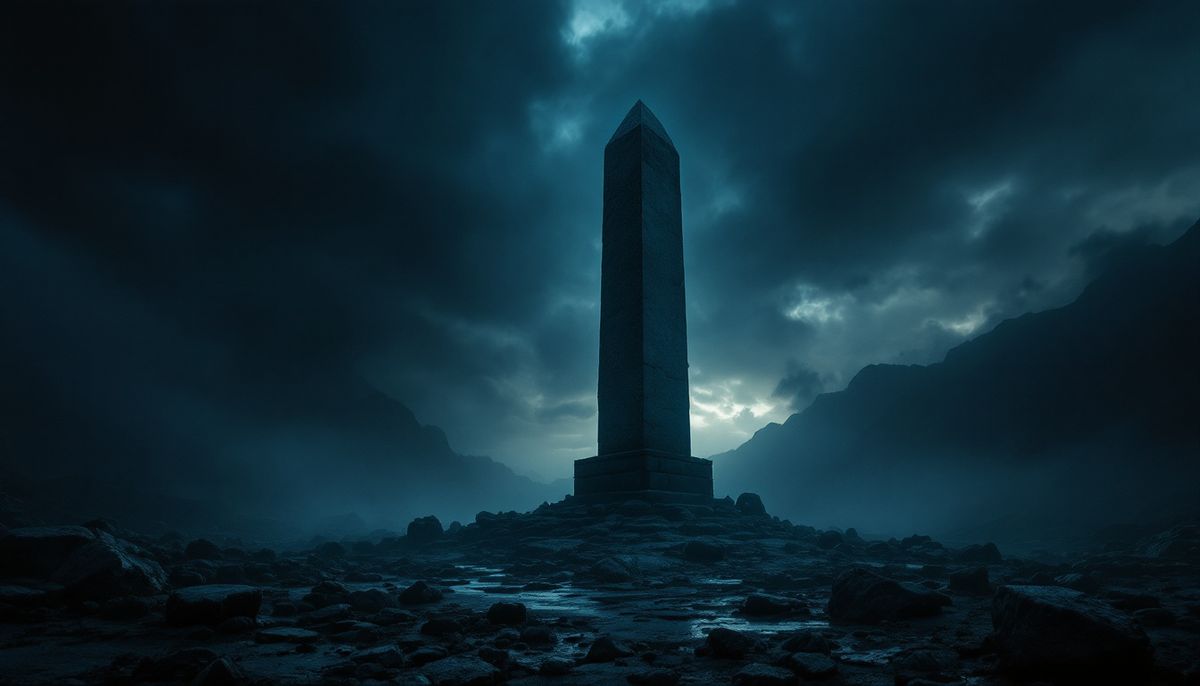
Let me tell you about a stack of granite in rural Georgia that managed to pull off something almost impossible: it became an unsolved mystery twice. Once when it went up, and once — forty-two years later, at 4 a.m., on camera — when it came down. Everything I’m about to tell you is documented. Bank records, county files, security footage, a GBI case number. And none of it answers either question.
It starts on a Friday in June 1979, in Elberton, Georgia — a small town that happens to be the self-proclaimed “Granite Capital of the World.” A well-dressed, gray-haired man walked into the offices of the Elberton Granite Finishing Company and told its president, Joe Fendley, that he wanted to commission a monument. Not a headstone. A massive one — four upright slabs nearly twenty feet tall, over a hundred tons of granite, engineered to survive a catastrophe and carry a message to whoever crawled out the other side. The man gave his name as Robert C. Christian, and then, in the same breath, admitted it was fake. He said he represented a small, anonymous group of “loyal Americans” who had been planning this for twenty years. Fendley assumed he was dealing with a crank and quoted him a deliberately outrageous price. Christian didn’t flinch.
He did agree to one condition. To handle the money, he was sent to Wyatt Martin, president of the Granite City Bank, who refused to move a dollar without knowing who he was actually dealing with. Christian relented — on the condition that Martin sign a confidentiality agreement and never reveal it. So the money flowed in from different banks around the country, the checks cleared, and exactly one human being on Earth knew who was behind it all. Martin kept records in a sealed box and spent the next four decades politely telling reporters, filmmakers, and conspiracy hunters the same thing: he’d sworn an oath, and he intended to keep it. He died in December 2021. As far as anyone can tell, he kept it. Whatever papers could have named “R.C. Christian,” Martin took to his grave — and he’d hinted more than once that he might destroy them anyway.
The monument itself went up on a hilltop in March 1980, and it was genuinely strange. Ten “guiding principles” carved in eight modern languages — English, Spanish, Swahili, Hindi, Hebrew, Arabic, Chinese, Russian — with a shorter message in four ancient scripts, including Egyptian hieroglyphs and Babylonian cuneiform. It was drilled with a hole that framed the North Star, a slot that tracked the solstices, and a channel that marked noon by sunbeam. People called it “America’s Stonehenge.” And then there was the first principle, the one that lit a forty-year fire: “Maintain humanity under 500,000,000 in perpetual balance with nature.” To admirers, it read as post-apocalyptic guidance — advice for rebuilding after a civilization-ending disaster. To others, it read as a depopulation agenda carved in stone by a shadowy elite who wouldn’t sign their names. I’ll be straight with you: the conspiracy theories wrote themselves, and the anonymity is what kept them alive. Guesses at Christian’s identity have ranged from Ted Turner to an Iowa physician named in a 2015 documentary — but that’s what they remain. Guesses. A book published under the R.C. Christian name in 1986 explained the group’s thinking and, very carefully, nothing about who they were.
Which brings us to the second mystery. At about 4 o’clock in the morning on July 6, 2022, an explosive device tore apart one of the four slabs. This wasn’t the nineteenth century — the site had security cameras. The footage, released by the Georgia Bureau of Investigation that same day, shows the explosion in the dark and then a car leaving the scene. Later that afternoon, officials demolished what was left of the monument for safety. Forty-two years of granite engineered to outlast the apocalypse, gone in a single day.
And here’s the part that gets me: nobody was ever caught. Think about what investigators had to work with — video of the blast, video of the vehicle, a bomb that leaves forensic evidence by its very nature, a rural county where strangers get noticed, and a motive pool that had been shouting its intentions in public for years. The stones had been denounced as satanic; a candidate in that year’s Georgia governor’s race had literally campaigned on tearing them down (she condemned the bombing itself, for the record — and no, there’s no evidence connecting her to it). The GBI investigated. No arrest. No suspect ever named publicly. To this day, the case is unsolved.
So the Georgia Guidestones now exist only as a double question mark. Somewhere, presumably, a few people know who “R.C. Christian” really was — if any of that small, patient group is even still alive. And somewhere, someone knows who drove away from that hilltop in the dark. Two secrets, forty-two years apart, orbiting the same pile of granite. The monument was built to deliver a message to the survivors of a catastrophe. Instead, its whole existence delivered a different one: in the age of paper trails and security cameras, it is still entirely possible to do something enormous — creation or destruction — and simply vanish.
Unsolved Mystery
