
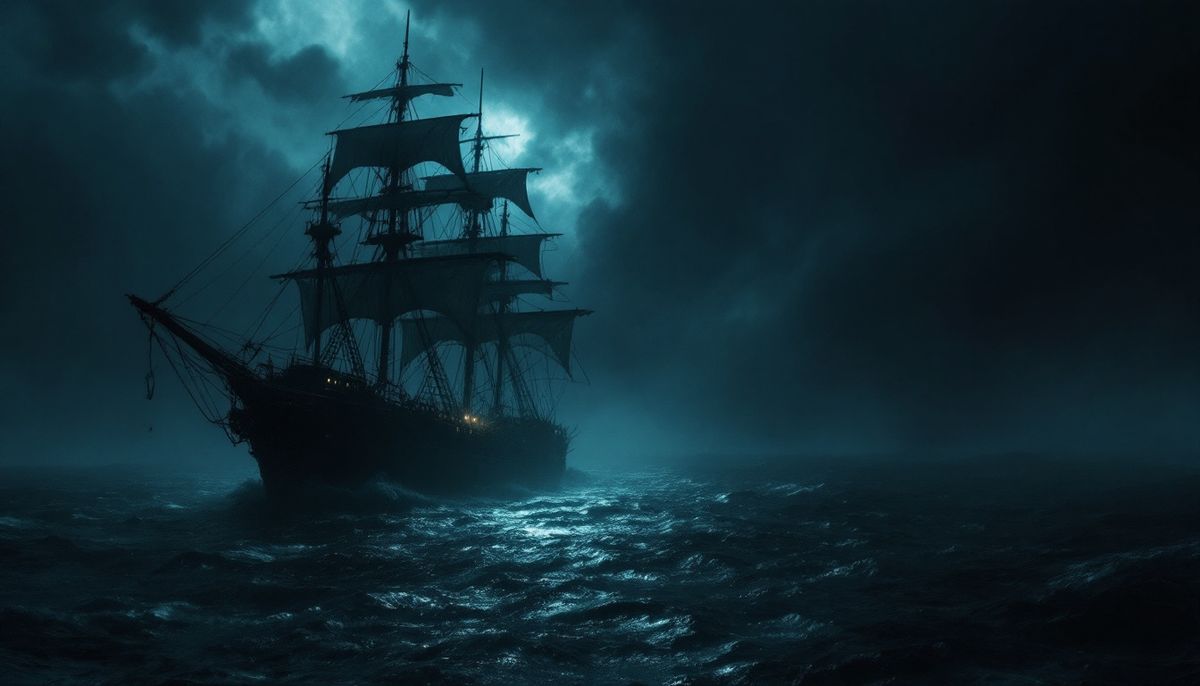
Let me tell you about the strangest thing the Coast Guard ever found off the coast of North Carolina — and before your mind jumps to sea monsters or the Bermuda Triangle, I want you to hold onto this: five separate departments of the United States government investigated this case. Commerce. Treasury. Justice. Navy. State. Real federal men in real federal offices, pulling files and interviewing witnesses for over a year. And at the end of all of it, they closed the case with a shrug that still echoes a century later.
It’s dawn on January 31, 1921, and a surfman at the Cape Hatteras life-saving station spots something impossible out on Diamond Shoals — the stretch of shifting sandbars sailors call the Graveyard of the Atlantic. A five-masted schooner, one of the biggest ever built, sitting hard aground with every sail set. She’s the Carroll A. Deering, out of Bath, Maine, homeward bound from Barbados. The seas are too rough to reach her for four days. When the wreckers finally climb aboard, they find the ship in eerie order — and not one living soul. Eleven men, gone. The two lifeboats, gone. The ship’s log, the navigation instruments, the crew’s personal belongings, the ship’s papers — all gone. And in the galley, this is the detail I can’t shake: food. Set out, mid-preparation. Ribs in a pan. Whatever happened to those men, it interrupted dinner.
Now rewind three days, because that’s where this stops being a shipwreck story and becomes a mystery. On January 28, the Deering passed the Cape Lookout Lightship, and a crewman — thin, red-haired, with a foreign accent, notably not the captain — hailed the lightship through a megaphone. “We’ve lost both our anchors,” he called, and asked that the owners be notified. The lightship keeper noticed two things wrong with that picture. First, the man giving orders wasn’t an officer. Second, the crew was loafing around the quarterdeck — officers’ territory, where working sailors had no business being. Then the lightship’s radio failed before he could report it, and a steamer that passed close behind the Deering refused to identify herself. Every one of those details is in the official record. Make of them what you will — everyone since 1921 has.
Here’s what the investigators knew about the people aboard. The captain, William Wormell, was a 66-year-old veteran who’d taken the command as a favor. His first mate, Charles McLellan, hated him. That’s not gossip — in Barbados, McLellan got drunk, threatened to kill Wormell, and was actually thrown in jail. And then, in the kind of decision that keeps historians up at night, Wormell paid his fine and took him back aboard for the voyage home. Whatever happened on that ship, it happened with a first mate who had publicly threatened the captain’s life standing watch beside him.
Then the case got stranger. In April 1921, a fisherman named Christopher Columbus Gray found a message in a bottle on a Hatteras beach: the Deering had been captured by a mysterious vessel, it said, crew taken prisoner. Handwriting experts initially matched it to the ship’s engineer. The captain’s own daughter, Lula Wormell, championed the note all the way to Washington, and it helped push the federal government into its five-department investigation — there was real fear that pirates or rum-runners or even Bolsheviks were seizing American ships, because here’s a fact that gets left out of the tidy retellings: other vessels vanished in those same waters around the same time, including the steamer SS Hewitt, which disappeared without a trace. Then investigators leaned on Gray, and he confessed. He’d written the note himself, hoping the attention would land him a job at the Cape Hatteras lighthouse. The best lead in the case was a fabrication — and I’d argue the note did lasting damage, because once it collapsed, the whole investigation’s momentum collapsed with it.
So what are we left with? Mutiny is the theory most historians favor — McLellan had motive, the wrong man was giving orders at Cape Lookout, and the crew was standing where officers stand. But if the crew seized the ship, why abandon a perfectly good vessel into January seas in open lifeboats? Piracy and rum-running had their federal believers for a while. A hurricane-force storm did sweep the coast in that window, and maybe eleven men simply took to the boats at the worst possible moment. Fine. But no lifeboat, no wreckage, no body — not one of eleven men — ever washed ashore. Anywhere. Ever.
In 1922, the government quietly closed the file. No conclusion. No suspects. Senator Frederick Hale of Maine, whose state built the ship, summed it up in a line I’d frame if I could: nothing like it “ever happened before in the history of the merchant marine.” The Deering herself was dynamited as a hazard to navigation, and pieces of her drifted onto the Outer Banks, where tourists photographed her bones for decades. Somewhere between Barbados and Diamond Shoals, eleven American sailors stepped off the record of the world — dinner on the stove, sails still set — and a hundred years of investigators, novelists, and armchair detectives haven’t moved the case one inch past that lightship at Cape Lookout, and the wrong man’s voice, calling across the water.
Unsolved Mystery
