
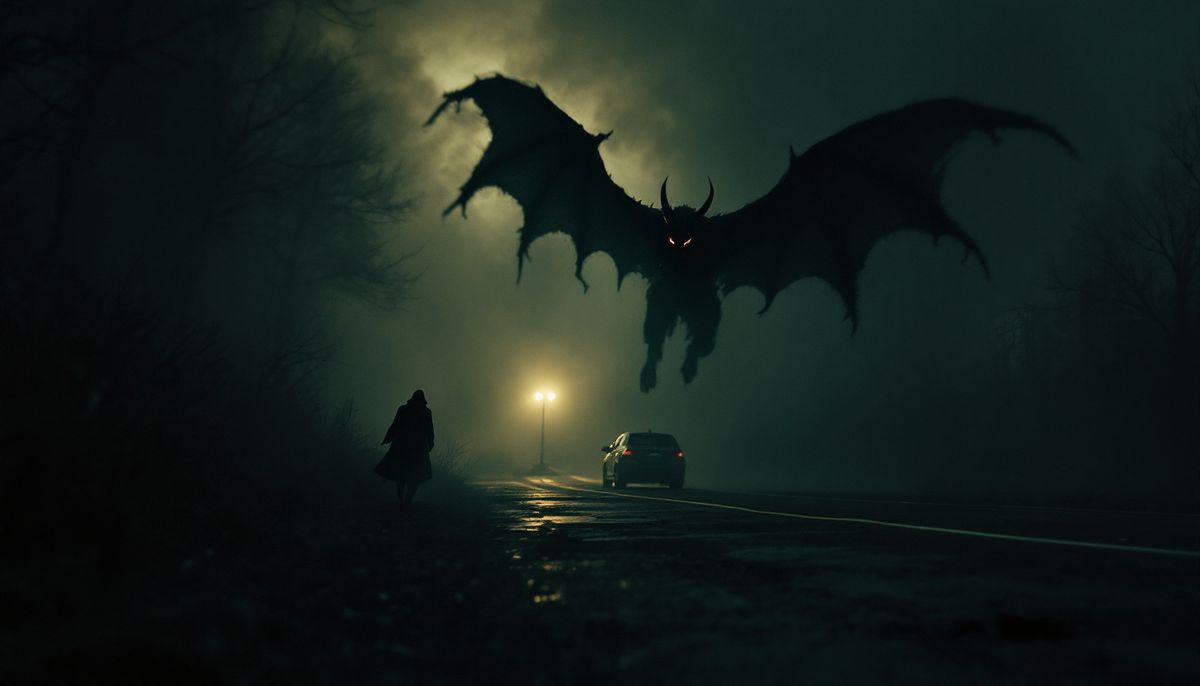
Let me tell you about the strangest week New Jersey has ever had — and I promise you, that’s a competitive category. For seven days in January 1909, factories closed, schools emptied, trolley conductors armed themselves, and grown men refused to walk to work after dark — all because of a creature that, depending on who you ask, was born to a South Jersey mother in 1735, cursed by her own words, and has been screaming through the Pine Barrens ever since.
The legend goes like this. A woman remembered as Mother Leeds, living deep in the Barrens near Leeds Point, discovered she was pregnant with her thirteenth child. Exhausted, poor, and past caring, she supposedly cried out, “Let this one be the devil!” And on a stormy night in 1735, the story says, she got her wish — a child born normal who, within minutes, transformed before the family’s eyes: the head of a horse or goat, leathery bat wings, hooves, claws, a forked tail. It let out a scream, thrashed its way up the chimney, and vanished into the pines. That’s the tale, anyway. Hold onto your skepticism — we’ll need it — but also hold onto this: people in South Jersey have been reporting something out there for the better part of three centuries.
Now, January 1909. This is the part that’s not folklore — it’s newspaper archives, police blotters, payroll records. During one extraordinary week, thousands of people across the Delaware Valley, from Camden to Philadelphia to Trenton, reported encounters with a winged, hoofed creature. Residents woke to find strange hoofprints in fresh snow — tracks that ran across rooftops, hopped fences, squeezed under bushes, and simply stopped in the middle of open fields. A Camden police officer and a Trenton city councilman both claimed sightings. In Gloucester City, mill workers stayed home in such numbers that plants shut down. Schools closed. Posses formed. The Philadelphia Zoo, half in on the joke, posted a $10,000 reward for the beast’s capture. For one week, a colonial ghost story effectively paralyzed a stretch of the industrial Northeast.
So what was actually flying around out there? Here’s where I owe you the honest version. The leading natural suspect is the sandhill crane — a bird with a six-foot wingspan, an unsettling prehistoric scream, and a habit of straying into the region. A big crane glimpsed at dusk by someone who already knows the legend checks a remarkable number of boxes. The famous hoofprints? Investigators have pointed to everything from ordinary animal tracks distorted by melting and refreezing snow to outright pranksters. And at least one piece of the 1909 panic was pure showbiz: a Philadelphia publicist named Norman Jefferies painted a kangaroo green, strapped fake wings to the poor animal, and exhibited it as the “captured” Jersey Devil at a dime museum on Arch Street. Admission was ten cents, and people paid it.
But here’s my favorite part of the whole story, because the real origin may be stranger than the monster. A historian named Brian Regal traced the legend back to an actual family — the Leeds family of Leeds Point — and an actual feud. Daniel Leeds was a colonial almanac publisher whose fondness for astrology got him branded “evil” by his Quaker neighbors. His son Titan inherited the almanac business and, in the 1730s, ran headlong into a young competitor named Benjamin Franklin. Franklin, in a legendary bit of trolling, jokingly predicted the exact date of Titan Leeds’s death in Poor Richard’s Almanack — and when Titan angrily protested that he was still alive, Franklin insisted his rival must be a ghost writing from beyond the grave. Add in the Leeds family crest, which prominently featured a winged dragon-like creature, and you can watch the “Leeds Devil” assemble itself in real time: a despised family, a devil’s reputation, a monster on their coat of arms. The dates even line up — right around 1735.
And yet. The tidy historical explanation covers the birth of the legend. It does not cover the sightings — hundreds upon hundreds of them, spread across three centuries, from colonial farmers to 1909 police officers to Pine Barrens hunters who will look you in the eye today and tell you what they saw. It doesn’t explain why the tracks in the 1909 snow stopped dead in open fields, or why so many witnesses in that one strange week, most of whom never met, described the same impossible thing.
New Jersey, for its part, made peace with its monster long ago. The state’s NHL team has been the Jersey Devils since 1982, Leeds Point leans into the tourism, and the Pine Barrens — a million-plus acres of dark pine and cedar water, one of the emptiest places on the Eastern Seaboard — remain exactly the kind of place where you could believe almost anything lives. Was it a smeared colonial family? A lost crane? A publicist with a green kangaroo? Probably some of each. But stand at the edge of those pines at dusk, listen to something scream way back in the dark, and you’ll understand why, 300 years on, South Jersey still isn’t entirely sure.
Unsolved Mystery
