
July 16th
Before dawn on July 16, 1969, the beaches, causeways, and roadsides around Cape Kennedy, Florida, were already packed. Close to a million people had camped out overnight — families on station wagon roofs, veterans with binoculars, kids asleep on blankets in the sand — all staring at the same distant point: a floodlit white rocket, 363 feet tall, standing alone on Pad 39A. Its name was Saturn V, and bolted to its top was a tiny cone called Columbia carrying three men — Neil Armstrong, Michael Collins, and Buzz Aldrin — who were about to attempt the boldest journey in human history.
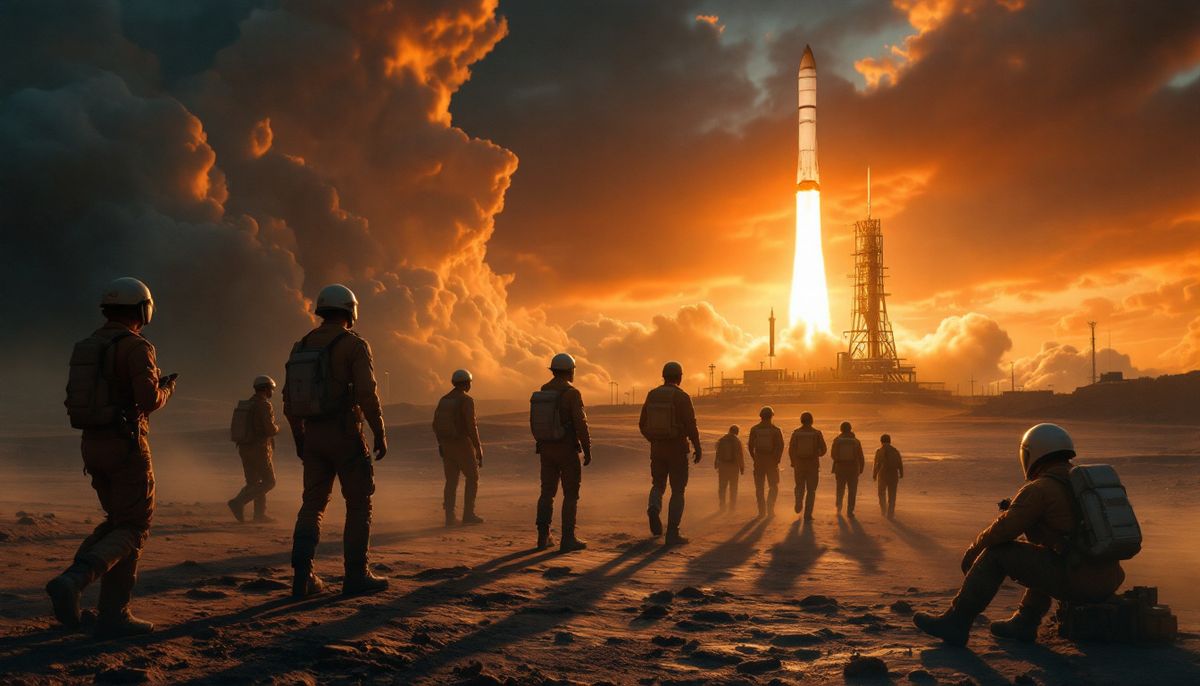
At 9:32 a.m. Eastern time, the five massive F-1 engines lit, pouring out some 7.6 million pounds of thrust — and for a few seconds the rocket simply sat there, straining against its hold-down arms while a man-made sunrise flooded the Florida coast. Then Apollo 11 began to climb. Spectators three miles away felt the ground shudder and their chests rattle before the sound even fully arrived, a crackling roar that witnesses said they didn’t just hear — they felt it in their bones.
Watching from the VIP stands were former President Lyndon Johnson and Vice President Spiro Agnew, alongside thousands of invited guests, while an estimated hundreds of millions more followed on television around the world. Walter Cronkite, narrating for CBS, could barely contain himself as the Saturn V cleared the tower. Eight years earlier, President Kennedy had promised the Moon before the decade was out. The decade had about five and a half months left.
Twelve minutes after liftoff, Armstrong, Collins, and Aldrin were in Earth orbit. A few hours later, a final engine burn flung them out of orbit entirely and toward the Moon — the start of a quarter-million-mile voyage that would end four days later with a single boot print in gray dust. But on July 16, nobody knew how the story would end. A million people on the beaches just watched the bright dot shrink into the morning sky, carrying the whole human race with it.
Also On This Day…
1945 — A Second Sun Rises Over New Mexico Here’s the eerie symmetry of July 16: exactly 24 years to the day before Apollo 11 lifted off, the atomic age began in the pre-dawn dark of the New Mexico desert. At 5:29 a.m. on July 16, 1945, scientists of the Manhattan Project detonated the world’s first atomic bomb — a plutonium device they called simply “the Gadget” — at the Trinity test site in the Jornada del Muerto desert. The flash lit the sky brighter than daylight and was visible for a couple hundred miles; the blast fused the desert sand beneath the tower into a green glass later named trinitite. Project director J. Robert Oppenheimer said a line of Hindu scripture crossed his mind: “Now I am become Death, the destroyer of worlds.” The same date, 24 years apart, gave America both the terrifying power of the atom and its greatest voyage of peaceful exploration.
1790 — Congress Invents Washington, D.C. On July 16, 1790, President George Washington signed the Residence Act, establishing a permanent national capital on the banks of the Potomac River — the city that would one day bear his name. The law grew out of one of the most famous backroom deals in American history: over dinner at Thomas Jefferson’s table, Alexander Hamilton got the votes he needed for the federal government to assume the states’ war debts, and in exchange James Madison and the southerners got the capital moved south. Philadelphia would serve as the temporary capital for ten years while the new federal city was carved out of farmland and swamp. In 1800, the government moved into its raw new home — and Washington, D.C. has been arguing with itself ever since.
1935 — The World’s First Parking Meter Starts the Clock Drivers, you can blame this one on a newspaperman. On July 16, 1935, the world’s first parking meter — Park-O-Meter No. 1 — went into service on a downtown corner in Oklahoma City. It was the brainchild of Carl C. Magee, a local newspaper editor tasked with solving downtown’s parking mess: workers parked all day, shoppers circled endlessly, and merchants fumed. Magee’s coin-operated timer charged a nickel an hour and worked almost too well — spaces turned over, shoppers returned, and city hall noticed the jingle of fresh revenue. Outraged drivers called it un-American to pay to park on a public street, but within a decade the meters had spread by the tens of thousands across the country.
1941 — DiMaggio Makes It 56 Straight On July 16, 1941, at League Park in Cleveland, Joe DiMaggio rapped out three hits against the Indians and extended his hitting streak to 56 consecutive games — a number that has towered over baseball ever since. The Yankee Clipper’s streak had gripped the country for two months; radio announcers broke into programming with updates, and “Did he get one today?” became a national greeting. Nobody knew it yet, but 56 was the end of the line: the very next night, before a huge crowd in Cleveland’s Municipal Stadium, two brilliant backhand stops by third baseman Ken Keltner helped finally stop him. More than eight decades later, no hitter has come seriously close.
1951 — Holden Caulfield Checks In On July 16, 1951, Little, Brown and Company published a slim first novel by a fiercely private writer named J.D. Salinger: The Catcher in the Rye. Its narrator — Holden Caulfield, a prep-school dropout adrift in New York and allergic to “phonies” — spoke in a voice American fiction had never quite heard before. Critics were split, but readers weren’t: the book became a generational touchstone, has sold tens of millions of copies worldwide, and still moves hundreds of thousands more every year. Salinger, meanwhile, did the opposite of his book’s fame — he retreated to a hilltop in New Hampshire and spent the rest of his long life refusing to be seen.
From a fireball in the New Mexico desert, to a capital conjured out of a dinner-table bargain, to a nickel-an-hour parking meter, to a million people watching three men ride a pillar of fire toward the Moon — July 16th is the day America keeps proving that everything, from the atom to the sky itself, can be engineered.
