
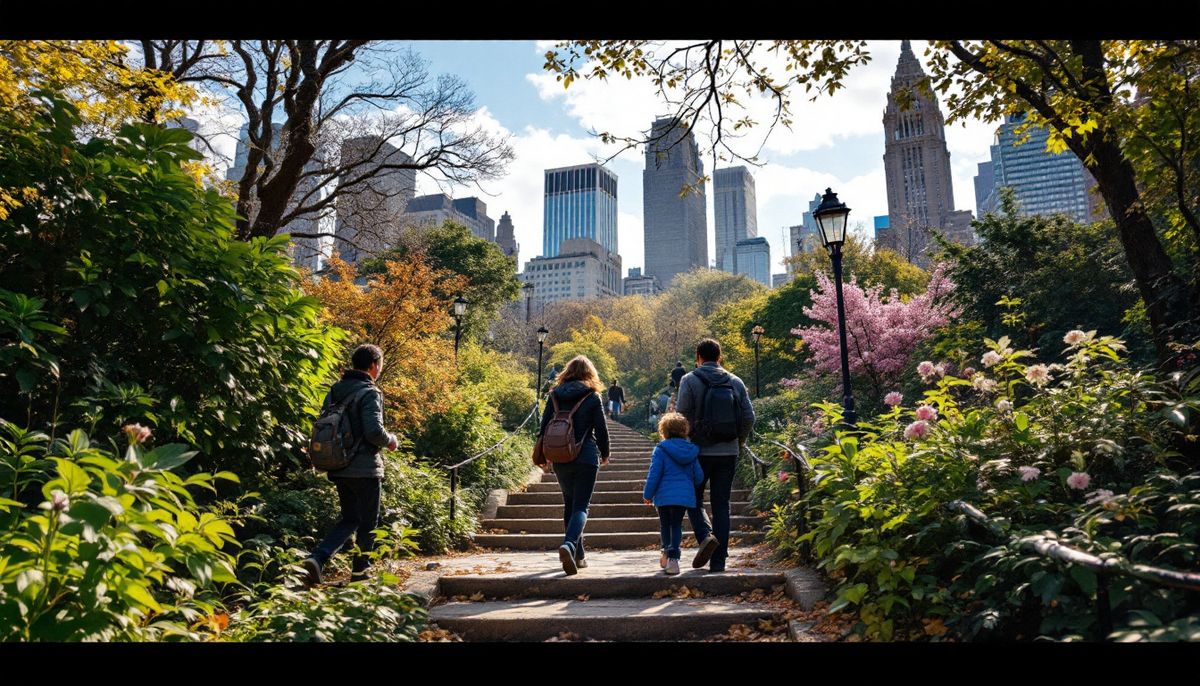
I used to think Central Park was the one part of Manhattan that developers never got their hands on — a little slice of untouched wilderness the city grew up around. Turns out I had it exactly backwards. Central Park is one of the most aggressively engineered pieces of land in America: every tree planted on purpose, every lake dug by hand, every “natural” meadow graded and sculpted by men with shovels and wheelbarrows. And the deeper you dig into how it got built — the blasting, the sheep, the whispering bench, the village that was erased to make room for it — the wilder the story gets. Here are ten Central Park facts that’ll change the way you look at every postcard.
1. Almost none of it is natural. Every tree was planted, and the lakes were dug by hand.
Central Park looks like Manhattan’s last surviving patch of wilderness. It’s the opposite: a fully constructed landscape built on what was largely swampland and rocky scrub. Workers drained the bogs, hauled in massive quantities of topsoil, dug and lined the lakes and ponds, and planted millions of trees, shrubs, and vines to designer Frederick Law Olmsted’s exact specifications. About the only things they didn’t install are the ancient bedrock outcrops poking through the lawns. That “untouched” forest you’re strolling through? It’s a 160-year-old special effect.
2. It’s bigger than an entire European country.
Central Park covers 843 acres — about 1.3 square miles. The Principality of Monaco, a sovereign nation with its own royal family, army, and Grand Prix, squeezes into roughly 0.8 square miles. In other words, you could drop all of Monaco inside Central Park and still have room left over for the reservoir. Vatican City? You could fit it in the park several times and lose it behind the Great Lawn. Somewhere a Monegasque billionaire is paying $50 million for an apartment overlooking a park bigger than his whole country.
3. Before the park, there was a village — and the city erased it.
The land wasn’t empty. Roughly 1,600 people were displaced to build the park, and the best-known community among them was Seneca Village, a settlement on the park’s west side founded in 1825. It was one of the era’s rare communities of African American property owners — with homes, churches, and a school — and owning that land gave some residents something precious: the property qualification needed to vote. In 1857 the city took it all through eminent domain, paid compensation many residents disputed as too low, and leveled the village. For over a century it was all but forgotten, until archaeologists began excavating the site in 2011. Next time you’re near West 85th Street, you’re walking on it.
4. Building it reportedly took more gunpowder than the Battle of Gettysburg.
Some 20,000 workers spent the better part of two decades transforming the site — moving nearly 5 million cubic yards of stone, dirt, and soil, enough to raise or lower the entire landscape by several feet. Blasting all that Manhattan bedrock took serious explosives: by the Central Park Conservancy’s estimate, more gunpowder was used to clear the park than was fired at the Battle of Gettysburg. All of it with picks, carts, horses, and black powder — the bulldozer hadn’t been invented yet. “Taking a peaceful walk in the park” has a violent origin story.
5. The winning design was entry #33 of 33 — and one of its creators was already mowing the lawns.
In 1857, the city announced a design competition for the new park and received 33 entries. The winner, announced in 1858, was the “Greensward Plan” by Frederick Law Olmsted and Calvert Vaux — the last entry submitted, reportedly finished in a frantic all-night push before the deadline. The kicker: Olmsted was already working on the site as the park’s superintendent, supervising the clearing crews by day and sketching the future park by night. The runner-up designs called for formal European-style layouts; Greensward gave America a new idea — a democratic landscape where anyone could wander. Procrastinators, take heart: sometimes the last entry wins.
6. Real sheep grazed the Sheep Meadow until 1934.
Sheep Meadow isn’t a cute name — it was a job site. Starting in 1864, a flock of purebred sheep grazed the meadow daily, keeping the grass trimmed and adding to the pastoral scenery, while a shepherd halted traffic to march them to and from their fold twice a day. The flock lasted a remarkable 70 years, until 1934, when Parks Commissioner Robert Moses evicted them — partly to build the Tavern on the Green in their old sheepfold, and, as the story goes, partly out of fear that Depression-era New Yorkers might start eyeing the flock as dinner. The sheep were shipped off to Prospect Park and eventually the Catskills. The lawn mower they were replaced with has yet to receive a plaque.
7. There’s a bench that carries whispers from one end to the other.
Tucked into the Shakespeare Garden near West 79th Street is the Charles B. Stover Bench, better known as the Whisper Bench — a curved granite bench where the acoustics do something delightful: whisper into one end, and a friend sitting 20-odd feet away at the other end hears you clearly, while anyone standing in front of the bench hears nothing. The curve of the stone carries the sound along its surface like a telephone wire. It’s been a secret-telling and marriage-proposal spot for generations of New Yorkers — and most tourists walk right past it.
8. The lampposts are secretly telling you where you are.
Get lost in the park’s deliberately winding paths (Olmsted designed them to make you forget the city) and salvation is bolted to every lamppost. Nearly all of the park’s thousands of cast-iron lampposts carry a small numbered plaque, and the first two digits tell you the nearest cross street — a post marked “7904” means you’re around 79th Street. It’s a built-in GPS that predates GPS, hiding in plain sight. New Yorkers love knowing this trick. Tourists wandering in circles near the Ramble clearly do not.
9. Every starling in North America traces back to a flock released in Central Park.
In 1890, an eccentric drug manufacturer named Eugene Schieffelin released several dozen imported European starlings into Central Park — legend says as part of a scheme to introduce the birds of Shakespeare to America. The birds did more than survive: today an estimated 200 million starlings blanket North America, virtually all of them descended from those Central Park releases, wreaking havoc on crops, native birds, and even aircraft along the way. It’s considered one of the most consequential species introductions in history. One man, one park, one very bad idea with wings.
10. It’s the most-filmed location on Earth.
Central Park isn’t just a movie star — it’s the movie star. It has appeared in more than 350 films, more than any other location in the world, from silent pictures over a century ago to Home Alone 2, When Harry Met Sally, Ghostbusters, Elf, and every rom-com montage ever cut. Directors love it for the same reason Olmsted built it: it’s a perfect countryside fantasy with a skyline conveniently in the background. Not bad for a park where even the “wilderness” was art-directed from day one.
Which one made you say “no way”? Send this to the friend who thinks they know New York — or the one who still believes the park was always there…
