
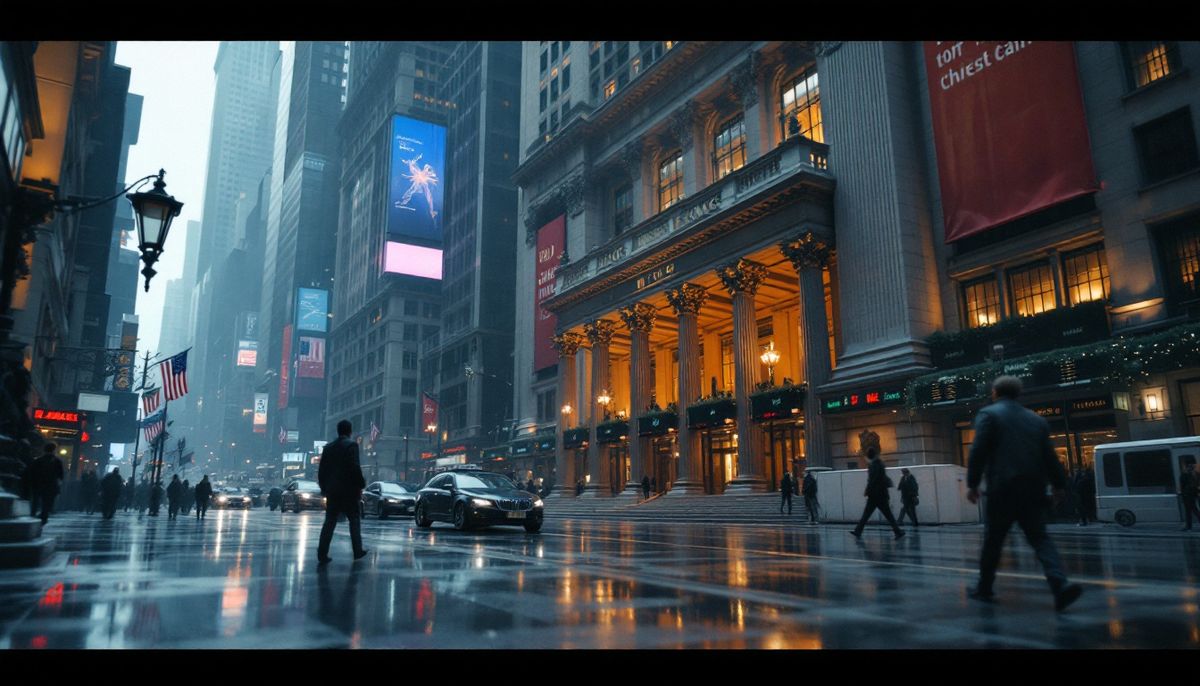
I’ll be honest: I used to picture the New York Stock Exchange as a bunch of guys in suits yelling at screens, and that was the extent of my curiosity. Then I learned the whole thing started with 24 men making a handshake deal under a tree — and that in 1967, a gang of hippies shut down trading by throwing dollar bills at the traders. Oh, and the building still wears the scars of a terrorist bombing that was never solved. The most powerful financial institution on Earth has a backstory weirder than most soap operas. Here are ten NYSE facts that’ll make you the most interesting person at your next barbecue.
1. The world’s most powerful market started under a tree.
On May 17, 1792, twenty-four stockbrokers gathered under a buttonwood tree outside 68 Wall Street and signed a one-paragraph pact — the Buttonwood Agreement — promising to trade only with each other and charge a fixed commission. That handshake under a sycamore grew into an exchange where the listed companies are now worth tens of trillions of dollars. One paragraph. Twenty-four signatures. A tree. Meanwhile, your HOA needs six meetings to approve a mailbox.
2. Wall Street is named after an actual wall.
In 1653, Dutch settlers in New Amsterdam built a wooden defensive wall across lower Manhattan to keep out the British and other threats. The path running alongside it became known as Wall Street. The British eventually took the city anyway — without ever needing to breach the wall — and tore it down in 1699. The wall failed at its one job, but the name stuck around long enough to become shorthand for global capitalism. Not a bad legacy for a fence.
3. Its first real headquarters was a coffeehouse.
Once the tree situation got old, the brokers moved into the Tontine Coffee House at the corner of Wall and Water Streets in 1793. Between cups, they traded stocks, argued politics, and auctioned goods in a room described by one visitor as so crowded that brokers were “gesticulating and mad.” So the epicenter of American finance began as a bunch of overcaffeinated guys shouting numbers at each other in a coffee shop. Some traditions never die.
4. Brokers who couldn’t get in traded outside in the street — wearing neon hats so their clerks could find them.
For decades, brokers who couldn’t afford NYSE membership ran a parallel “Curb Market” right outside on Broad Street — rain, snow, or shine. Clerks leaned out of office windows and communicated with their brokers below using frantic hand signals, and the curb brokers wore brightly colored hats and jackets so their clerks could spot them in the mob. This sidewalk circus finally moved indoors in 1921 and eventually became the American Stock Exchange. Yes: the second-most-famous exchange in America began as the guys standing outside the first one.
5. Ticker-tape parades started with brokers throwing their trash out the window.
The stock ticker, invented in 1867, printed prices onto endless ribbons of paper — which piled up by the mile in every Wall Street office. During the 1886 dedication of the Statue of Liberty, office workers spontaneously hurled the spent tape out their windows onto the parade below, and New Yorkers loved it so much it became the city’s official way to honor heroes. Astronauts, presidents, and championship teams have all been showered in what was, originally, office garbage.
6. When World War I broke out, the exchange simply closed — for over four months.
In July 1914, with Europe collapsing into war and panicked investors dumping stocks, the NYSE did something unthinkable: it locked the doors. Trading halted on July 31 and didn’t fully resume until December — the longest shutdown in its history. Compare that to 1929, 1987, or 2008, when the market stayed open and simply plunged. Sometimes the boldest move on Wall Street is refusing to play.
7. The building across the street still has shrapnel scars from a bombing that was never solved.
On September 16, 1920, a horse-drawn wagon packed with dynamite and iron sash weights exploded at Wall and Broad Streets, killing 38 people in America’s deadliest terror attack up to that time. Investigators suspected anarchists, but no one was ever charged. J.P. Morgan’s headquarters at 23 Wall Street was pockmarked by the blast — and the firm deliberately never repaired the marble, as a gesture of defiance. The gouges are still there. You can walk up and touch them today.
8. In 1967, hippies threw dollar bills onto the trading floor — and traders stopped working to grab them.
Abbie Hoffman and a crew of fellow pranksters took the public gallery tour, then rained fistfuls of dollar bills down onto the trading floor. Some traders booed; others reportedly scrambled to pocket the cash while trading stalled. Hoffman called it a morality play about greed, and the NYSE’s response was telling: it soon enclosed the gallery in bulletproof glass. The exchange survived wars and crashes, but a few guys with singles forced a permanent renovation.
9. The first woman to own a seat had to ask ten men before one would sponsor her.
In December 1967, Muriel “Mickie” Siebert became the first woman to own a seat on the NYSE — after nine of the first ten men she asked refused to sponsor her application. She then spent years as the only woman among 1,365 men, and when the exchange dragged its feet on adding a ladies’ room near the floor, she threatened to have a portable toilet delivered. The bathroom appeared. Never underestimate a woman with a seat at the table and a Porta-Potty vendor on speed dial.
10. A single seat on the exchange once sold for $4 million.
For over two centuries, the only way to trade on the floor was to buy a “seat” — a membership that changed hands like a rare painting. Prices swung from a few thousand dollars in the 1800s to a record $4 million in December 2005. Then came the punchline: within months, the NYSE merged with an electronic exchange and became a publicly traded company itself in 2006. The exchange that spent 214 years listing other companies finally had to list… itself. Even Wall Street can’t escape Wall Street.
Which one made you say “no way”? Send this to the friend who checks their portfolio five times a day — they need the history lesson…
