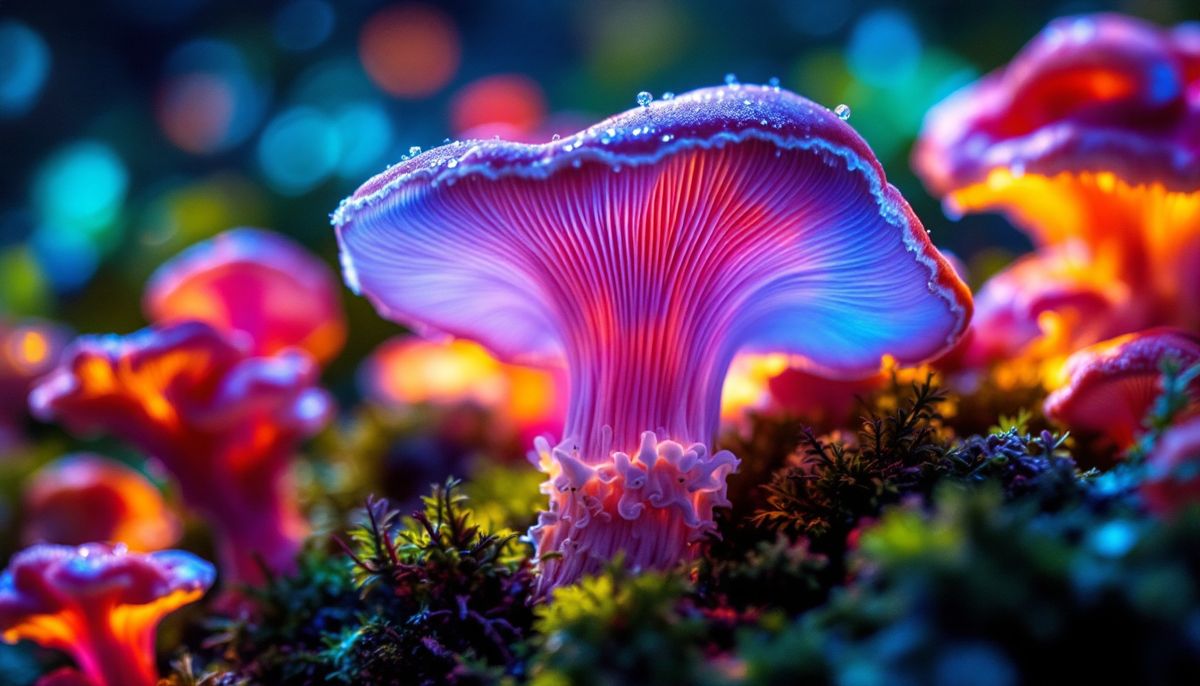
I’ll be honest, for most of my life I filed mushrooms under “weird vegetable.” They show up on pizza, they grow in the yard after it rains, and I never gave them a second thought. Then I learned a few things that completely rearranged my mental furniture. Mushrooms aren’t plants at all, the part you see is barely the organism, and the biggest living thing on the entire planet happens to be one of them, quietly eating a forest in Oregon. Here are five true things about mushrooms and fungi that genuinely stopped me in my tracks.
Did you know fungi are more closely related to animals than to plants?
This one rewired my brain. We tend to lump mushrooms in with the lettuce and the carrots, but genetically they’re sitting at our table, not the salad’s. Fungi and animals share a more recent common ancestor with each other than either of us does with plants, and scientists group us together in a clade called opisthokonts. The split happened roughly a billion years ago. The reason it makes sense once you hear it: plants make their own food through photosynthesis, while fungi and animals both have to go out and get their food from the world around them. Fungi have no chloroplasts, no way to turn sunlight into sugar. So in the grand family tree of life, that mushroom on your plate is a distant cousin of yours, not a leafy vegetable.
Did you know the largest living organism on Earth is a fungus in Oregon?
When people picture the biggest living thing, they think blue whale, or maybe a giant sequoia. They’re not even close. The title belongs to a single honey fungus (Armillaria ostoyae) growing in the Malheur National Forest in eastern Oregon. This one organism sprawls across about 2,385 acres, which works out to roughly 3.7 square miles of forest. It’s estimated to weigh thousands of tons and may be somewhere in the neighborhood of 8,000 years old. Researchers only figured out it was a single organism through genetic testing, after noticing trees dying across a huge area. Most of it is invisible, hidden underground as a vast web of threadlike filaments. They’ve nicknamed it the “humongous fungus,” which is exactly the kind of name I can get behind.
Did you know the mushroom you see is just the “fruit,” and the real organism lives underground?
Here’s the part that flips your whole mental picture. The mushroom poking up out of the soil isn’t the organism, it’s more like an apple on a tree. The actual living thing is a sprawling underground network of fine threads called mycelium, and the mushroom is just its fruiting body, the part that pops up to release spores and make more fungi. The vast majority of a fungus’s mass lives below the surface, completely out of sight. The numbers are wild: some estimates suggest you can pack miles of these mycelial threads into a single cubic inch of soil. So when you spot a mushroom in the woods, you’re really just seeing the tip of something much, much bigger spreading out beneath your feet.
Did you know some fungi glow in the dark?
This sounds like something out of a fairy tale, but it’s real, and it has a name that’s even better: foxfire. Dozens of fungus species, somewhere around 70 or more have been identified, produce a soft, eerie green light, glowing on rotting logs and forest floors at night. People have noticed it for thousands of years, with mentions going all the way back to Aristotle. The glow comes from the same kind of chemistry that lights up a firefly, a compound called luciferin reacting with oxygen and a helper protein. Scientists think the fungi may glow to attract insects, which then carry their spores off to new places, sort of like how a flower’s color draws in a bee. A glowing mushroom is nature quietly running its own little nightlight.
Did you know one of the most important medicines ever discovered came from a mold?
Mold is a fungus too, and one accidental brush with it changed the course of human history. In 1928, scientist Alexander Fleming returned from a vacation to find that a stray mold had drifted onto one of his lab dishes, and wherever the mold grew, the bacteria around it had died. That mold belonged to the Penicillium family, and the substance it produced became penicillin, the world’s first true antibiotic. It went on to save countless lives and kicked off the entire era of antibiotics. The kicker is that it happened almost entirely by chance, from a contaminated dish Fleming nearly threw out. The humble fungus didn’t just earn a spot in the medicine cabinet, it helped build the modern one.
Send this to the friend who picks mushrooms off their pizza… they have no idea they’re snubbing a distant relative that’s basically running the forest.
