
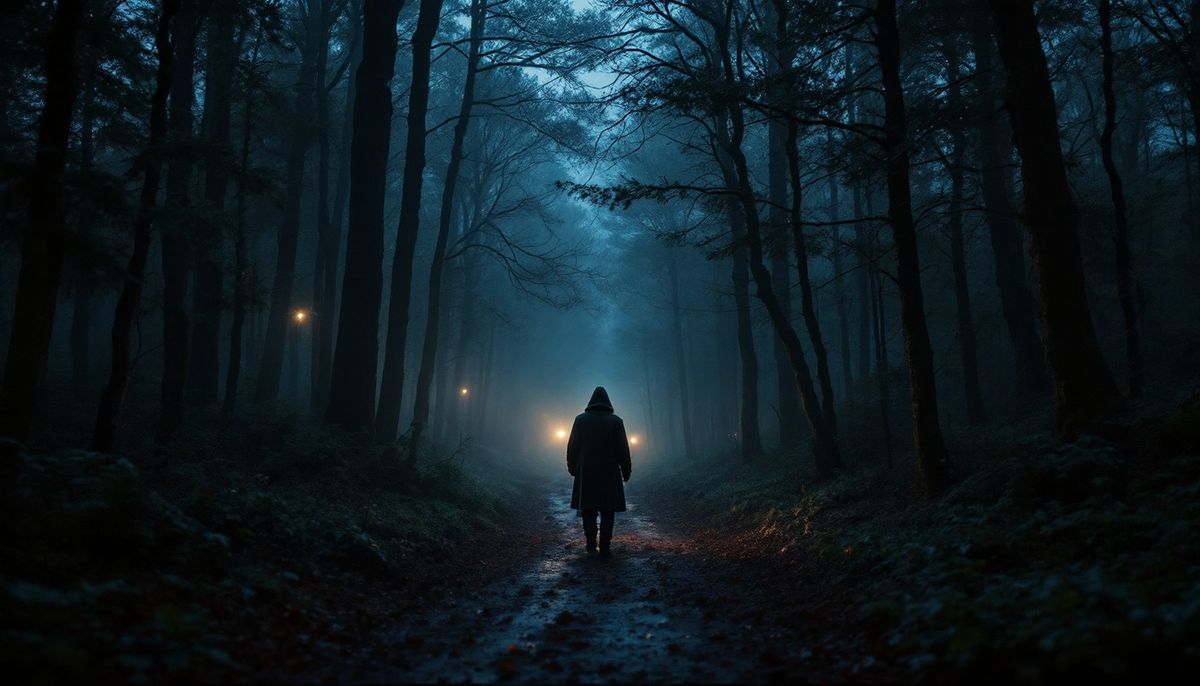
Let me tell you about the strangest three nights in the history of the United States Air Force in Britain — and I want you to hold onto one detail the whole way through: this isn’t a story that leaked out of a tabloid. The central document is a real government memo, written by a real lieutenant colonel, on real Air Force letterhead. You can read it today. Its subject line, typed by a deputy base commander with a spotless career, says simply: “Unexplained Lights.”
It starts in the early hours of December 26, 1980, at the twin bases of RAF Bentwaters and RAF Woodbridge in Suffolk, England — British bases, but leased to the U.S. Air Force, home to the 81st Tactical Fighter Wing and, as was later confirmed, one of the largest stockpiles of nuclear weapons in Europe. Around 3 a.m., security patrolmen near the east gate at Woodbridge saw lights descending into Rendlesham Forest, just beyond the perimeter fence. Their first thought was the sensible one: an aircraft had gone down. Three airmen — among them John Burroughs and Sergeant Jim Penniston — went into the trees to find the wreck. What they say they found instead was not a wreck.
Penniston’s account, given consistently in its core details for decades, is that he came upon a small triangular craft, roughly nine feet across, sitting in a clearing — metallic, warm to the touch, marked with symbols he didn’t recognize. He says he walked around it. He says he touched it. He sketched the symbols in his police notebook, and that notebook still exists. Then, according to the airmen, the thing rose silently through the trees and shot away at impossible speed. When daylight came, patrols found three indentations in the frozen ground, arranged in a neat triangle, along with broken branches and scorch-like marks on the surrounding pines. Skeptics would later say rabbits could have dug those holes. The men who stood in that clearing have never accepted that, not once, not in forty years.
Here’s where the story stops being a campfire tale and becomes a paperwork problem. Two nights later, when the lights came back, the man who went out to debunk them was Lieutenant Colonel Charles Halt — the deputy base commander, a by-the-book officer who, in his own words, went into the forest to “put this thing to rest.” He brought a team, radiation detectors, and a handheld tape recorder, and that tape survives. You can listen to it: a career officer’s voice, flat and procedural, slowly tightening as the night goes wrong. Readings that “peak” at the landing site. Then, through the trees, a red sun-like light that winks, moves, and — in Halt’s own recorded words — appears to drip something like molten metal before breaking apart. Later, star-like objects overhead, one of them sending down a narrow beam of light near where he stood. Two weeks later, Halt wrote it all up and sent his memo to the British Ministry of Defence. It surfaced through a Freedom of Information request in 1983, and the headlines wrote themselves.
Now for the other side — because there is one, and it’s not stupid. Investigators, most prominently the astronomy writer Ian Ridpath, assembled a mundane explanation with real evidence behind it: a brilliant fireball meteor recorded over southern England at 2:50 that first morning, right when the alarm went up. The Orfordness lighthouse, five miles away, whose beam swept the treeline in roughly five-second pulses — a plausible match, on paper, for a winking light glimpsed through moving branches by men who’d never viewed it from inside the forest. Bright stars low on the horizon, twinkling hard in cold air. Radiation readings that, examined later, sat within the range of ordinary background. It’s a tidy package, and pieces of it almost certainly explain pieces of those nights.
But here’s the honest problem: it doesn’t explain all of it, and the witnesses won’t get out of the way. Halt has said, over and over, that he could see the lighthouse and the object at the same time, in different directions — and whatever else you make of him, he was the second-ranking officer of a nuclear-armed base, standing in that forest, narrating into a tape recorder in real time. He later signed a sworn affidavit saying he believes what he saw was under intelligent control and not of this earth. That’s not a man protecting his reputation; that’s a man spending it. And fairness cuts both ways: some of what’s attached to this story deserves your skepticism. Penniston’s most dramatic claim — that touching the craft downloaded pages of binary code into his mind, which he wrote out years later — emerged long after the fact, and even researchers sympathetic to the case handle it with tongs. Strip away every late addition, though, and you’re still left with the first-night core: trained airmen, a close encounter reported up the chain within hours, physical traces in the ground, and a government memo nobody has ever managed to make disappear.
The British Ministry of Defence reviewed the file and concluded the events posed “no defence significance” — which, if you think about it, is a remarkable thing to say about unidentified objects maneuvering over a nuclear weapons depot. And that’s where the record leaves everyone, more than forty years on: a meteor that explains the first alarm but not the clearing, a lighthouse that explains a winking light but not the beam Halt watched come down out of the sky, and a group of aging Air Force veterans who have told the same core story through every decade, every interview, and every round of mockery since. Something happened in Rendlesham Forest during those three nights in December 1980. The men who were there put it in writing. Nobody — believer or skeptic — has ever fully explained it away.
Unsolved Mystery
