
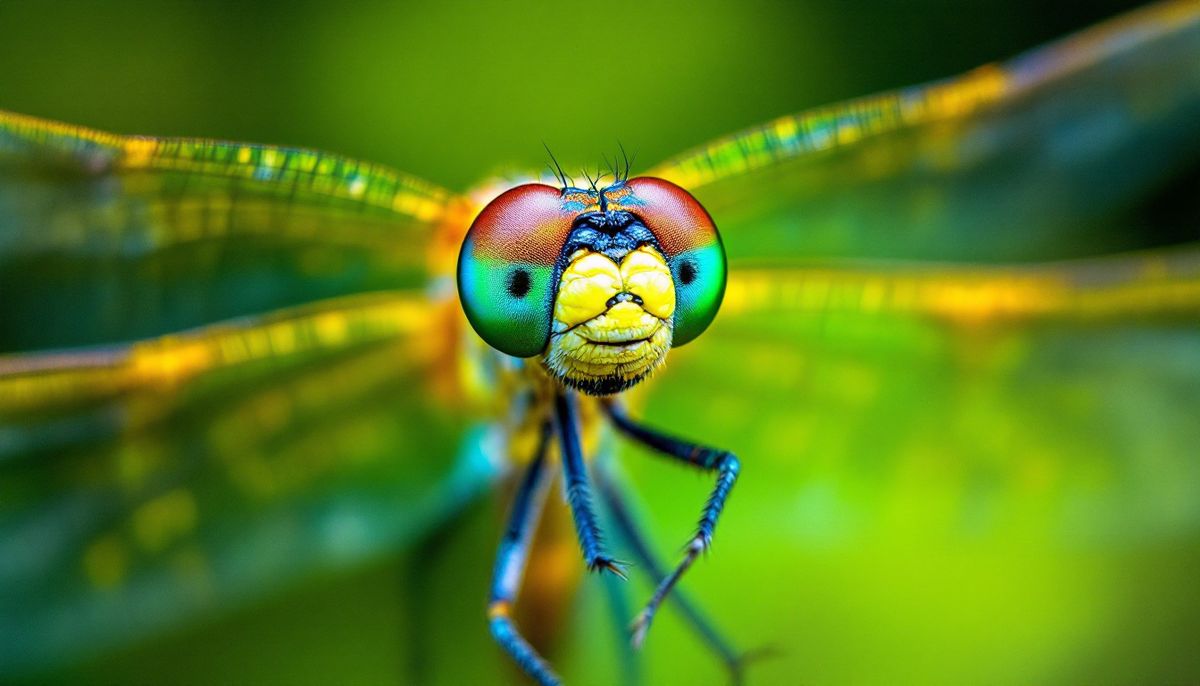
If you asked me to name the deadliest predator on the planet, I’d have gone through the usual suspects: great white shark, lion, maybe a hawk. I would have been wrong by a mile. The most lethal hunter on Earth is sitting on a cattail at your local pond right now, and it weighs about as much as a paperclip. The dragonfly has been perfecting its craft for over 300 million years — it was already ancient when the first dinosaurs showed up — and the numbers it puts up are frankly embarrassing for everything else in the animal kingdom. Here are five true things about dragonflies that made me look at the pond completely differently.
Did you know dragonflies are the most successful predators on Earth?
Lions, for all their branding, catch their prey roughly a quarter of the time. Great white sharks land about half their attacks. Dragonflies? Studies have clocked their hunting success rate at up to 95 percent. When a dragonfly decides a mosquito is lunch, that mosquito is essentially already lunch. The secret is that dragonflies don’t chase prey — they intercept it. Their brains calculate where the target is going to be and plot a flight path to arrive at the same moment, the same way a quarterback leads a receiver. Scientists have found neurons in dragonflies dedicated to this predictive targeting, a computational trick we mostly associate with guided missiles. A single dragonfly can put away hundreds of mosquitoes in a day, which means the deadliest hunter alive is also doing you a personal favor every summer evening.
Did you know dragonflies can fly backward and hover like helicopters?
Most flying insects flap their wings as a matched set. Dragonflies operate all four wings independently, each one powered by its own muscles, and the result is an aircraft that aerospace engineers openly envy. They can hover in place, pivot, fly straight up, straight down, stop on a dime, and yes — fly backward at speed, one of the very few creatures on Earth that can. They hit around 35 miles per hour going forward, can pull mid-air U-turns in the space of a few body lengths, and routinely endure accelerations that would knock a fighter pilot unconscious. Engineers designing drones have spent years studying dragonfly flight mechanics and still haven’t fully matched it. Three hundred million years of R&D is tough to catch up on.
Did you know prehistoric dragonflies had wingspans over two feet wide?
Roughly 300 million years ago, before dinosaurs existed, the skies belonged to griffinflies — enormous dragonfly relatives like Meganeuropsis, whose wingspan stretched over two feet across. That’s the largest flying insect that has ever lived, a predatory insect the size of a crow patrolling the swamps of prehistoric Kansas. How did bugs get that big? The leading explanation is oxygen: back then, the atmosphere was around 30 percent oxygen compared to today’s 21, and since insects breathe through tiny tubes in their bodies rather than lungs, richer air meant bigger bodies. When oxygen levels fell, the giants disappeared, and the dragonfly downsized to the version dive-bombing your birdbath today. Same design, same hunting instincts — just travel-sized.
Did you know dragonflies see the world in nearly 360 degrees?
Each dragonfly eye is built from up to 30,000 individual lenses, called ommatidia, wrapped around its head like a motorcycle helmet made of cameras. The result is close to full 360-degree vision — there is essentially no sneaking up on a dragonfly. But it gets stranger. Humans have three types of light-sensitive proteins for seeing color; dragonflies can have as many as 30, meaning they perceive colors — including ultraviolet — that we don’t even have names for. And their eyes are fast: they process visual information at a rate that makes human vision look like a slideshow. A movie playing at normal speed would look to a dragonfly like a series of still photographs. Which explains a lot about why you’ve never once managed to swat one.
Did you know some dragonflies migrate across open ocean — as a family relay race?
The globe skimmer dragonfly makes one of the most astonishing journeys in the animal kingdom: a multi-generation migration circuit of thousands of miles, including a leg across the open Indian Ocean from India to East Africa — hundreds of miles of water with nowhere to land. It’s the longest known insect migration on Earth, out-distancing even the famous monarch butterfly. And here’s the part that gets me: no single dragonfly completes the trip. One generation flies a leg, stops to breed, and the next generation picks up the route, navigating a course its parents started and its grandparents planned — with no map, no leader, and a brain the size of a pinhead. They ride monsoon winds at high altitude, refuel in temporary rain pools along the way, and complete the circuit like a family heirloom passed down in the form of a flight plan.
Send this to the person in your life who’s scared of bugs… then remind them the deadliest predator on Earth has never once bitten a human on purpose.
