
I grew up picturing volcanoes the way cartoons drew them — a single cone-shaped mountain, a glowing river of lava, run away from the lava. It turns out almost every part of that mental image is wrong, and the real story is far stranger. Here are five facts that completely rearranged how I think about the most dramatic thing the planet does.
Did you know most of Earth’s volcanoes are underwater — and they form the longest mountain range on the planet?
When you picture a volcano, you picture a mountain you can see. But the overwhelming majority of Earth’s volcanic activity happens where nobody is watching: at the bottom of the ocean. Somewhere between 80 and 90 percent of all volcanic activity occurs along the mid-ocean ridges, a continuous seam of underwater volcanoes that wraps around the globe like the stitching on a baseball. That ridge system runs roughly 40,000 miles — making it, by a wide margin, the longest mountain range on Earth, and almost none of us will ever lay eyes on it. The famous volcanoes on land are basically the few that happened to poke their heads above the water.
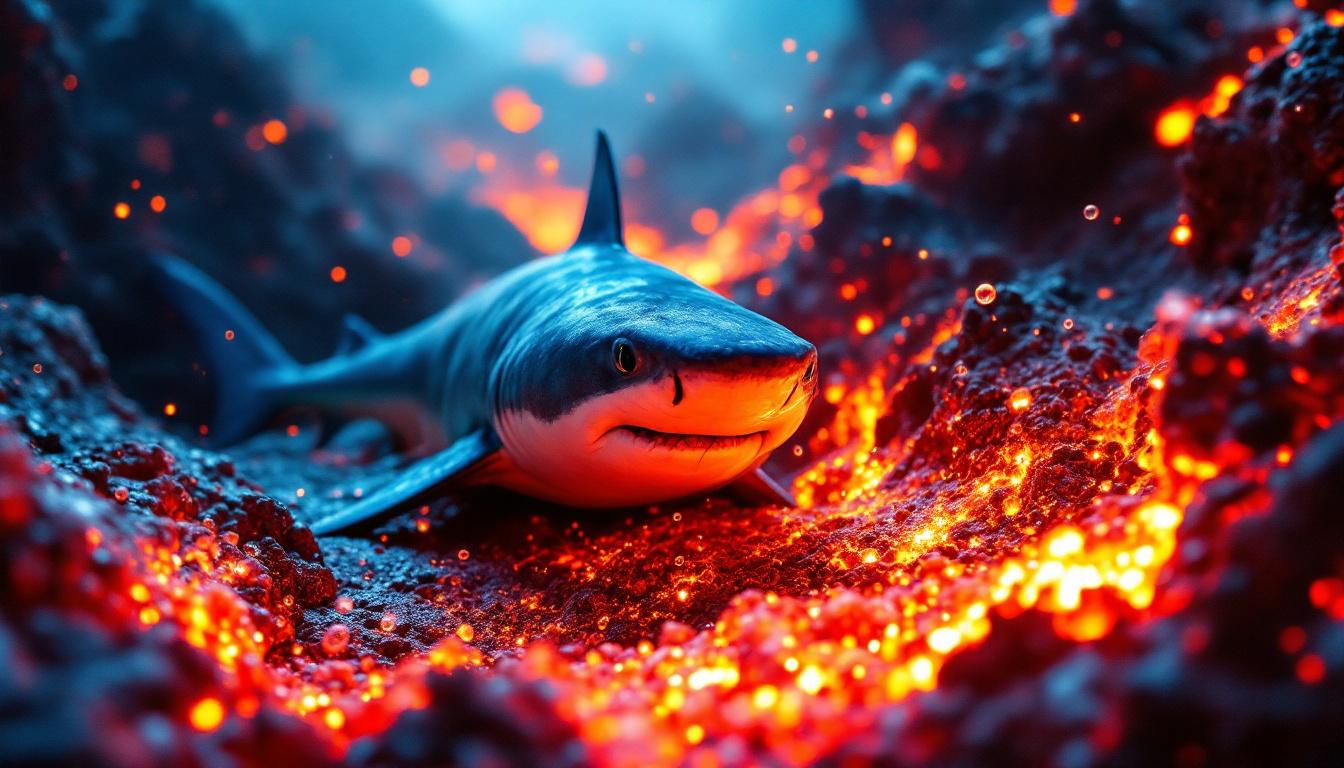
Did you know there’s an underwater volcano with sharks living inside its crater?
About 15 miles off the Solomon Islands sits Kavachi, an active submarine volcano that periodically erupts steam, lava fragments, and sulfur-rich gas into water that is hot and acidic. In 2015, scientists lowered a baited camera into the crater fully expecting it to be a lifeless zone. Instead, the footage showed scalloped hammerhead sharks and silky sharks cruising around inside, along with stingrays and reef fish — a thriving ecosystem in conditions that should, by every reasonable expectation, cook a fish. Researchers were so baffled they nicknamed it “Sharkcano,” and they still aren’t entirely sure how the sharks tolerate it. The leading guess is that they simply swim in and out, which raises the obvious question of why they keep choosing to swim back in.
Did you know lava is one of the *least* deadly things a volcano can do to you?
This is the one that genuinely embarrassed me. The lava is the part everyone fears, but a study of volcanic deaths from the year 1500 all the way to 2017 found that fewer than 700 people in that entire span were killed by lava. Lava is hot, yes, but it’s also slow — most flows move slowly enough that a person can simply walk away. The real killer is the pyroclastic flow: an avalanche of superheated gas, ash, and rock that can roar downhill at speeds over 400 miles per hour at temperatures hot enough to char a city in seconds. Pyroclastic flows have killed roughly 60,000 people. They — not the glowing red river — are what buried Pompeii.
Did you know volcanic eruptions create their own lightning?
Watch footage of a big explosive eruption and you’ll see something that looks like a thunderstorm trapped inside the ash cloud — bright forks of lightning crackling through the plume. That’s not a coincidence of weather. The eruption generates the lightning itself. As the volcano blasts out countless tiny particles of shattered rock and ash, those particles collide and rub against each other, building up enormous static charge — the same basic process as scuffing your socks on a carpet, scaled up to a mountain. When the charge gets big enough, it discharges as lightning. So a volcano doesn’t just erupt. It throws its own private electrical storm.
Did you know one volcanic eruption was so powerful its ash cloud punched into the edge of space?
In January 2022, an underwater volcano near Tonga erupted with a force that stunned scientists, and the plume it produced set a record that’s hard to even picture. The ash and gas shot up about 35 miles high — straight through the layer of the atmosphere where weather happens, through the layer where jets fly, through the layer where shooting stars burn up, and into the mesosphere. It was the first volcanic plume ever observed reaching that high. The previous record-holder, Mount Pinatubo in 1991, topped out around 25 miles. For one brief moment, a volcano on the floor of the Pacific Ocean threw a column of debris nearly to the doorstep of outer space.
Send this to the person who still thinks the scary part of a volcano is the lava — gently break the news that the lava is the part you could probably outwalk.
