
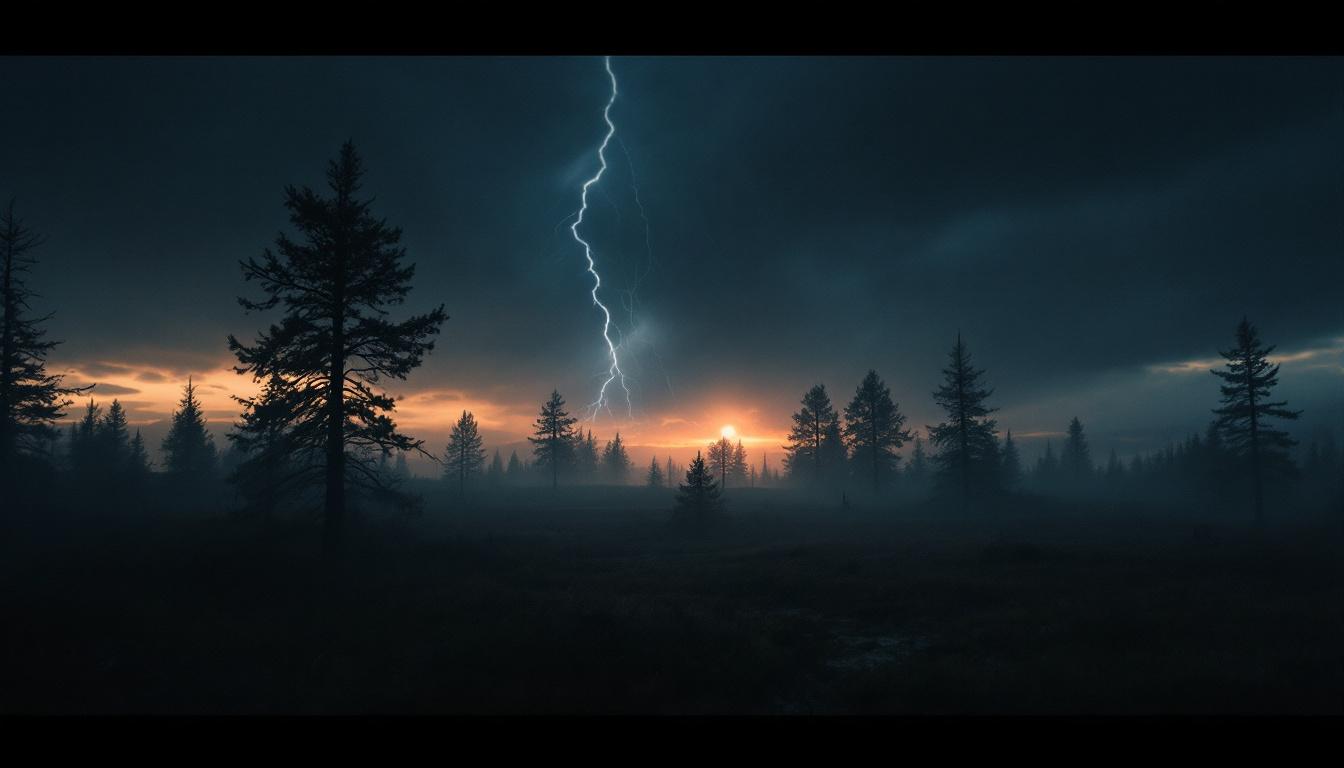
It was just after seven in the morning on June 30, 1908, and a man named S. Semenov was sitting on the porch of a trading post in a place called Vanavara, in the East Siberian wilderness, doing nothing more dramatic than eating his breakfast. Then, by his own account, the sky to the north split in two. Fire spread across the whole northern horizon, high and wide over the forest. The heat hit him like an open oven door — he said it felt as if his shirt had caught fire — and a moment later something picked him up off his chair and threw him several feet. When he came to, the porch roof had come down and there was a sound rolling across the taiga like the world’s largest artillery barrage. And Semenov was one of the lucky ones. He was sixty-five kilometers away from whatever had just happened.
Now I want you to sit with that distance for a second. Forty miles. That’s the gap between where Semenov was sitting and the thing that knocked him out of his chair. Closer in, reindeer herders of the Evenki people — the only humans who actually lived out there — described a fireball trailing smoke, then a flash brighter than the sun, then a wall of sound. Their tents were torn apart. Their reindeer were scattered and some were killed. People were thrown into the air. And here is the first detail that ought to make the hair on your arm stand up: the shockwave was strong enough that seismographs in Western Europe picked it up. A blast in the middle of Siberia rattled needles on machines in London. The night skies over Europe and Asia glowed for days afterward — bright enough, in some places, that people could read a newspaper outdoors at midnight without a lamp.
So you would think the scientists of the world would have been on the next train east. They were not. And this is the part of the story that I find almost harder to believe than the explosion itself.
Nobody went to look. Not for nineteen years. Russia in 1908 was a country on the edge of catastrophe — a revolution coming, then a world war, then a civil war on top of that. The blast had gone off in one of the emptiest places on Earth, where there were no cities, no roads, and almost nobody to file a complaint. There were newspaper reports. There were the eyewitness accounts. And then the whole thing just sort of… sat there. Eighty million trees lying flat in the snow, and the outside world shrugged and moved on to other problems.
The man who finally couldn’t let it go was a mineralogist named Leonid Kulik. He worked for the Soviet Academy of Sciences, and he was convinced — absolutely convinced — that a giant iron meteorite had come down out there, and that somewhere under the Siberian mud was the biggest hunk of space metal anyone had ever found. In 1921 he led an expedition into the region but never reached the actual blast site. It took him until 1927 to get all the way in. He hired Evenki hunters as guides, and they walked him through some of the most miserable terrain on the planet — swamp, bog, mosquitoes, cold — toward the center of it all. Kulik expected to crest a rise and look down into an enormous crater.
There was no crater.
Instead, here is what Kulik found, and I want you to picture it the way he saw it. For kilometers in every direction, the forest was knocked flat — and not randomly. The trees had all fallen pointing outward, away from a single central spot, like grass combed flat by an enormous hand, like spokes around a hub. Later surveys would map the whole devastated zone and find it was shaped, of all things, like a butterfly — a spread-eagled butterfly with a wingspan of about seventy kilometers. Over two thousand square kilometers of forest, down. And at the very center, at ground zero, where the destruction should have been worst of all, the trees were still standing. Stripped of their branches and their bark, scorched black, every one of them — but standing. Upright. Like a forest of telegraph poles. Kulik called them exactly that.
Now think about what that means, because Kulik did. Trees only stand up like that under a blast if the blast came from straight overhead. Whatever did this didn’t hit the ground. It detonated in the air. And forty years later, the survivors of Hiroshima would describe the very same eerie thing at the center of that destruction — the stripped trees and shattered structures still standing directly under the point of detonation, while everything around them was flattened. Kulik was looking at the signature of an air burst decades before anybody had a word for it. He kept searching. He drained a swampy “pothole” he hoped was a crater, and at the bottom he found nothing but an old tree stump. No crater. No meteorite. No fragments. No giant hunk of iron. He went back again and again — in 1929, in 1938 he even arranged an aerial survey, fifteen hundred photographs of that butterfly-shaped scar — and he never found the thing he’d staked his career on. Kulik joined a militia when the next war came, was captured, and died of typhus in a German prisoner-of-war camp in 1942, still without his answer.
So what was it? The honest answer, the one the science actually supports, is this: almost certainly a chunk of rock or ice from space — a small asteroid or a fragment of a comet, somewhere around fifty or sixty meters across — that came screaming into the atmosphere at enormous speed and met so much pressure and heat that it exploded several kilometers up before it could ever reach the ground. That’s why there’s no crater. That’s why there are no fragments. The object didn’t land. It ceased to exist in mid-air, dumping the energy of something between ten and fifteen million tons of TNT into the sky over Siberia — a thousand times the bomb dropped on Hiroshima. That is the leading explanation, and it is almost certainly correct, and the men and women who worked it out deserve a great deal of credit for solving a puzzle from a century’s distance using nothing but flattened trees and old men’s memories.
But I’ll be honest with you, the way a storyteller has to be. There are still loose threads, and that’s why people can’t stop talking about Tunguska. No one has ever recovered a definitive piece of the object — not one indisputable fragment. Scientists still argue about whether it was rock or ice, asteroid or comet, and they argue about the exact altitude and the exact size. An Italian team once proposed that a small lake near the blast site, Lake Cheko, was a crater gouged by a surviving chunk — and Russian researchers fired right back that the lake is older than the explosion. And because the case has an open door, the fringe has walked right through it for over a hundred years. People have blamed Tunguska on a tiny black hole passing through the Earth. On a collision with antimatter. On a crashed spacecraft. On Nikola Tesla testing a death ray from a tower in New York. There is no evidence for any of that, and I’m not asking you to believe a word of it. I’m just telling you that for nineteen years the largest explosion in recorded human history sat out in the Siberian forest with nobody watching it — and that even now, more than a century later, with all our satellites and all our science, no one has ever held the thing in their hand and said, with certainty, “here it is.” The sky opened up over Siberia one summer morning, flattened a forest the size of a major city, and then closed again. And it never left a return address.
Unsolved Mystery
