
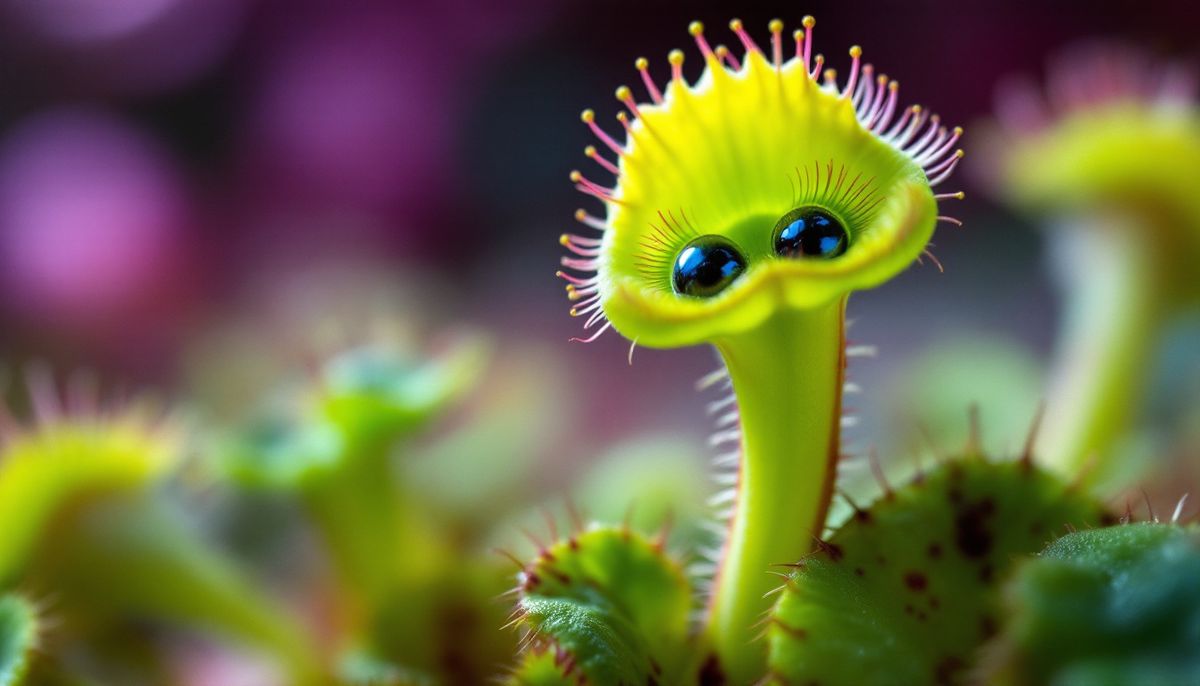
I always assumed the Venus flytrap was some exotic jungle monster, the kind of thing you’d find dripping over a vine in the Amazon. Turns out it’s basically a North Carolina local that got famous. And the more I read, the stranger it got: the plant can count, it moves faster than your reflexes, and Charles Darwin was so obsessed with it he called it one of the most wonderful things in the world. Here are five true things about the Venus flytrap that made me look at my sad little windowsill plant with a lot more respect.
Did you know the Venus flytrap can actually count?
This sounds like a party trick, but it’s real biology. The inside of each trap is lined with tiny trigger hairs, and one touch does nothing at all. The plant needs a second touch within about 20 seconds before it snaps shut. That’s not laziness, it’s math. Snapping closed costs the plant a lot of energy, so a single tap, say a raindrop or a stray leaf, isn’t worth the effort. Two taps in quick succession, though, usually means something alive is crawling around in there. And it keeps counting even after the trap closes: around five total touches trigger the digestive juices, and more struggling means more enzymes get pumped out. The bug essentially digs its own grave by fighting harder. A plant with no brain and no nerves is running a threshold calculation, and it’s better at it than most smoke detectors.
Did you know a Venus flytrap snaps shut faster than you can blink?
When both trigger hairs get tripped, the trap slams closed in about one-tenth of a second. For a creature with no muscles, that’s astonishing. The secret is a mechanism scientists call snap-buckling: the leaves are held under tension in a slightly domed, convex shape, and the trigger causes them to suddenly flip to a concave shape, like turning a contact lens inside out or popping a soft plastic lid. The two halves don’t seal all the way at first either. The spiky “teeth” along the edges interlock into a cage, leaving small gaps. Tiny bugs can escape through them, which is the plant’s polite way of saying it isn’t going to waste a week of digestion on an appetizer.
Did you know Venus flytraps grow wild in only one small spot on Earth?
Forget the rainforest. In the wild, Venus flytraps grow naturally in a single region: a roughly 75-mile radius around Wilmington, North Carolina, spilling just barely into South Carolina. That’s it. That’s the entire native range on the whole planet. They thrive in the nutrient-poor, boggy soils of that coastal area, and everywhere else they exist, from a greenhouse in Oregon to a windowsill in Tokyo, they got there because a human carried them. Because they’re so rare in the wild, poaching became a real problem, and in 2014 North Carolina made stealing a Venus flytrap from the wild a felony. Yes, you can catch a felony charge for kidnapping a houseplant.
Did you know a Venus flytrap eats bugs for the same reason you take a vitamin?
Here’s the twist that flips the whole “man-eating plant” image on its head. Venus flytraps aren’t carnivorous because they can’t photosynthesize. They photosynthesize just fine, soaking up sunlight and making sugar like any respectable green plant. The problem is their home turf. That boggy Carolina soil is so starved of nitrogen and phosphorus that the plant can’t get enough nutrients from the ground. So it evolved to get them from bugs instead. The insect isn’t a meal in the sense of energy, it’s a nutrient supplement, the plant’s version of a multivitamin. In richer soil, a flytrap would happily skip the murder entirely and just stand there being a normal plant.
Did you know each trap only works a few times before it dies?
A Venus flytrap trap is not a reusable snap trap you can trip forever. Each individual trap can generally close and reopen only a handful of times, and it can fully digest maybe three or so meals in its lifetime before that trap turns black, withers, and dies off. Digestion alone takes anywhere from five days to over a week for a good-sized insect. This is exactly why tapping the traps to watch them close, the thing every kid does within four seconds of meeting one, is genuinely bad for the plant. Every false alarm burns through one of its limited lifetime snaps and gets it nothing in return. So the little green diva has a strict policy: no meal, no snapping. And honestly, after learning it can count, move faster than my eye, and survive in a swamp that would starve anything else, I’m inclined to let it keep its rules.
Send this to the friend who overwaters every plant they own… they’ll never poke a flytrap again.
